
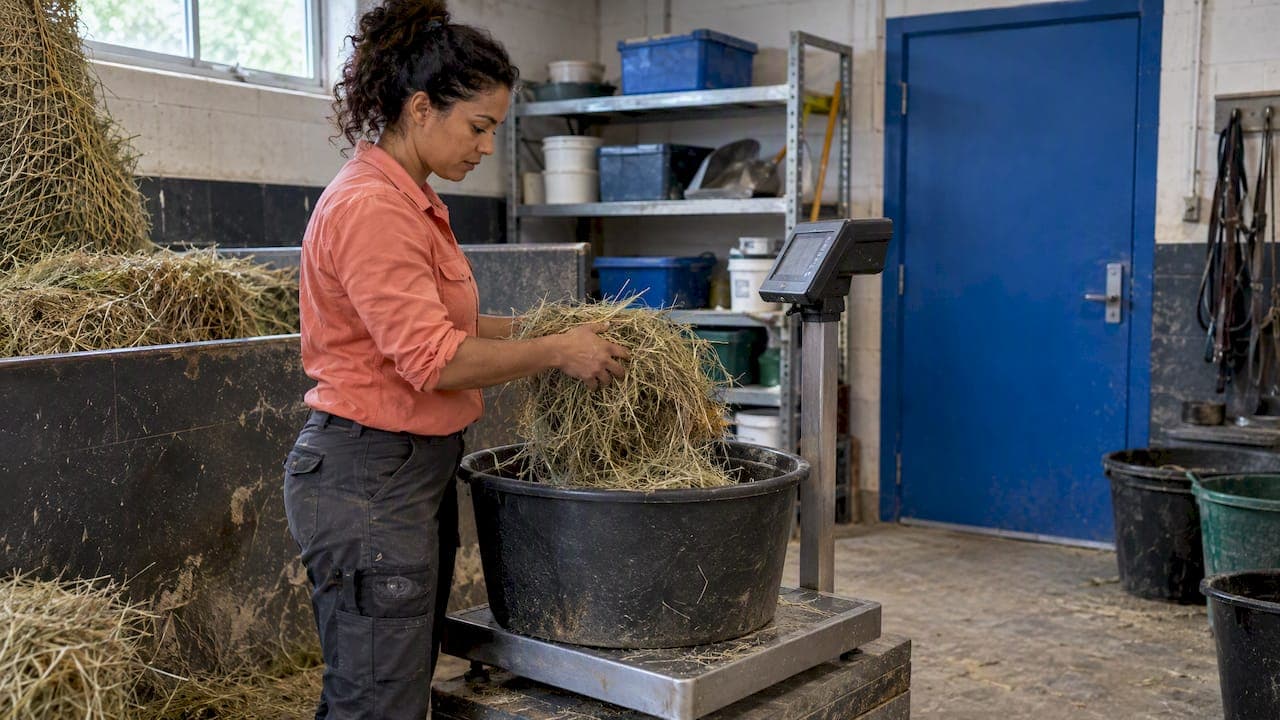
Owner feed charges are what a yard bills an owner for the hay, hard feed, chaff and supplements their horse eats, on top of or inside the board or agistment fee. Done well, they are predictable, itemised and backed by records. Done badly, they are the most common source of awkward phone calls at month end. This guide covers how to decide what feed is included, how to work out a fair charge per horse, how to handle price rises and wastage, and what to keep on file so an owner never has to take your word for it.
TL;DR
- Decide in writing what the base fee includes (for example hay only, or a standard feed program) and charge everything beyond it as a separate, itemised line.
- Base each horse's charge on what that horse actually eats, using weighed rations rather than a flat guess, and add a transparent allowance for wastage and preparation.
- Put the notice period for price rises in the agreement. A calendar month is a commonly suggested standard.
- Keep dated feed records you can show the owner. Victoria's agriculture department says agistment cost records should be available to the owner.
- Check GST and tax treatment with your accountant or the ATO before you finalise how feed appears on invoices.
Table of Contents
- What owner feed charges usually cover
- Put the feed terms in the agreement first
- How to calculate a fair charge per horse
- Wastage, preparation and price changes
- Itemise so the invoice explains itself
- What records back up a feed charge
- Know your local tax and legal position
- Our perspective
- Keep feed charges visible with EquiBETS
- A simple rollout for your yard
- FAQ
- Sources
What owner feed charges usually cover
There is no single national standard, so the first job is to define your own. Across yards, the charge tends to fall into one of three shapes:
- All-inclusive board. Hay, a standard hard feed and basic supplements sit inside one weekly or monthly fee. Simple for owners, but you carry the risk when prices move.
- Base fee plus feed program. A fixed board fee, with feed billed as a standard program (say, a set number of scoops and a set amount of hay per day).
- Pass-through feed. Board is separate, and every bag, bale and supplement is billed to the owner's horse at cost or cost plus a handling margin.
Large organisations make the same split. The Hong Kong Jockey Club's owners' handbook, for example, lists livery fees plus separate charges for bedding, horse feeds, vaccinations, de-worming, farriery and dental care, with insurance folded into the basic monthly livery fee. The point is not the numbers. It is that every line is named, so an owner can see what the base fee buys and what it does not.
In Australia the same logic applies to agistment and full-board arrangements. Whichever model you pick, the owner should be able to answer one question from the paperwork alone: "What am I paying for when I pay for feed?"
Put the feed terms in the agreement first
Most disputes about feed are really disputes about what was agreed. Victoria's Department of Energy, Environment and Climate Action (Agriculture Victoria) advises that you keep a written agistment contract listing fees, costs, charges and payment schedules, and that you make records of agistment costs available to the owner. The same guidance says the contract should cover any special dietary requirements and the quality of pasture, feed and supplements.
Turn that into a checklist for your own agreement:
- What is in the base fee (type of hay, number of feeds per day, standard supplements).
- What is not (rugging, extra feeds, veterinary-prescribed diets, supplements the owner supplies).
- How extras are priced: at cost, cost plus a stated percentage, or from an attached price list.
- How often you invoice and when payment is due.
- How and when prices can change, and how much notice you give.
- What happens if the owner supplies their own feed.
Rural agistors publish workable examples. One Australian agistment agreement states that hay costs are shared among owners on the property and may fluctuate with the season, and that prices can change with 30 days' notice. Whether you copy that model or not, notice that it tells the owner in advance that feed cost is variable. Nobody is surprised later.
How to calculate a fair charge per horse
Flat feed fees are easy to administer and quietly unfair. The 15.2hh pony on a handful of chaff subsidises the 17hh warmblood in hard work, or the other way round, depending on how you set the average. If you want charges owners accept, tie them to what each horse actually eats.
Start from the ration, not the average
Forage is the bulk of most rations. Kentucky Equine Research notes that for an average 500 kg horse, the recommended forage intake is 1.5% of body weight, or about 7.5 kg of hay per day. That figure is a useful sanity check when you are pricing a hay allowance, but it is a starting point. Your actual horses will vary with weight, workload, age, pasture access and any veterinary diet.
A simple method that works at most yards:
- Write down each horse's daily ration in kilograms, not "two scoops". Weigh a typical scoop of each feed once so you can convert.
- Multiply by the current cost per kilogram of each feed, including freight.
- Add a wastage allowance (see below).
- Add a handling or preparation component if you charge for it, and name it as such.
- Multiply by days in the billing period and round only at the end, on the invoice total.
A worked example
Take a horse on 7 kg of hay, 2 kg of a hard feed and 0.5 kg of chaff a day. Assume, purely for illustration, hay at $0.50 per kg, hard feed at $1.10 per kg and chaff at $0.80 per kg. Daily cost is $3.50 + $2.20 + $0.40 = $6.10. Over a 30-day month that is $183.00 before wastage and any handling charge. If you allow 10% for wastage, the feed line becomes $201.30. These unit prices are placeholders; swap in your own supplier invoices.

The value of working it this way is that the owner can see the same arithmetic you did. If their horse drops a feed, the charge drops with it, and nobody has to argue about it.
Wastage, preparation and price changes
Three things make a feed charge drift away from the simple ration maths.
Wastage
Hay fed on the ground loses value. Kentucky Equine Research reports that about 13% of hay fed from a small square bale is wasted when spread on the ground. Their nutrition advisor also points out that owners should limit waste while keeping the horse's natural foraging behaviour, because feeding off the ground has health benefits. So the answer is rarely "stop feeding off the ground". It is to measure the loss and decide who carries it.
Two fair options: build a stated wastage percentage into the hay price, or reduce waste with feeders and charge the lower number. If you are weighing up a feeder purchase, our seven-day protocol to measure yard feed wastage shows how to prove whether the saving covers the cost.
Preparation and processing
Soaking, mixing, splitting feeds and handing out supplements take labour. Some yards fold this into board; others charge a preparation line. Either is defensible if it is written down. What owners resent is discovering a charge they did not know existed.

Processing also affects the feed itself. The MSD Veterinary Manual notes that cracked or rolled grains can improve nutrient availability but are more susceptible to mould. That matters for how much you buy at a time and how much spoils in a warm, humid month, which flows straight into your cost.
Price rises
Hay and grain prices move with season, drought, freight and fuel. Published boarding schedules say so openly: the OC Fair and Event Center in California states that feed prices may change because of fuel prices, market fluctuations or unforeseen economic circumstances, with notice given for increases. That is a United States example, but the principle travels.
The UK's Farmers Weekly, discussing livery contracts, says that unclear fee structures and notice periods are a primary cause of disagreements and suggests a calendar month as a suitable notice period for price increases. Two simple habits follow:
- State in the agreement that feed prices are reviewed as supplier costs change, and how much notice you will give.
- When you do raise a charge, show the supplier price movement that caused it. An owner who sees hay go from one price to another will accept a rise far more readily than one who just sees a bigger total.
Itemise so the invoice explains itself
A single line reading "Feed: $412" invites questions. A line-by-line invoice answers them before they are asked. A typical structure:
| Line | What the owner sees | Basis |
|---|---|---|
| Board or agistment | Weekly or monthly base fee | Agreed in contract |
| Hay | Kilograms per day, rate per kg | Ration sheet and supplier price |
| Hard feed | Feed name, daily amount, rate | Ration sheet and supplier price |
| Supplements | Product, dose, days | Owner-approved list |
| Wastage allowance | Stated percentage | Agreement |
| Preparation | Flat fee or per day | Agreement |
| Adjustments | Days away, feed changes | Dated record |
A UK livery template takes a similar line: feed or services beyond the package are charged from an attached price list and itemised on the monthly invoice, with the package inclusions recorded. Treat it as a structure to borrow rather than a legal document for an Australian yard.
For a fuller list of what to show, see our guide to eight invoice line items that give owners billing transparency. And if feed is only one of several costs that surprise owners, the ten expense categories to stop surprise bills is a good companion.
What records back up a feed charge
If an owner challenges a charge, you want to answer in minutes with evidence, not reconstruct a month from memory. Keep:
- A current ration sheet per horse, with the date and who changed it (vet, trainer, owner request).
- Supplier invoices for hay, grain and supplements, so unit costs can be shown.
- Dated change logs. When a horse went onto a new feed, off a supplement, or away at a show.
- Owner approvals for non-standard items, ideally in writing in a place both sides can find.
- Your invoice history, so month-to-month changes are explainable.
This is the same discipline Agriculture Victoria points to when it says records of agistment costs should be available to the owner. The easier the records are to retrieve, the less often you will need them.
Know your local tax and legal position
Rules on how feed is charged and taxed differ by country and sometimes by state. In New Jersey, for example, boarding and feeding charges are taxable unless an exemption applies, while training charges are not, and a boarding business can claim a resale exemption on the feed it buys. Australia works differently. A NSW Department of Primary Industries guide on GST for primary producers states that GST will be payable on agistment, though that page is written for cattle producers and your situation depends on your registration and what you supply.
Before you finalise how feed appears on invoices, check three things with your accountant or the Australian Taxation Office:
- Whether you are, or need to be, registered for GST.
- Whether feed is treated as part of one supply (board) or a separate supply, and how that should be shown on a tax invoice.
- What you can claim back on the feed you buy.
A quick note on the results that dominate searches for this phrase: the Reserve Bank of Australia's card surcharge changes concern payment surcharges on cards, which is a different topic from feed billing. If you add a processing fee to invoices, check the current rules on that page of the RBA's site before you do.
Our perspective
We build software for professional yards, and the pattern we see is consistent: owners rarely object to a feed bill because it is high. They object because they cannot see how it was made. A yard that can show the ration, the unit price, the days and the change history almost never has the argument.
That is why we think of feed charges as a data problem before a pricing problem. If each horse has a ration on file, if feed purchases are logged against the yard, and if the owner can open a portal and see the same numbers you see, the charge largely explains itself. Our own work on per-horse cost tracking and per-horse profit and loss for stables comes from the same belief: you cannot price fairly what you do not measure by horse.
We would also say, plainly, that no software fixes a vague agreement. Write the terms first. Then make it effortless to follow them.
— isaac
Keep feed charges visible with EquiBETS
EquiBETS is a single workspace for professional yards: horse records, feed planning and nutrition analysis, finance tracking, owner portals and an offline mobile app that works when the signal does not. Feed plans sit with the horse, expenses sit with the yard, and owners can see updates without ringing the office. If you want to pilot it, there is a free trial before you pay, and the EquiBETS Complete plan is $9.99 AUD per month with all features and modules.

If owner calls are part of the problem, our piece on offline horse management software that reduces owner calls explains how portals change the conversation, and the owner communication system for yards covers what to send and when.
A simple rollout for your yard
You do not need to rebuild your billing in a weekend. A sensible order:
- Week one: record every horse's current ration in kilograms and work out the real cost per horse per day.
- Week two: compare that to what you currently charge. Note which owners are over- or under-charged.
- Week three: update your agreement or price list with inclusions, extras, wastage, preparation and notice period.
- Week four: give owners notice in writing and send the first itemised invoice, with a short note explaining the new layout.
If some owners will pay more under the new structure, move them in stages and explain why. If others will pay less, say so too. Fairness is persuasive in both directions. When you have several owners per horse, such as in syndicates, the six roles for multi-owner horse management helps decide who receives which invoice, and the cash flow guide for stables helps you time feed purchases against payments.
FAQ
What should owner feed charges include?
At minimum, the hay and hard feed the horse actually eats, any supplements the owner has approved, and a stated allowance for wastage. If you charge for preparation or delivery to paddocks, show it as its own line. The agreement should list what the base fee covers so extras are never a surprise.
How much notice should a yard give before raising feed prices?
Put the notice period in your agreement. A calendar month is suggested in UK livery contract guidance, and some Australian agistment agreements use 30 days. Longer notice is fair for large increases.
Should feed be charged at cost or with a margin?
Either works if it is written down. Charging at cost keeps owners comfortable but leaves your time uncovered, so many yards add a clearly named handling or preparation charge instead of hiding a mark-up in the feed price. Whatever you choose, show supplier prices on request.
Is GST charged on feed supplied to agisted horses?
That depends on your GST registration and how the supply is structured. A NSW government guide says GST is payable on agistment, but it is written for cattle producers, so confirm with your accountant or the ATO how feed should be shown on your tax invoices.
How do I handle an owner who disputes a feed bill?
Open the ration sheet, supplier prices and change log for that period and walk through them together. If you find an error, correct it promptly and say so. If the record supports the charge, a calm walk-through usually ends the matter, and a clear written agreement covers the rest.
Sources
- Hong Kong Jockey Club owners' handbook: livery and veterinary charges
- Agriculture Victoria: horse agistment contracts
- Kentucky Equine Research: owners should weigh horse feed and limit when necessary
- MSD Veterinary Manual: feeding practices in horses and other equids
- OC Fair and Event Center: horse boarding rates and fees
- Farmers Weekly: how robust livery contracts help avoid disputes
- Template livery contract (detailed)
- New Jersey Division of Taxation: horsekeeping businesses
- NSW DPIRD: handling the GST on cattle and beef sales
- Archery Ascension horse agistment agreement