

Track expenses through a per-horse ledger paired with facility-level accounts, capture every receipt at the point of purchase, and reconcile weekly rather than at month-end. That's stable expense tracking done properly. Whether your yard runs manual entry or bank-sync with AI categorisation, the discipline matters more than the tool. EquiBETS and the Stable Budget Playbook both build from this same structure.
TL;DR:
- Proper expense tracking requires detailed, weekly reconciliation of receipts, categorization, and separating owner and yard accounts to prevent unreliable reports.
- Tracking expenses across ten categories, including vet, farrier, feed, and equipment, helps prevent surprise bills and enables better budget forecasting.
- Manual entry suits smaller yards with fewer staff, while larger operations benefit from bank-sync with AI categorization, but both workflows need consistent, daily or weekly logging.
- Monthly reports should focus on per-horse profit and loss, seasonal spending patterns, and cash-flow forecasts to improve financial management.
- Using a dedicated platform like EquiBETS streamlines per-horse ledgers, receipt attachment, and owner visibility, especially when paired with disciplined expense tracking routines.
Table of Contents
- Why stable expense tracking matters more than most yards admit
- Stable budget playbook: 10 categories to stop surprise bills
- Manual entry or bank-sync: which workflow actually works?
- What reports should you run each month?
- How to build a reliable reconciliation process
- What experienced stable managers still get wrong
- How EquiBETS fits into your stable's expense tracking
- Sources
- FAQ
Why stable expense tracking matters more than most yards admit
A yard with twelve horses and no per-horse breakdown is flying blind. You know the bank balance is thinning, but not why, or which horse, owner, or paddock is driving it. That gap costs more than money. Owners ask sharper questions than they used to, and "it's roughly $800 a month" doesn't survive a lease negotiation or an insurance claim the way an itemised statement does.
Per-horse profit and loss changes the conversation entirely. It tells you whether a spelling horse is quietly draining $400 a month in feed and farrier work with zero income against it, which matters when you're deciding on agistment pricing or whether to renew a lease. Per-horse cost tracking also gives you the paper trail insurers and buyers actually want to see.
The failure modes are predictable:
- Receipts stuffed in a glovebox or a shared inbox, never logged
- One lump "horse expenses" category that hides which animal or activity is costing the most
- Vet bills treated as one-off shocks instead of a budgeted contingency
- No separation between the owner's personal card and the yard's operating account
- Reports built only when the accountant asks, months after the numbers meant anything
Each of these turns a five-minute weekly task into a stressful, retrospective scramble every tax season.
Stable budget playbook: 10 categories to stop surprise bills
Surprise bills almost always trace back to a category nobody was tracking properly. The Stable Budget Playbook breaks stable spending into ten categories, and every one needs the same core fields logged: date, horse or facility, vendor, amount, a receipt photo, and whether it's a recurring cost.
- Vet and medicines — the biggest source of budget blowouts if untracked; log per-horse, always.
- Farrier and dental — recurring by nature, so flag it and let the system predict the next due date.
- Feed and hay — often facility-level, but split by horse where rations differ significantly.
- Supplements — small individually, significant in aggregate; easy to lose track of.
- Bedding and arena maintenance — facility cost, seasonal spikes worth watching.
- Utilities and fuel — facility-level, useful for spotting waste or leaks in usage.
- Labour and contractors — wages, casual staff, and specialist contractors like clippers or dentists.
- Insurance and licences — annual or quarterly, easy to forget between renewals.
- Travel, transport and shows — float hire, fuel, entry fees, agistment while away.
- Sundries and equipment — rugs, tack repairs, fencing, the miscellaneous bucket that shouldn't become a dumping ground.
For non-monthly hits like vet emergencies, set aside a fixed monthly provision rather than absorbing the shock when it lands. A contingency line worth a moderate percentage of your average monthly per-horse spend gives most yards enough buffer for an unplanned colic workup or lameness investigation without derailing cash flow.
Pro Tip: Tag every recurring cost the first time you log it. A farrier visit tagged as recurring lets you forecast next quarter's cash needs instead of discovering the bill three days before it's due.
Manual entry or bank-sync: which workflow actually works?
Both workflows are legitimate. The right one depends on team size and how much staff time you can spare for admin.
Manual entry suits smaller yards or teams where one person owns the books. Someone photographs the receipt on their phone the moment it's paid, staff log entries against the relevant horse or facility code, and a designated person reviews and tags everything weekly. It's slower per transaction but gives you full control over categorisation from day one.
Bank-sync with AI categorisation suits larger operations with higher transaction volume. The yard's operating account connects securely to a finance platform, transactions get auto-categorised against your ten expense categories, and a human reviews the AI's calls before they're locked in. A mixed model, where staff still log cash and card purchases manually but the business account syncs automatically, tends to give teams the best balance of speed and accuracy.
Whichever workflow you choose, the cadence matters more than the method:
- Daily: log receipts as they happen, don't batch them
- Weekly: review and tag every entry, chase down anything missing a receipt
- Monthly: close the books, run reports, reconcile against bank statements
- Quarterly: refresh the budget against actual spend and adjust contingency lines
Pro Tip: If receipts are still arriving a week after the transaction, the workflow is broken, not the staff. Fix the capture point, not the person.
What reports should you run each month?
Three reports do most of the heavy lifting for a professional yard, and each one answers a different question you'll get asked eventually.
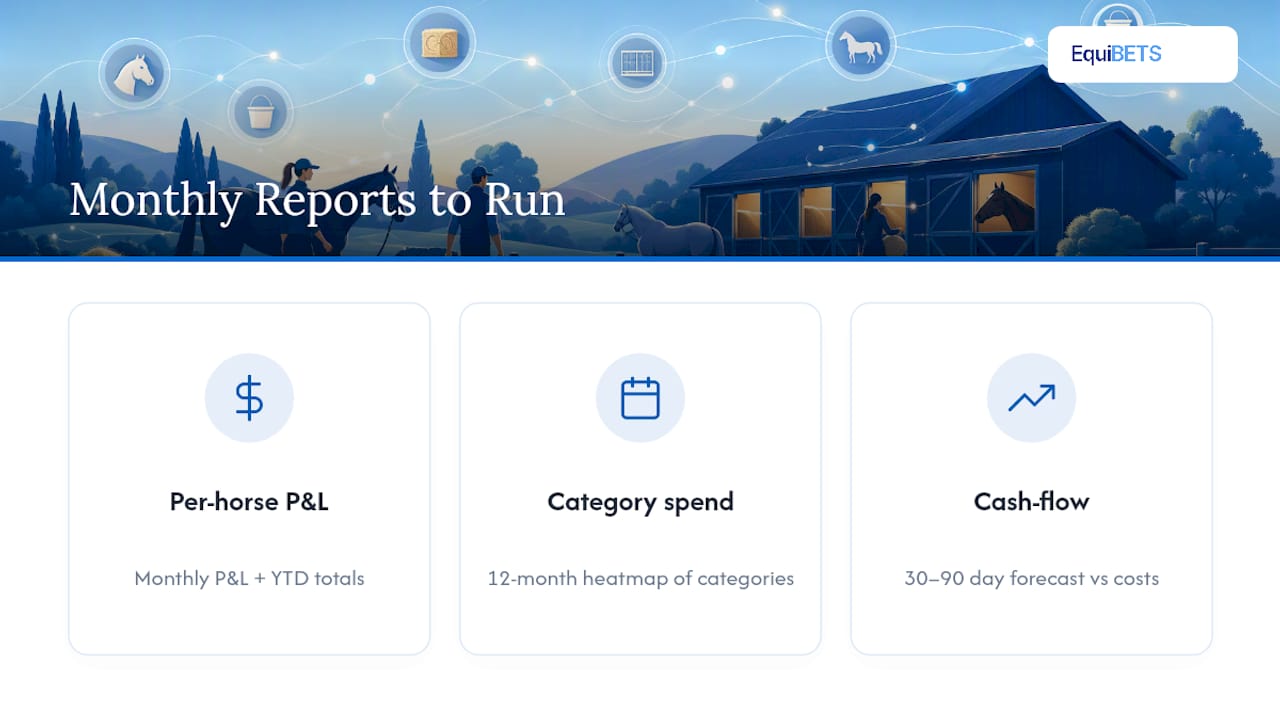
Per-horse monthly P&L and year-to-date totals answer the question every owner, lessee, or buyer eventually asks: what does this horse actually cost to run? Yearly per-horse breakdowns turn a vague "it's expensive" into a defensible figure backed by vet invoices, farrier logs, and feed costs.
Category spend with a 12-month heatmap shows you seasonal patterns. Farrier costs spike differently to feed costs, and bedding usage climbs hard through winter. Spotting the pattern early means you provision for it next year instead of getting caught again.
Cash-flow forecast projects the next 30 to 90 days against known recurring costs and expected income, which is where most yards find the gap between "profitable on paper" and "can't cover next month's feed order."
For exports, match the format to the audience. Accountants want CSV files they can drop straight into their own software or reporting workflow. Owners generally want a clean PDF summary, not a raw spreadsheet full of category codes.
How to build a reliable reconciliation process
Tracking breaks down when nobody owns it. Fix that with three defined roles and a repeatable checklist.
- Receipt logger — usually whoever makes the purchase; responsible for photographing and entering the transaction within 24 hours.
- Reviewer — checks weekly entries for missing receipts, miscategorised spend, and duplicate charges.
- Finance owner — signs off the month-end close, reconciles against bank statements, and runs the reports.
A basic monthly close checklist covers: all receipts logged and tagged, bank statement matched against entries, recurring costs confirmed against actual invoices, per-horse P&L generated, and reports exported and filed.
Set permissions so only the finance owner can edit closed months, back everything up automatically, and keep receipt images for at least the period your local tax authority requires for business records. Schedule exports to happen the same day every month, not whenever someone remembers.
What experienced stable managers still get wrong
The most common mistake isn't a missing receipt. It's mixing the owner's personal spending with the yard's operating account, which makes every report downstream unreliable no matter how disciplined the receipt capture is. Separate the accounts first, before you touch categories or software.
The second mistake is treating vet costs as unpredictable when they're actually just under provisioned. A yard that budgets a genuine contingency line rarely gets blindsided the way one running bare-bones monthly totals does.
Automation earns its keep here, but only paired with per-horse discipline. Bank-sync without per-horse tagging just gives you a faster version of the same lumped totals that caused the problem. Pair the two, using something like the cash flow guide for provisioning logic, and disputes with owners drop sharply because the numbers are already broken down before anyone asks.
— isaac
How EquiBETS fits into your stable's expense tracking
If you're running the manual workflow described above and it's eating hours every week, EquiBETS is built around exactly the structure this article recommends. Per-horse ledgers sit alongside facility accounts, receipt photos attach directly to each transaction, and owner portals give clients real-time visibility into their horse's costs without you compiling a separate report every month.

The platform's finance tracking module handles the categorisation and reconciliation cadence covered here, and offline mobile access means staff can log a farrier bill from the yard without waiting for signal. If you're weighing up whether to switch, run one month in parallel: keep your current spreadsheet or system running alongside EquiBETS, then compare the reports side by side. EquiBETS Complete is $9.99 AUD per month and covers the full stable manager toolkit, including finance tracking, so you can see the difference in your own numbers before committing to anything.
Sources
- Horse Expense Tracker — Per-horse costs & yearly P&L | Equimeta
- Professional horse care expense tracking and budgeting tool | Rodeo Graphics
FAQ
What should a stable expense tracking system record for each transaction?
At minimum, log the date, the horse or facility the cost belongs to, the vendor, the amount, a receipt photo, and whether the expense recurs. This is the same field set the Stable Budget Playbook uses across all ten expense categories.
How much should I budget per horse each month?
Per-horse budgets vary widely depending on discipline, boarding type, and location, ranging from roughly $200 to $4,500 monthly for single horse owners.
Should I use manual entry or bank-sync for expense tracking?
Both work and many yards run a mixed model where cash and card purchases are logged manually while the operating account syncs automatically with AI categorisation. The choice comes down to transaction volume and how much admin time your team can spare each week.
What reports do accountants actually want from a stable?
Accountants generally want CSV exports of categorised transactions and a per-horse or facility profit and loss statement, not a raw pile of receipts. Owners tend to prefer a simplified PDF summary instead of the full export.
Does EquiBETS include expense tracking for stables?
Yes. EquiBETS includes finance tracking with per-horse ledgers, receipt attachments, and owner portal visibility as part of EquiBETS Complete, priced at $9.99 AUD per month.