
Expect roughly $200 to $700 a month for a backyard or self-care horse, $400 to $1,500 for a boarded horse in average work, and $1,000 to $4,500 or more if you're competing seriously. The first year runs well above any of these figures because of pre-purchase vet checks and starter equipment. The next step is simple: pull together your own invoices and run them through the monthly conversion method below.
TL;DR:
- Monthly costs vary from around $200 to $700 for a backyard horse and can exceed $4,500 for serious competition horses, with first-year expenses significantly higher.
- Costs depend heavily on board type, feed quality, farrier needs, and competition schedule, which influence the tier of ownership from budget saver to show professional.
- Converting irregular expenses like farrier visits and vet bills into monthly averages prevents underestimating ongoing costs and ensures accurate budgeting.
- An emergency fund of 10% to 20% of annual routine care costs is recommended, with a separate savings account for quick access to potential accident or illness expenses.
- Using centralized finance tools like Equibets helps track, amortize, and share costs accurately, reducing surprises and disputes, especially when managing multiple horses.
Table of Contents
- Budget tiers: realistic monthly and annual ranges explained
- Monthly line-item breakdown: what to budget for each recurring cost
- First-year and startup costs to budget separately
- Emergency fund and insurance: how much to hold and how to budget for it
- Worked scenarios and a copyable per-horse template
- How to calculate a true per-month cost from irregular bills
- Practical, welfare-first cost-saving moves and trade-offs
- How consolidated records cut per-horse surprises
- Budgeting across multiple horses: what actually scales and what doesn't
- A yard manager's short first-person view on budgeting a single horse
- A better way to track what your horse actually costs
- Sources
Budget tiers: realistic monthly and annual ranges explained
Horse budgets generally fall into three broad tiers, influenced by factors like board type, feed quality, and competition ambitions, which adjust overall costs accordingly.
The budget saver tier covers a horse kept at home or on a basic paddock agistment, fed largely on pasture with supplementary hay, and seeing the vet only for annual jabs and the odd lameness check. Monthly costs typically sit between $200 and $700, though Joyful Equestrian's 2026 breakdown puts the true floor closer to $400 once you count feed, farrier, and routine vet care properly rather than assuming pasture keep is free.
The boarded or "happy medium" tier is where most recreational riders land: full board at a yard, regular farrier visits, occasional lessons, maybe a handful of local shows a year. This tier generally runs within a moderate monthly cost range, varying depending on region and yard quality.
The competitor or show tier adds training fees, transport to events, entry fees, and often a second set of tack for competition. Monthly outlay can be substantially higher when participating in regional or national circuits.
What actually pushes a horse from one tier to the next?
- Board type — self-care paddock agistment versus full-service board with feeding and turnout included
- Feed quality and quantity — a hard keeper on premium hard feed costs far more than an easy keeper on grass and hay
- Farrier needs — barefoot trims versus shoes all round, especially with pads or corrective work
- Training and lesson frequency — weekly lessons add up fast compared to occasional coaching
- Competition schedule — entry fees, floating, and accommodation for away shows
Seasonal swings matter too. Winter typically means higher hay bills and rugging costs in cooler climates, while summer can bring drought-driven feed price spikes in some regions. Regional cost differences are just as significant. Board and hay prices near major cities or in drought-affected areas can run double what you'd pay in a rural area with reliable pasture.
Monthly line-item breakdown: what to budget for each recurring cost
Once you know your tier, the next job is building out each line item so nothing sneaks up on you. Here's how to think through the recurring costs that make up a per-horse budget.
-
Board or agistment. Self-care paddock agistment is the cheapest option, often just covering pasture and water access. Part-board or "DIY plus" arrangements add feeding and basic checks. Full board at a professional yard includes feeding, turnout, and often stable maintenance, and it's usually the biggest single line item on a boarded horse's budget.
-
Hay and feed. A horse typically eats 1.5% to 2% of its bodyweight in forage daily, and using a university extension hay calculator to estimate your actual tonnage by weight and region beats guessing by the bale. Hard feed, supplements, and treats sit on top of that forage base and vary enormously depending on workload and whether the horse is an easy or hard keeper.
-
Farrier. Most horses need trimming or shoeing every six to eight weeks. Barefoot trims are the cheapest option; shoes all round, especially with therapeutic pads, push costs up considerably. Because this bill lands every six weeks rather than monthly, it's one of the first things to amortise (more on that below).
-
Routine vet, dental, and vaccinations. Annual vaccinations, a dental float once or twice a year, and a general wellness check form the backbone of preventative care. Extension and veterinary guidance is consistent on this point: routine care costs a fraction of what a single emergency does, which is exactly why skipping it to save money backfires.
-
Bedding. Straw, shavings, or pelleted bedding for stabled horses adds a modest but steady monthly cost, heavier in winter when horses spend more time inside.
-
Transport. Whether you own a float or hire one, budget for fuel, registration, and maintenance if you're regularly hauling to lessons, shows, or the vet clinic.
-
Tack and equipment maintenance. Saddles need periodic reflocking, girths and bridles wear out, and rugs need replacing. This is a small monthly figure most months and a bigger one a few times a year.
-
Lessons and training. Weekly or fortnightly lessons are a discretionary cost, but a meaningful one for anyone actively improving or competing.
-
Competition costs. Entry fees, judging fees, floating, and overnight stays for away events belong here, and they're highly seasonal, clustering around show season in your region.
A useful filter for any yard-boarded horse: work out what your board fee already includes before double-budgeting. Most full-board arrangements cover feeding, turnout, and stable cleaning, but farrier, vet, dental, and lessons are almost always owner-paid extras. Ask your yard for a written breakdown of what's bundled. It's the single fastest way to stop overestimating or underestimating your true monthly number.
First-year and startup costs to budget separately
The first year of horse ownership costs substantially more than any subsequent year, and conflating the two is the most common budgeting mistake new owners make. InfoHorse's 2026 analysis puts total first-year costs, including purchase price, startup gear, and initial upkeep, at roughly $11,000 to $35,000. Purchase price is usually the smallest part of that figure.
The startup items to budget separately from your ongoing monthly figure include:
- Pre-purchase vet exam. A vetting, including basic X-rays or flexion tests, is one of the best-value expenses in horse ownership, catching problems before they become your problem.
- Starter tack and equipment. Saddle, bridle, rugs, grooming kit, first aid supplies, and a halter and lead rope all need buying at once, not gradually.
- Fencing and shelter, if keeping at home. Post-and-rail or electric fencing repairs, a field shelter, and yard setup can run into thousands before the horse even arrives.
- Float or trailer readiness. If you don't already own suitable transport, factor in hire costs or the price of arranging regular transport access.
If you're financing the purchase or splitting costs with a co-owner, present first-year and ongoing costs as two separate lines, not one blended number. A lender or partner needs to see that the $15,000 you spent in month one won't repeat every month after. This is also where a tool like Equibets' ROI calculator guide helps model the gap between startup outlay and steady-state monthly cost.
Emergency fund and insurance: how much to hold and how to budget for it
Colic surgery alone can run into several thousand dollars, and it's the single most common reason horse owners face a financial crisis they didn't budget for. Harry Hall Insurance's guidance is blunt on this point: most horse costs aren't monthly at all, they're irregular and often severe, which is exactly why an emergency fund matters more than almost any other line in your budget.
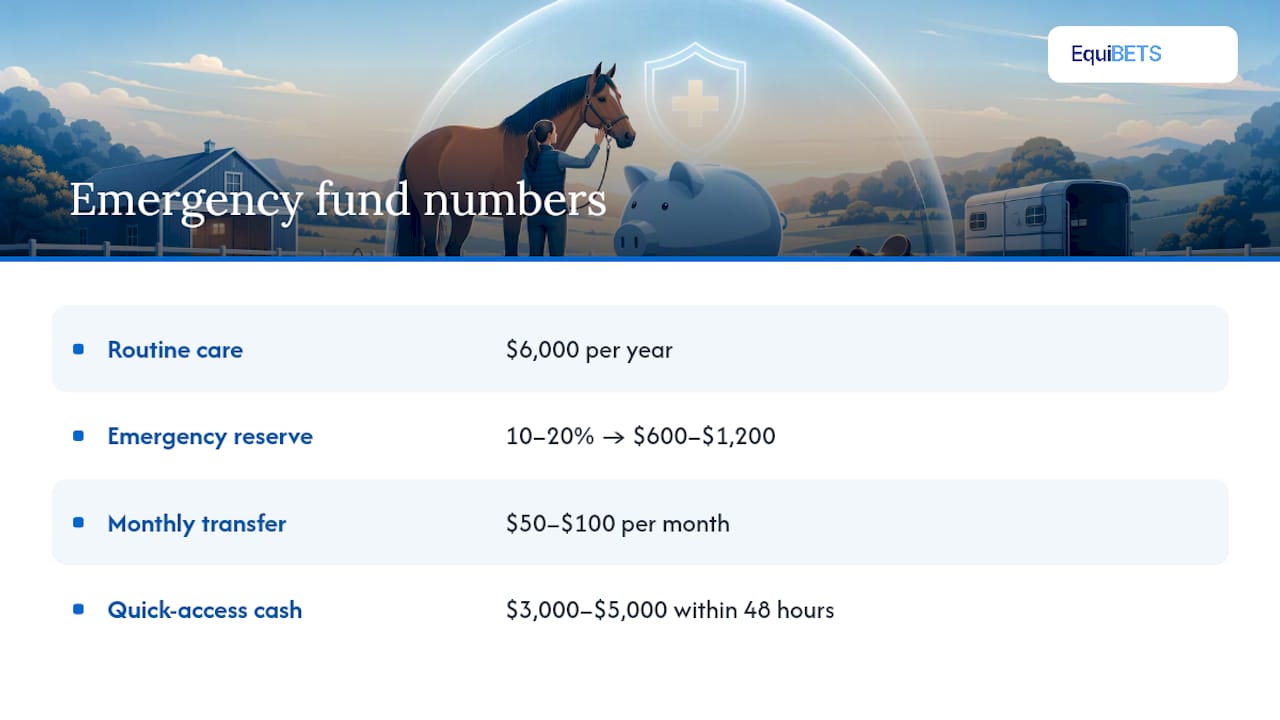
Statistic callout: Professional yards commonly treat an emergency reserve equal to 10% to 20% of annual routine care costs as compulsory, not optional, according to InfoHorse's analysis of hidden ownership costs. For a horse costing $6,000 a year in routine care, that means holding $600 to $1,200 in reserve, on top of whatever insurance you carry.
Insurance splits into two main types worth understanding: mortality cover, which pays out if the horse dies or must be euthanised, and major medical/surgical cover, which contributes toward vet bills for illness or injury. Whether insurance pays for itself depends on your risk tolerance and how much cash you can access quickly. A horse worth relatively little but prone to health issues might be a better candidate for self-insuring (building your own reserve) than paying premiums each month.
Pro Tip: Set your emergency contribution as a fixed monthly transfer, even $50 to $100, into a separate account you don't touch for anything else. Treating it like a bill rather than leftover savings is the only way it actually accumulates before you need it.
Ask yourself three questions before deciding: Can I access $3,000 to $5,000 in cash within 48 hours if needed? Does my horse have a pre-existing condition that would exclude major medical cover anyway? Would a monthly premium genuinely cost less than what I'd save toward the same reserve myself?
Worked scenarios and a copyable per-horse template
Numbers land better with examples attached to them. Here are three realistic monthly budgets across the tiers discussed earlier, based on the ranges from InfoHorse's cost calculator and Joyful Equestrian's 2026 figures.
These are starting points, not fixed answers. Your region, board quality, and horse's individual needs will shift every row.
To build your own version, copy these fields into a spreadsheet or notes app: board fee, average monthly feed spend, farrier cost divided by weeks between visits then multiplied by 4.3, annual vet/dental/vaccination total divided by 12, bedding, lessons, competition costs divided by 12, and emergency contribution. Add them up for your true monthly figure.
If you're sharing costs with a co-owner or part-boarder, list each line item with an agreed split percentage next to it, and keep a running log of who's paid what. Disputes over shared horses almost always trace back to unclear or undocumented cost splits rather than genuine disagreement about what's owed.
How to calculate a true per-month cost from irregular bills
The mistake almost every new owner makes is adding up only the bills that arrive monthly and ignoring everything else, which produces a number that looks comfortingly low and is quietly wrong. Harry Hall Insurance makes this point directly: most horse costs aren't monthly, so you have to convert them to be monthly before your budget means anything.
Here's the method:
- List every cost and its actual frequency. Farrier every 6 to 8 weeks, dental once a year, vaccinations once or twice a year, insurance as one annual premium, competition costs clustered around show season.
- Convert each to a monthly figure. Divide the annual total by 12, or for costs on a weekly cycle (like farrier every 7 weeks), multiply the per-visit cost by 52 and divide by 12 weeks worth of visits.
- Add the monthly-equivalent figures together, including your emergency fund contribution, to get your true monthly cost.
Worked example: Farrier at $80 every 7 weeks works out to $80 × (52/7) ÷ 12 = roughly $50 a month. Dental at $150 once a year is $12.50 a month. An annual insurance premium of $600 becomes $50 a month. None of these numbers show up if you only track what hits your bank account monthly.
A simple spreadsheet with columns for item, frequency, cost per instance, and calculated monthly equivalent does this job well. This is precisely the kind of amortisation that Equibets' finance tracking automates for yards managing multiple horses, but the underlying maths is exactly what you'd do by hand for one horse.
Practical, welfare-first cost-saving moves and trade-offs
Cutting costs on a horse budget is fine. Cutting the wrong costs isn't. The difference matters.
- Buy hay in bulk when prices are low, and invest in proper dry storage. Losing a portion of a hay lot to mould because it sat under a tarp costs more than the bulk discount saved.
- Never skip vaccinations or farrier visits to save money. Extension research consistently shows preventative care costs a fraction of treating the problems it prevents, and a badly overdue trim risks lameness that costs far more to fix.
- Consider part-board or a loan arrangement if your horse is underused, but put the cost split and responsibilities in writing before anyone hands over money.
- Be honest about DIY keeping. Facility upkeep at home (fencing repairs, water systems, pasture management) often erodes the savings people expect from avoiding board fees, according to the same extension research.
- Use record-keeping tools to catch patterns early, like a farrier bill creeping up or feed costs spiking, before they become a budget crisis.
How consolidated records cut per-horse surprises
Most owners track horse costs across three or four places: a bank app, a paper diary, maybe a shared spreadsheet with a part-boarder. That fragmentation is exactly why irregular bills get missed until they're overdue.
Centralised finance tracking, like the module built into Equibets, automatically calculates monthly equivalents from irregular invoices rather than making you do the maths by hand every time a farrier bill lands.
- Owner portals give part-boarders or co-owners real-time visibility into what's been spent and what's owed, cutting the disputes that come from unclear cost splits.
- Finance tracking modules amortise annual costs like insurance and dental automatically, so your monthly report reflects reality, not just what hit the bank account that month.
- Medical record consolidation reduces duplicate vet callouts and supports faster insurance claims when something does go wrong.
Budgeting across multiple horses: what actually scales and what doesn't
Costs don't multiply cleanly once you own more than one horse, and knowing which lines scale and which don't saves real money.
Fixed costs per horse, board, individual farrier visits, dental, vaccinations, scale almost exactly linearly. Two horses on full board cost close to double one horse's board bill, with no discount to speak of.
Shared costs scale much better. A single float trip can carry two or three horses to the same show for barely more fuel than carrying one. Bulk hay purchasing often drops the per-bale price once you're buying for multiple horses rather than one. A single farrier callout fee gets split across however many horses get trimmed that visit, so the marginal cost of the third horse's trim is just the trim itself.
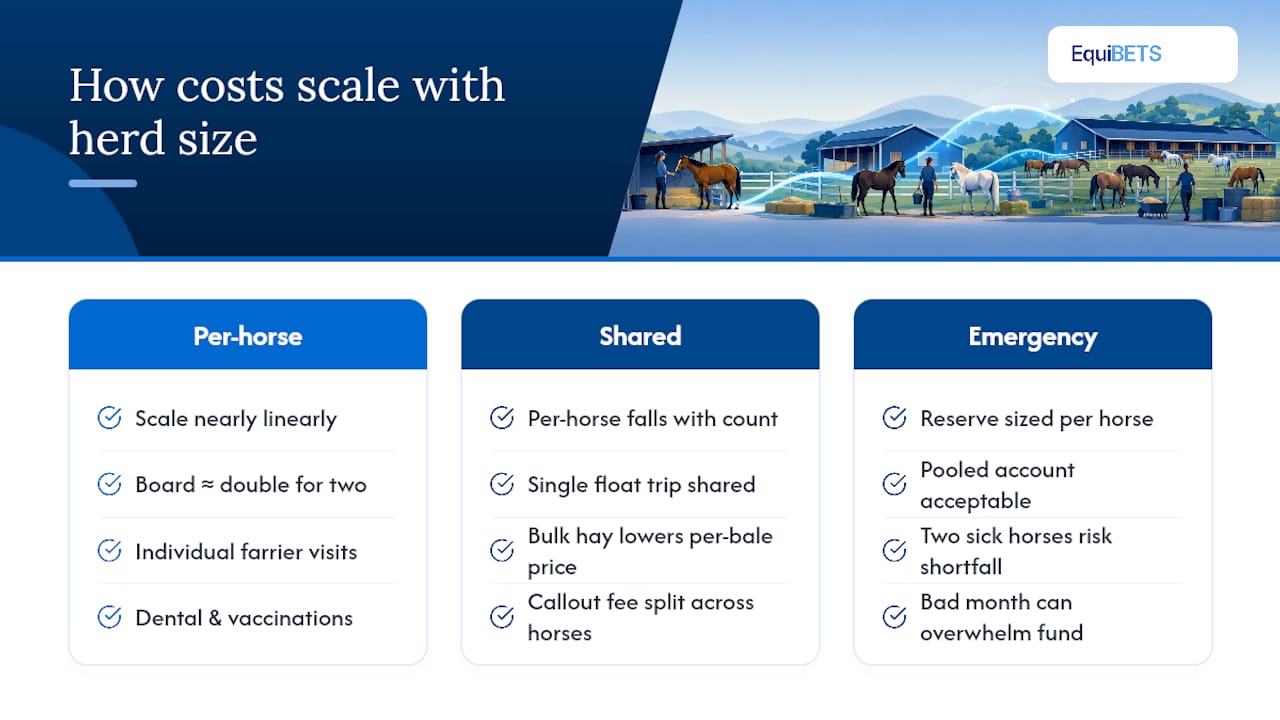
Where scaling gets genuinely harder is emergency funds. Owners often assume they can share one reserve across multiple horses, but colic doesn't wait for your other horse's vet bill to clear first. The safer approach is sizing your emergency fund per horse, even if you keep it in one pooled account, so a bad month with two sick horses doesn't leave you short.
A practical scaling approach: keep one shared line for genuinely shared costs (float, bulk feed, one farrier callout) and separate per-horse lines for everything else. This gives you an accurate cost-per-horse figure even as your herd grows, which matters if you're ever deciding whether a third horse is actually affordable or just feels affordable because costs got blurred together.
A yard manager's short first-person view on budgeting a single horse
The owners who avoid financial stress aren't the ones who spend less. They're the ones who review costs monthly instead of once a year in a panic. A recurring habit of checking actual spend against the budgeted figure, and topping up the emergency fund whenever it dips, catches problems while they're still small and manageable. Set a date each month, review your numbers, adjust, move on.
— isaac
A better way to track what your horse actually costs
Spreadsheets work until a farrier bill and a vet invoice land the same week and nobody remembers to update the annual total. That's the gap Equibets is built to close for horse budgets: finance tracking that amortises irregular costs automatically, so your monthly figure is always current rather than a guess you made three months ago.

Owner portals mean a part-boarder or co-owner sees the same numbers you do, in real time, without a group text asking who paid the last farrier bill. Combined with medical record storage, that also means claims and vet history are in one place when an emergency actually happens, not scattered across old text messages and a shoebox of receipts.
Equibets isn't a mandatory purchase for owning one horse. It's an alternative to the spreadsheet-and-shoebox approach for anyone who'd rather see a real per-horse monthly figure without doing the amortisation maths by hand every time. Check the pricing page for the free trial and see whether it fits how you already manage your horse's costs.
Sources
- How Much Does It Cost to Own a Horse in 2026? (Monthly + Yearly Calculator)
- How much does it really cost to own a horse? - Harry Hall Insurance