
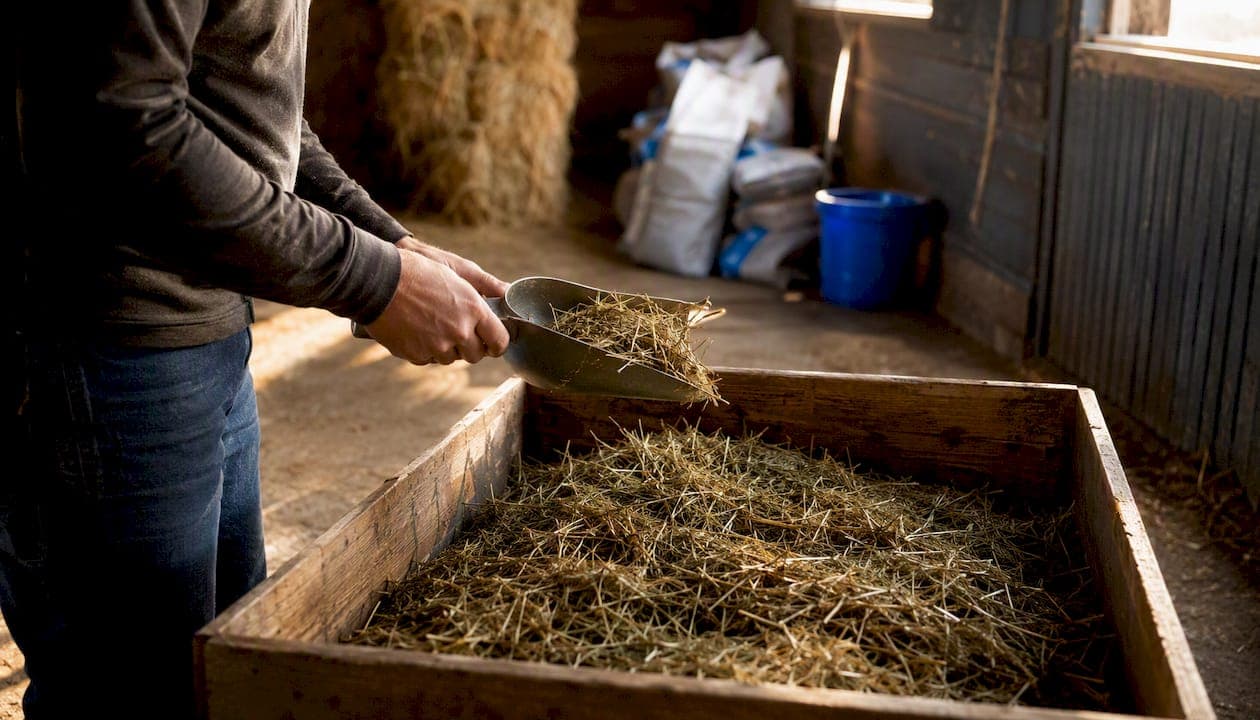
For a typical 500 kg horse, this equates to roughly 10 to 12.5 kg of DM daily, which translates to approximately 12 to 15 kg of as-fed hay weight, depending on hay moisture content. Three rules govern everything else: forage should never drop below 50% of total DM, concentrate feeds are generally recommended not to exceed 0.5% of body weight per single meal (approximately 2.5 kg for a 500 kg horse), and every calculation should start in dry matter before you convert to what actually goes in the feed bin.
That's not a soft guideline. Below that threshold, gut function and hindgut microbial health start to suffer, and the risk climbs sharply if the shortfall comes from cutting forage rather than easing off concentrate.
- Daily DM target: 2 to 2.5% BW for most mature horses at maintenance to moderate work
- Theoretical intake ceiling: 3 to 3.5% BW DM, rarely useful as a working target
- Forage floor: at least 50% of total DM from hay, haylage or pasture
- Concentrate per meal: no more than 0.5% BW, split across multiple feeds if the daily total runs higher
- Danger zone: under 1.25% BW DM without professional guidance risks malnutrition and hindgut disruption
Key Takeaways
| Point | Details |
|---|---|
| Set the DM target first | Use 2 to 2.5% BW DM as the baseline, adjusting upward for growth, lactation or heavy work. |
| Respect the forage floor | Keep at least 50% of total DM from hay, haylage or pasture in every ration. |
| Cap concentrate per meal | Limit hard feed to 0.5% BW per feeding and split larger totals across multiple meals. |
| Test forage regularly | Retest hay for DM, protein, energy, calcium, phosphorus and NSC with each new batch. |
| Adjust gradually and monitor | Change intake by 5 to 10% at a time, then recheck body condition after two to three weeks. |
Table of Contents
- Calculating horse feed rations: dry matter vs as-fed
- What forage types work best for horse feed rations?
- How much concentrate can a horse safely eat per meal?
- When should you use a ration balancer instead of concentrate?
- Adjusting horse feed rations for growth, pregnancy and performance
- What feeding routines keep horses safest?
- Sample horse feed rations you can use today
- How often should you check and adjust the ration?
- How Equibets simplifies horse feed rations for busy yards
- Practical rations beat perfect formulas
- Sources
Calculating horse feed rations: dry matter vs as-fed
Every serious ration calculation happens in two currencies: dry matter and as-fed. Dry matter is what's left once you strip out the moisture, and it's the only basis on which you can fairly compare a bale of hay (roughly 88% DM) against haylage (often 60 to 70% DM) or fresh pasture (as low as 15 to 20% DM). Feed tags and most everyday feeding conversations use as-fed weight, which is what you actually shovel into a bucket. Mixing the two up is the single most common error in home-built rations, and it's usually the reason a "correct" ration ends up under or overfeeding a horse.
The conversion is simple once you have the moisture percentage: as-fed weight = DM weight ÷ (DM% of the feed ÷ 100).
Here's the calculation sequence worth memorising:
- Pick a %BW DM target based on the horse's life stage and workload (2% for an easy keeper at maintenance, 2.5% or higher for a horse in moderate to heavy work).
- Multiply that percentage by body weight to get total kg of DM needed per day.
- Split the DM total between forage (at least 50%) and concentrate, based on workload and condition.
- Convert each portion back to as-fed weight using its specific DM percentage, because hay and hard feed rarely share a moisture content.
Total daily feed: roughly 9.1 kg hay plus 2.2 kg concentrate, split across at least two meals.
Pro Tip: Weigh your hay and hard feed with a luggage scale for a month before trusting a "scoop" measurement. Scoops vary wildly by feed density, and a "standard" scoop of chaff can weigh half what the same scoop holds in pelleted feed.
What forage types work best for horse feed rations?
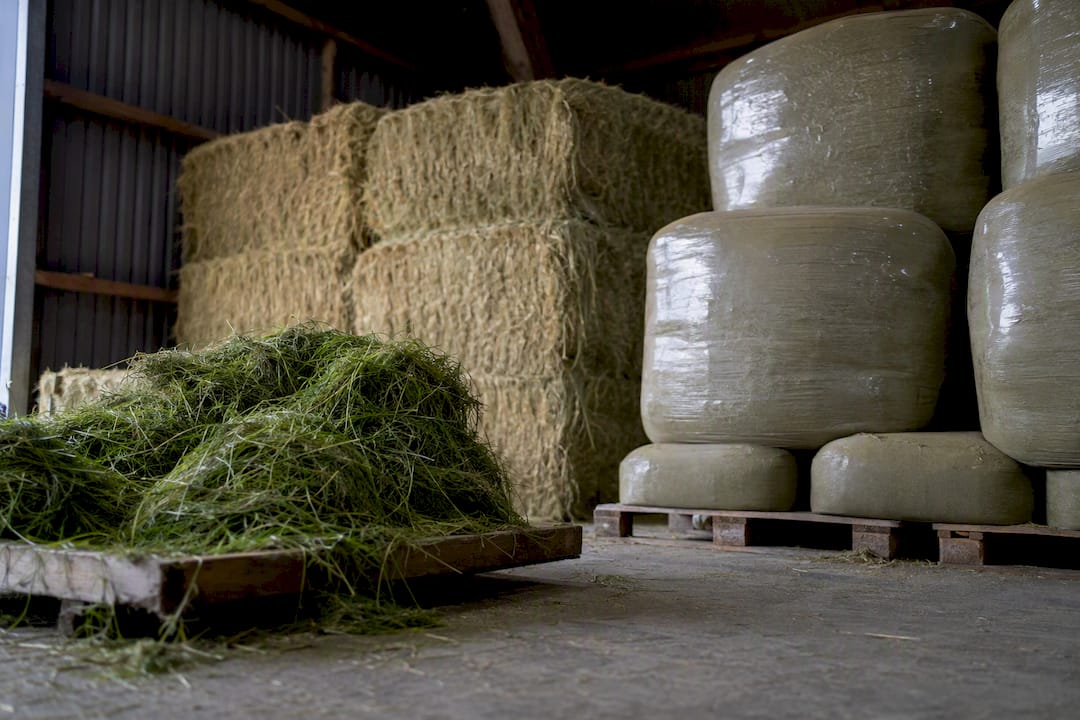
Forage should carry the biggest share of any ration, and the type you choose changes the whole nutritional picture. Pasture quality varies seasonally and by species mix, from lush spring grass rich in non-structural carbohydrates (NSC) to dormant winter growth primarily providing fibre. Grass hays like timothy or Rhodes grass sit in the middle: moderate protein, moderate energy, generally lower NSC than legumes. Legume hays such as lucerne pack more protein, calcium and energy per kilogram, useful for growing or lactating horses but often too rich for easy keepers or metabolic cases.
None of that matters much without a hay analysis. A basic forage test should report:
- Dry matter percentage, so you can convert lab results to as-fed feeding amounts
- Crude protein, to check whether you need a protein top-up or a balancer
- Digestible energy (DE) or total digestible nutrients (TDN), the main energy metric for matching intake to workload
- Calcium and phosphorus, because an inverted Ca:P ratio drives skeletal problems over time
- Non-structural carbohydrates (NSC), critical for laminitis-prone or metabolic horses
Ration evaluation and formulation works far better when it's anchored to actual lab numbers rather than a feed tag's typical values, because the same hay species can vary by double digits in protein and NSC depending on cutting, maturity and season.
Pro Tip: *If you feed round bales or use a hay net, budget for waste separately from your DM calculation.
How much concentrate can a horse safely eat per meal?
For a 500 kg horse, that's 2.5 kg of concentrate in any single feed. Going over that regularly means you're gambling with hindgut acidosis, even if the horse "seems fine" for a while.
If a horse's total daily concentrate requirement exceeds what fits in one or two meals under that limit, the answer is more meals, not bigger ones. A horse needing 5 kg of hard feed a day should get at least two feeds of 2.5 kg, ideally three smaller ones if workload or metabolic risk demands extra caution. Extension guidance from Oklahoma State recommends designing rations around roughly 80% of a horse's maximal voluntary intake, which naturally builds in room for forage to do most of the work and keeps concentrate meals conservative.
- Leave at least an hour, ideally longer, between a large grain meal and strenuous exercise
- Space bigger meals roughly 8 hours apart where practical, rather than clustering feed into two huge sittings
- Weigh concentrate rather than scooping it. A scoop of pelleted feed and a scoop of chaff can differ by 40% or more in actual kilograms
- Choose processing to suit the horse: rolled or crimped grains digest more efficiently than whole grain for most horses, while extruded feeds break starch down further again, useful for horses prone to hindgut upset
Reading a feed bag's guaranteed analysis tells you protein, fat and fibre percentages, but it won't tell you how much starch hits the gut per meal unless you also know the feeding rate and your horse's actual weight, so always cross-check bag directions against your own calculated ration rather than following the label blind.
When should you use a ration balancer instead of concentrate?
A ration balancer is a concentrated pellet fed in small amounts, typically 0.5 to 1 kg a day for a 500 kg horse, designed to fill protein, vitamin and mineral gaps without adding meaningful calories. It solves a specific problem: what happens when a horse doesn't need extra energy but still needs proper nutrition on top of forage alone.
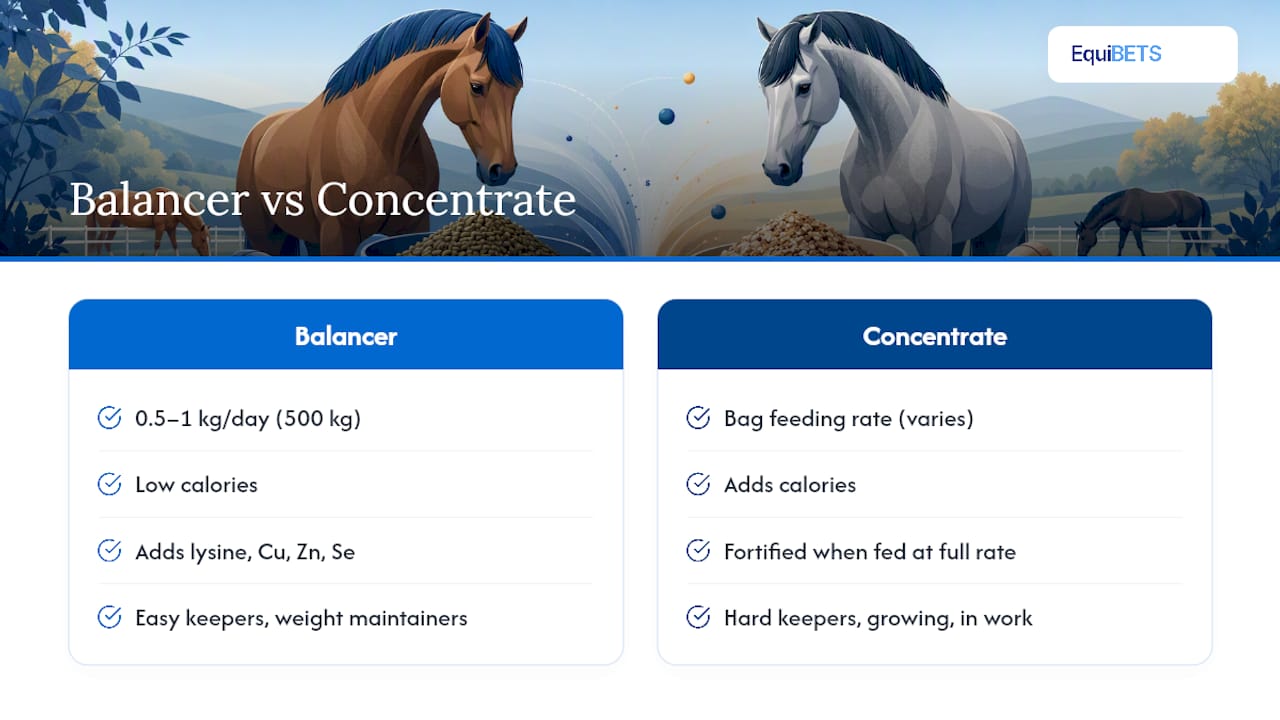
Easy keepers and horses maintaining weight on forage alone are the classic balancer candidates. A horse holding condition well on hay doesn't need a calorie-dense sweet feed, but plain hay rarely supplies enough lysine, copper, zinc or selenium on its own. Feed a balancer instead of a full concentrate, and you close that gap without piling on unwanted energy.
Calorie concentrates make sense when the horse actually needs more energy, whether that's a hard keeper, a growing horse or one in solid work. If a horse's required feeding rate for a bagged concentrate would fall below the manufacturer's stated minimum, switch to a balancer rather than underfeeding the bag, because underfeeding a fortified concentrate below its designed rate delivers proportionally less of every vitamin and mineral it's meant to supply.
Added fat, usually oil, can be introduced for extra calories without extra starch, but ramp up over two to three weeks rather than dumping a full cup in on day one. Most horses tolerate up to around 100 to 150 mL of oil per meal once adapted. Before adding any supplement, check the balancer's own label against what the forage test already shows. Doubling up on selenium or vitamin A from three different sources is a genuine risk, not a theoretical one.
Adjusting horse feed rations for growth, pregnancy and performance
Baseline numbers shift once you're feeding anything other than a mature horse at rest. Growing horses and weanlings need noticeably higher protein and energy density relative to body weight, because they're building bone and muscle on a smaller frame.
Lactating mares carry some of the highest energy demands in the whole horse population, often needing 1.5 to 2 times a maintenance ration in early lactation.
Feeding the bulk of daily concentrate after work, once the horse has cooled and settled, generally sits easier on the gut than a big meal beforehand.
Starving a metabolic horse below that floor risks hyperlipaemia, particularly in ponies and donkeys.
Pro Tip: For any special-needs horse, whether growing, lactating or metabolic, retest forage every time you change hay batches. A "safe" NSC reading on the last load doesn't guarantee the same result on the next one, especially across a season change.
What feeding routines keep horses safest?
Good feeding routines catch problems long before they become emergencies. The habits matter as much as the numbers on the ration sheet.
- Avoid feeding a large grain meal within an hour of hard exercise, and try to keep roughly 8 hours between the day's biggest meals so the hindgut isn't repeatedly hit with large starch loads close together.
- Provide fresh water at all times and free access to plain salt or a mineral block. Horses that drink less after exercise in cool weather are at higher impaction colic risk, so watch water intake as closely as feed intake.
- Learn the early signs of digestive trouble: reduced appetite, pawing, looking at the flank, reduced or abnormal droppings, and a reluctance to move (especially a shortened, shuffling gait suggestive of laminitis). Any of these warrants a call to the vet rather than a wait-and-see approach.
- Keep simple records of daily intake, droppings, and body condition. A gradual drift in any of these over a few weeks is far easier to catch on paper than by memory alone.
Yards running several horses on different rations tend to lean on a stable management system precisely because manual tracking across a dozen or more feeding charts is where small errors creep in unnoticed.
Sample horse feed rations you can use today
These three worked rations cover the situations most owners actually face.
If forage quality drops (lower DE, higher stem content), the concentrate share usually needs to rise slightly to hold energy intake steady, and vice versa if you move to a richer hay or fresh spring pasture. If workload increases, add energy through concentrate in small increments over one to two weeks rather than one large jump, watching body condition as you go.
How often should you check and adjust the ration?
Body condition scoring (BCS), typically on a 1 to 9 scale, remains the most practical monitoring tool available to any owner. Check monthly for most horses, weekly for anything recently changed to a new ration or recovering from illness. A body weight tape or scale used every two to four weeks tracks trends a visual check alone will miss.
Because individual metabolism can vary by 10 to 15% from what a calculation predicts, no formula replaces watching the actual horse in front of you.
- Retest forage whenever you open a new batch or the season changes, since NSC and protein shift meaningfully between cuttings
- Keep a simple log of batch IDs and moisture content so you can trace which hay lot correlates with any change in condition
How Equibets simplifies horse feed rations for busy yards
Manual ration sheets fall apart fast once a yard runs more than a handful of horses, each on a slightly different plan. Equine nutrition tools built into a management platform automate the DM-to-as-fed conversion, store forage batch profiles alongside lab results, and generate feeding templates staff can follow without redoing the maths every time a horse changes workload.
Digital records also cut the human error that creeps into paper charts, particularly around scoop-to-kilogram conversions and per-meal concentrate limits. When a hay delivery changes or a horse comes back into work, Equibets updates the ration and pushes the change to whoever's feeding that horse next.
- Automated DM and as-fed conversions tied to each stored forage profile
- Feed schedule alerts that flag when a concentrate meal approaches the 0.5% BW ceiling
- Batch-linked records so a forage retest updates every horse's ration on that hay at once
Practical rations beat perfect formulas
It isn't. Every formula in this article, and every formula in the extension literature it draws from, assumes an average horse that doesn't actually exist on your property.
What gets underestimated is how much routine, not precision, prevents feeding disasters. A horse fed a slightly imperfect ration on a consistent schedule, with fresh water and steady forage, will usually outperform a horse fed a mathematically flawless ration that changes chaotically week to week. The meal-timing and per-meal concentrate rules matter more day to day than chasing the third decimal place on a DM calculation.
Get those two right, weigh feed instead of scooping it, and retest hay when it changes. The rest is fine-tuning, best done with a vet and a body condition score in hand rather than a spreadsheet alone.
— isaac
Sources
- Rations for horses: nutrients, feedstuffs and safety | Oklahoma State Extension
- Ration evaluation and formulation | Veterian Key