
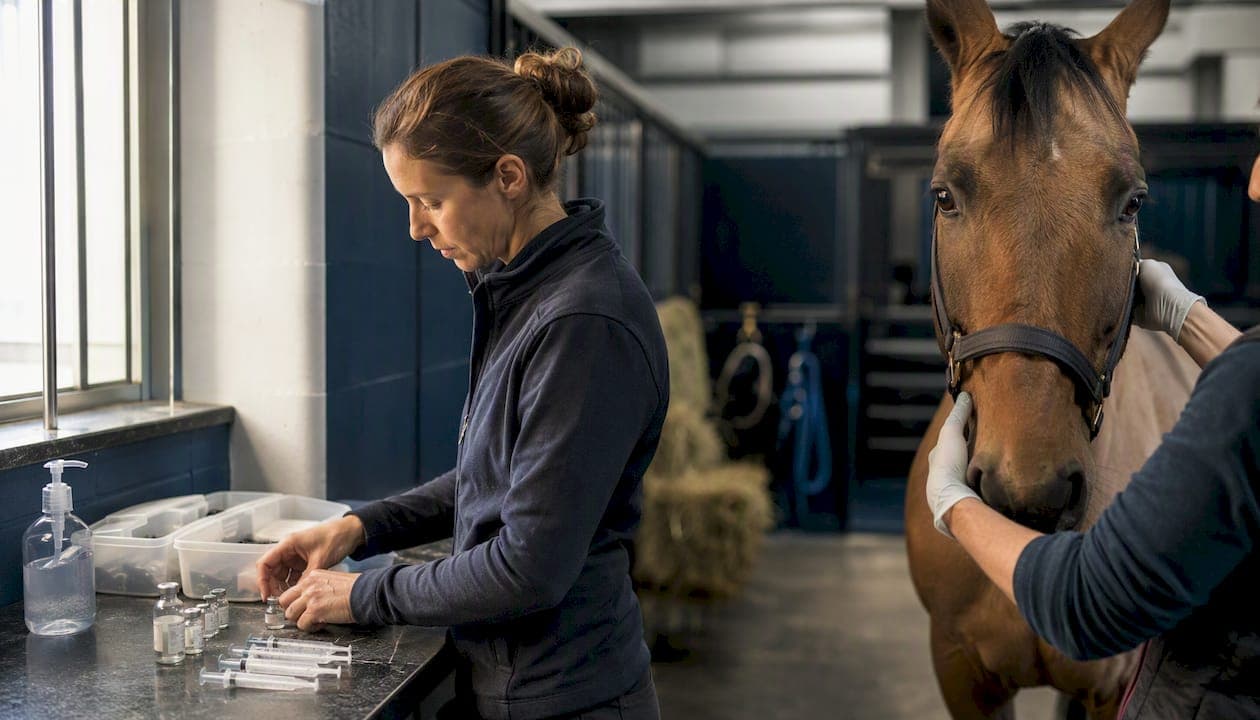
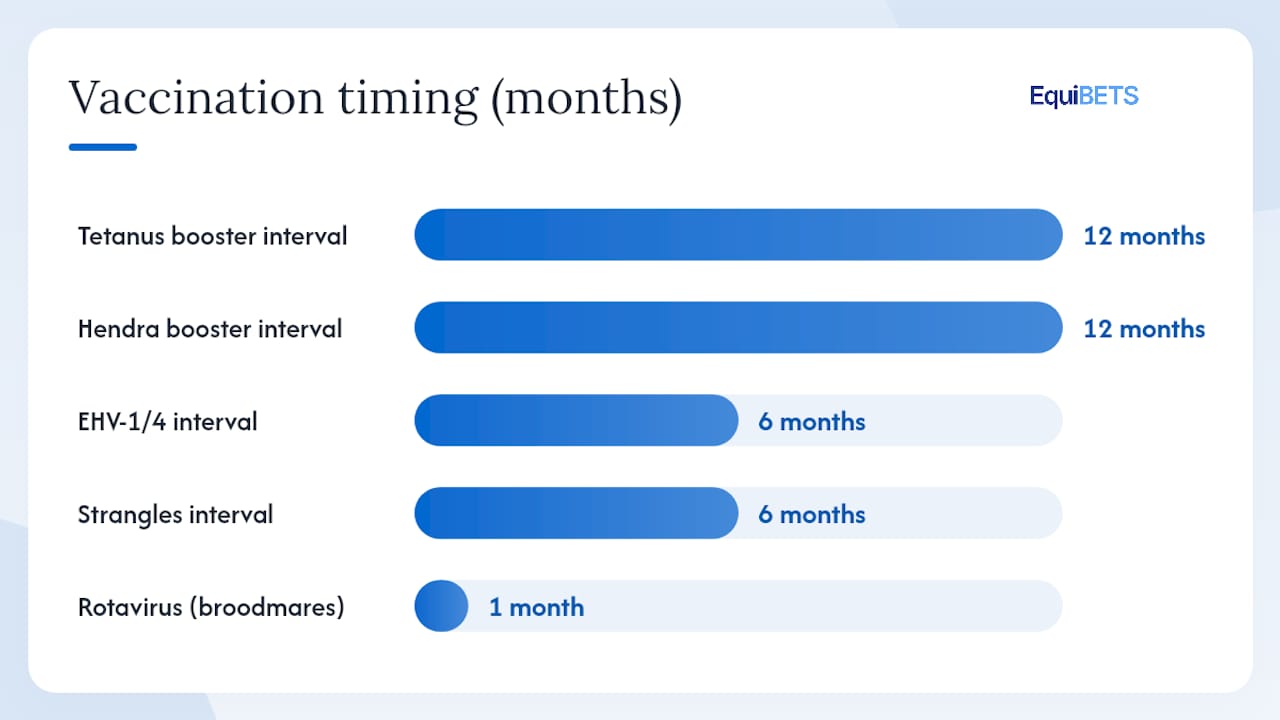
In Australia, every horse needs at minimum two core vaccines: tetanus and Hendra virus. Tetanus is typically boosted annually. Hendra follows a three-dose primary course (two doses 3–6 weeks apart, a third dose six months later, then annual boosters). Risk-based vaccines, including Equine Herpesvirus (EHV-1/4), Strangles and Rotavirus for broodmares, are layered on top depending on your horse's age, use, and location. Your vet builds the final schedule. You keep the records.
Core priorities at a glance:
- Tetanus: annual booster for all horses; primary course if history unknown
- Hendra virus: three-dose primary course, then annual; microchipping and online registry entry required within two days of each dose
- EHV-1/4: commonly every six months for horses in contact with others or travelling
- Strangles: every six months for at-risk horses; not recommended if Strangles is active in the yard
- Rotavirus: broodmares one month before foaling to protect foals via colostrum
- Event entry: a single dose does not qualify a horse for competition; the full primary series must be complete
Pro Tip: Keep a digital vaccination record from day one. If you acquire a horse with no history, treat it as unvaccinated and start a full primary course. The EIDAB vaccination chart is a free, practical reference for priming regimens.
Key takeaways
| Point | Details |
|---|---|
| Core vaccines are non-negotiable | Tetanus and Hendra are the baseline for every horse in Australia; all others are risk-based. |
| Hendra requires a three-dose primary course | Two doses 3–6 weeks apart, a third six months later, then annual boosters; microchipping is required before the first dose. |
| Broodmares need gestation-timed EHV boosters | EHV at five, seven, and nine months of gestation; rotavirus one month before foaling. |
| Event entry needs the full primary series | A single dose does not qualify a horse for competition or movement; allow seven to eight months to complete Hendra priming. |
| Equibets centralises records and reminders | The stable management module stores batch numbers, due dates, and exports histories for events or vets. |
Table of Contents
- Which vaccines do Australian horses actually need?
- Sample vaccination timelines for foals, adults and broodmares
- How do you build a personalised vaccination plan with your vet?
- What does a vaccination programme cost and how long does it take?
- What side effects should you watch for after vaccination?
- How Equibets helps you stay on top of vaccination records
- What experienced yard managers actually do differently
- Equibets keeps your vaccination records where you need them
- Sources
Which vaccines do Australian horses actually need?
Not every vaccine suits every horse. The distinction between core and risk-based vaccines is where most owners get confused, so here is how Australian veterinary guidance frames it.
Core vaccines
Tetanus is non-negotiable. Clostridium tetani spores live in soil across Australia, and any wound, no matter how minor, is a potential entry point. Annual boosters are the standard maintenance interval.
Hendra virus is the other core vaccine for Australian horses, particularly in Queensland and northern New South Wales where flying foxes (the natural reservoir) are endemic. The Australian government identifies vaccination as the most effective way to manage Hendra and reduce transmission risk to people. Because Hendra is fatal in horses and can kill humans, the public-health rationale is as strong as the animal-health one. Some events in endemic regions require proof of vaccination before entry.
Risk-based vaccines
| Vaccine | Primary recipients | Typical timing | Key trigger |
|---|---|---|---|
| EHV-1/4 | All horses in contact or travel | Every 6 months | Mixing with other horses, competition, pregnancy |
| Strangles | At-risk horses, yards with new arrivals | Every 6 months | Exposure risk, new stock |
| Rotavirus | Broodmares | 1 month before foaling | Breeding operation |
| Salmonella | Horses in high-risk environments | Vet-directed | Outbreak or endemic area |
Pro Tip: Never vaccinate against Strangles when the disease is already present in your yard. Your vet will advise on timing relative to any active infection or recent exposure.
Vaccination reduces disease severity and risk but does not guarantee prevention. For Strangles in particular, it is a population-management tool, not a silver bullet. Pair every vaccine with biosecurity basics: isolate new arrivals for at least two weeks, monitor for clinical signs, and report suspected cases promptly.
Sample vaccination timelines for foals, adults and broodmares
These timelines are starting points. Your vet adjusts them based on your horse's history, location, and use.
Foal priming schedule
Foals from vaccinated mares carry maternal antibodies that can interfere with early vaccination. The EIDAB chart recommends starting Hendra priming at six months of age for foals born to vaccinated mares. Foals from unvaccinated mares may start earlier, subject to vet advice.
| Age / Timepoint | Action |
|---|---|
| Birth to 3 months | Colostral antibody cover (from vaccinated dam); no primary doses yet |
| 4–6 months | Tetanus primary dose 1; Hendra dose 1 (if from unvaccinated dam, earlier on vet advice) |
| 6 months | Hendra dose 1 (foals from vaccinated mares); microchip required before first Hendra dose |
| 6 weeks after dose 1 | Hendra dose 2; Tetanus dose 2 |
| 6 months after dose 2 | Hendra dose 3 (third primary dose) |
| Annually thereafter | Tetanus booster; Hendra booster |
| From 6 months | EHV and Strangles priming on vet advice |
Event entry reminder: A horse is only considered protected for movement or competition after completing the full primary immunisation series and maintaining recommended boosters. A single dose does not confer event-entry status. Allow for all required intervals before planning travel or competition.
Adult maintenance schedule
For adult horses with a complete vaccination history, the typical Australian maintenance programme runs:
- Tetanus: annual booster
- Hendra: annual booster (after completing the three-dose primary course)
- EHV-1/4: every six months, or more frequently for horses in high-contact environments
- Strangles: every six months for at-risk horses
Broodmare schedule
Broodmares need careful timing. Virbac AU recommends EHV boosters at five, seven, and nine months of gestation to reduce the risk of EHV-related abortion. Rotavirus vaccination is given one month before foaling to boost colostral antibodies and protect the newborn foal. Avoid vaccinating within the first 45 days after mating and in the two weeks before expected foaling for some products. Always check the product leaflet and confirm timing with your vet.
How do you build a personalised vaccination plan with your vet?
A vet consultation is the only way to get a schedule that actually fits your horse. Come prepared.
Before the appointment, gather:
- Horse's age, breed, and reproductive status
- Complete vaccination history (or note that it is unknown)
- Travel and competition plans for the next 12 months
- Foaling dates if applicable
- Your property's location relative to Hendra-endemic regions
- Details of any new horses recently introduced to the yard
Questions worth asking your vet:
- Does my horse need a full primary course, or is a booster sufficient?
- What is the minimum interval between doses for each vaccine?
- Which vaccines are required for the events or movements I have planned?
- Should I adjust the schedule given my property's Hendra risk status?
- Are there any pregnancy windows I need to avoid for my broodmares?
- What biosecurity measures should I pair with vaccination?
For high-risk seasons or local outbreaks, your vet may recommend expediting boosters or adding vaccines not normally on your schedule. Australian veterinary experts consistently advise tailoring programmes to the horse's age, use, and local Hendra risk rather than applying a one-size-fits-all approach.
Pro Tip: If you manage multiple horses, ask your vet to align booster dates across the yard where possible. A single annual vaccination day cuts admin, reduces missed doses, and makes record-keeping far simpler.
Record every vaccination with the date, product name, batch number, and administering vet. For Hendra, microchipping must occur before the first dose, and each dose must be entered in the online registry within two days of administration.
What does a vaccination programme cost and how long does it take?
The primary course for Hendra alone spans several months from the first dose to the completion of the third. Factor that into any competition or movement planning.
Cost drivers to budget for:
- Vaccine product cost (varies by manufacturer and product)
- Vet consultation and administration fees
- Travel call-out fees for remote properties
- Microchipping (one-off, required before first Hendra dose)
- Online registry administration for Hendra
Practical note: Batching vaccinations across multiple horses in a single vet visit is the most cost-effective approach for yards with several horses. Align booster dates with routine farrier or dental visits to reduce the number of separate vet call-outs per year.
Costs vary significantly by region, vet practice, and the number of vaccines administered. Contact your local vet for a quote specific to your situation.
What side effects should you watch for after vaccination?
Most horses tolerate vaccination well. Mild local reactions at the injection site, brief lethargy, and a low-grade temperature in the 24–48 hours after vaccination are common and generally self-limiting.
If your horse shows a concerning reaction, follow these steps:
- Note the time of vaccination and the first sign of the reaction.
- Record the vaccine product name and batch number from the label.
- Keep the horse calm, in a safe environment, and monitor closely.
- Contact your vet immediately if you observe: severe swelling or pain at the injection site, hives or facial swelling, difficulty breathing, collapse, or signs of anaphylaxis.
- Do not administer any medication without veterinary advice.
- Report the adverse event to your vet and, where required, to the vaccine manufacturer for traceability.
Keeping a batch number on record is not just good practice; it is essential for traceability if a batch-level issue is later identified. Store vaccine packaging or photograph the label before disposal.
How Equibets helps you stay on top of vaccination records
Vaccination compliance on a busy yard comes down to one thing: whether the records are easy to find and the reminders actually fire. Equibets's stable management module is built around exactly that workflow.
What you can do in Equibets:
- Store each horse's vaccination dates, product names, batch numbers, and administering vet in a single centralised record
- Set recurring booster reminders so nothing slips between annual visits
- Log microchip IDs and Hendra registry entries alongside vaccination history
- Share vaccination records with owners through the owner portal, or export histories for event organisers and vets
- Attach vaccination notes to emergency plans so first responders have immediate access to health status
| Task | Manual approach | With Equibets |
|---|---|---|
| Tracking booster due dates | Spreadsheet or paper diary | Automated reminders per horse |
| Sharing records for events | Printing or emailing PDFs | Export directly from the platform |
| Emergency health access | Filing cabinet or vet notes | Integrated emergency plan, accessible offline |
| Multi-horse yard overview | Multiple files | Single dashboard for all horses |
The platform also links vaccination records to broader health and nutrition workflows, so a vet or yard manager reviewing a horse's profile sees the full picture, not just one data point.
What experienced yard managers actually do differently
The yards that rarely miss a booster share a few habits that have nothing to do with technology.
Annual vaccination days work because they create a social and logistical anchor. Book the vet for the same week each year, pair it with dental checks, and the whole yard gets done in one visit. It sounds obvious, but most missed boosters happen because the date drifts by a few weeks each year until it is six months late.
Mixing vaccinated and unvaccinated stock is a genuine risk that many owners underestimate. When new horses arrive, isolate them for at least two weeks regardless of their stated vaccination history. Paperwork gets lost, histories get misremembered, and a single unvaccinated horse in a group can seed an outbreak that a vaccinated herd still struggles to contain.
For foals, the handling experience during vaccination matters as much as the vaccine itself. A foal that associates the vet with calm, low-stress handling will be far easier to vaccinate throughout its life. Take the time to do it right from the first dose.
Equibets keeps your vaccination records where you need them
Keeping a vaccination schedule is straightforward in principle and genuinely difficult in practice across a busy yard. Equibets gives you a single place to store every horse's vaccination history, set booster reminders, and produce records for events or vets on demand.

The Equibets platform is built for professional yards that need more than a spreadsheet: centralised records, owner portal updates, offline mobile access, and emergency plans that put health information in front of the right people at the right time. Vaccination records sit alongside nutrition, movement, and finance data in one workspace.
Your vet makes the clinical decisions. Equibets makes sure the records are there when it matters. Start a free trial at Equibets and see how much simpler a vaccination programme becomes when the reminders run themselves.
Always follow your veterinarian's advice. Equibets is a management adjunct, not a substitute for professional veterinary care.
Sources
These are the primary references to consult for up-to-date protocols, product leaflets, and regional biosecurity guidance. Always confirm exact dosing and registry requirements with your vet and the relevant product leaflet.
- Equivac® HeV | Zoetis AU
- Hendra virus - DAFF
- Hendra FAQs (Equestrian Australia)
- Routine Vaccination of Breeding Horses (Virbac AU)
- Murray Vets — equine vaccination overview