

Tag every expense to a horse and event the moment you pay for it, invoice pass-through costs promptly after the event, and never let owner money sit in the yard's general account. Everything else in stable bookkeeping, from lease splits to syndicate statements, flows from that one rule. Get the tagging and timing right and disputes mostly disappear on their own.
TL;DR:
- Tag expenses immediately to the relevant horse and event, attaching receipts before leaving the payment location to prevent reconciliation delays.
- Classify costs as pass-through, board-tier, yard operating, capital, or shared, ensuring expenses are allocated to the correct source and owner claim.
- Record gross income and book owner payable shares promptly, with pass-through costs invoiced within 72 hours and recurring costs bundled monthly.
- Use automated tagging and real-time owner portals to reduce disputes caused by delays and lack of evidence in chargeback processes.
- Employ dedicated software as yard size grows to automate expense capture, invoicing, and reconciliation, minimizing manual work and memory gaps.
Table of Contents
- How do you tag and process a chargeback expense as it happens?
- Which expenses can you charge back, and which stay with the yard?
- What's the simplest system for turning receipts into paid invoices?
- How should you handle a disputed chargeback or processor fee?
- What do owners and syndicate members expect from your bookkeeping?
- Common pitfalls and how better tools close them
- Where EquiBETS fits into your chargeback process
- Sources
How do you tag and process a chargeback expense as it happens?
Most chargeback disputes trace back to a gap between the moment money leaves the account and the moment it's recorded against a specific horse. Close that gap and the rest of the process runs itself.
- Capture the data at the point of payment. Note the horse, owner, event, expense type, and attach the receipt before you leave the till or the vet's yard.
- Classify it immediately. Decide whether it's a pass-through (feed, farrier, vet callout) the owner pays in full, or a barn operating cost absorbed into board fees.
- Book gross and post the payable. For leases and commission arrangements, record the full receipt as income, then immediately book the owner's share as a payable rather than netting it off later.
- Apply invoicing timing rules. Pass-through costs go out within 72 hours with the receipt attached; recurring costs bundle into the monthly statement.
- Reconcile weekly and set a follow-up deadline. Unpaid invoices past a reasonable timeframe trigger reminders and then a phone call if unresolved.
Pro Tip: Photograph the receipt before you put your wallet away. A tagged photo at the point of sale removes the entire "what was this for again?" problem that eats up reconciliation time three weeks later.
Which expenses can you charge back, and which stay with the yard?
Owners generally accept a chargeback without question when the line item is obviously theirs. They push back the moment a cost looks like it's subsidising the yard's overheads, so the split has to be defensible before you ever send an invoice.
- Direct pass-throughs: farrier visits, vet call-outs, individual supplements, show entries and float hire for a specific horse.
- Board-tier costs: feed, bedding and basic care, which should sit inside whichever board tier the owner has actually signed up for, not averaged across the whole yard.
- Barn operating costs: utilities, general labour, arena maintenance and insurance, which stay with the yard because every horse benefits from them regardless of tier.
- Capital costs: fencing, float purchases and yard renovations, which belong on the yard's books, not an owner's invoice.
- Shared events: a float trip carrying four horses to the same show splits by headcount or agreed proportion, documented at the time of booking.
Tracking board revenue by service tier rather than as one lump figure matters more than most yards realise. If full-board, part-board and pasture-board income all land in the same bucket, you can't tell which tier is actually profitable, and you risk quietly subsidising a cheap tier with revenue from a premium one. The same discipline applies to leases: book the full lease payment as income, then post the owner's share as a payable straight away, so the yard's real revenue is only its commission, never the whole cheque.
Seasonal cost swings deserve their own line in the budget rather than a shrug. Hay and feed prices spike predictably every winter in most regions, and a yard that hasn't budgeted for it ends up either eating the cost or scrambling to justify a sudden invoice jump to owners who weren't warned.
What's the simplest system for turning receipts into paid invoices?
The workflow matters more than the software. A yard with three horses can run this on a spreadsheet; a yard with thirty needs something that tags automatically.
- Tag now, invoice on a cadence. Pass-throughs are invoiced promptly after the expense; recurring board and fees consolidate into a monthly statement.
- Post lease income gross, payables immediately. The moment a lease cheque clears, book the owner's share as a payable in the same session, not at month-end.
- Reconcile weekly, not monthly. A ten-minute Friday check against the bank statement catches a missed tag before it becomes a missing $400 nobody can explain in March.
- Progress your tools as the yard grows. A spreadsheet works for a handful of horses; once you're juggling multiple owners and syndicates, dedicated accounting software or a yard-management platform with owner portals earns its cost back in saved admin hours.
Automating the capture step is where most of the time savings actually live. Automating expense tracking so a receipt photo becomes a tagged, categorised line item without manual typing cuts the error rate that causes the "I never approved this" disputes in the first place. Tagging at the point of purchase, complete with receipt photo and event tag, turns reconciliation from a memory exercise into mechanical matching.
Pro Tip: If you're still typing receipts into a spreadsheet by hand once you're managing more than a handful of owners, that's the signal to move up, not a badge of thriftiness.
How should you handle a disputed chargeback or processor fee?
Disputes almost always come down to missing evidence, not genuine disagreement about whether the cost was fair.
- Attach the full packet to every invoice. Receipt, horse tag, event reference and a one-line note on why the cost applies. An invoice with no backup is an invoice inviting a question.
- Decide chargeback processor fees in advance, not mid-dispute. Whether you absorb a payment processor's chargeback fee or pass it on to the owner should sit in the syndicate agreement or boarding contract, not get decided on the fly when a card gets disputed.
- Escalate on a fixed timeline. Reminder at 14 days, phone call at 30, formal notice at 45, with debt collection or legal advice as the last resort once the evidence packet and communication trail are both solid.
- Prevent the next one. Clear terms and conditions, an owner portal showing real-time balances, and invoicing within days of the event close most disputes before they open.
Owner portals and finance tracking speed up dispute resolution largely because the owner can see the receipt and the tag themselves instead of taking the yard's word for it.
What do owners and syndicate members expect from your bookkeeping?
Owners don't need to see your general ledger. They need a statement that lines up with what they remember paying for, delivered soon enough that the memory is still fresh.
Run a separate client-funds account for deposits and owner money, and never let the yard's operating cash and owner-held funds sit in the same pool. Book gross receipts and post owner payables immediately rather than netting figures at month-end, so there's never a moment where the ledger implies the yard has "borrowed" from an owner even briefly.
Build a rolling 12-month cashflow that treats board fees as your base income layer and show-season revenue as the variable on top. A rolling cashflow forecast turns winter feed spikes and competition-season swings into something you planned for months ago rather than a surprise shortfall in July.
Monthly statements should list pass-throughs, board tier, and any processor fees as separate line items, not a single number. Syndicate administrators managing multiple owners across one horse benefit from following a 90 Day Accounting Checklist built specifically for that reconciliation cycle, and it doubles as evidence if a member ever queries a statement months later.
Common pitfalls and how better tools close them
The two failures that lose yards the most money aren't complicated. They're commingling owner funds with the yard's operating account, and invoicing too slowly for anyone to remember what the charge was for. Both are entirely preventable with discipline, and both get harder to avoid the more horses and owners you're juggling on a spreadsheet.
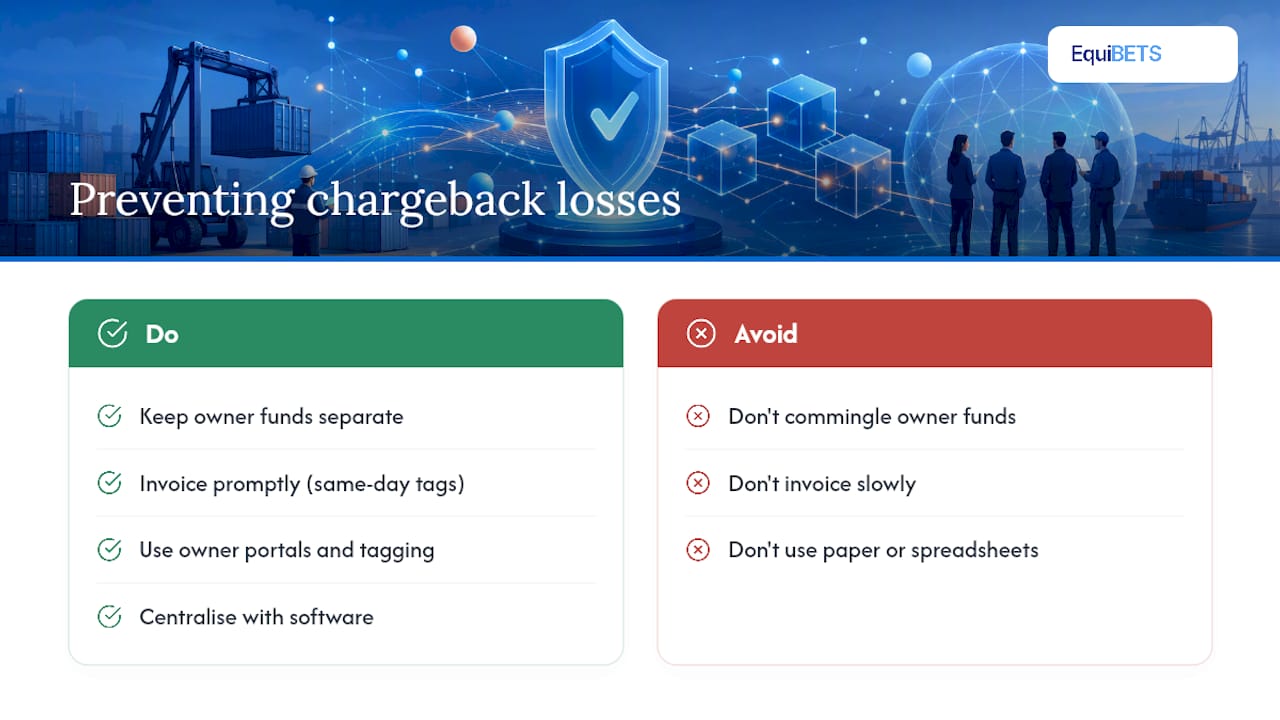
Owner portals and real-time tagging fix this because they remove the lag between spend and visibility. When an owner can see a tagged receipt the same day it's paid, there's no three-week gap for memory to fade or suspicion to build. That's the gap where most disputes are born, not in the actual fairness of the charge.
If you're running this process on paper or scattered spreadsheets right now, the checklist above will get you most of the way. Software that centralises tagging, owner portals and invoicing gets you the rest of the way without the weekly admin slog.
— isaac
Where EquiBETS fits into your chargeback process
Everything covered here, the tagging, the timing, the payables, the statements, is a discipline problem before it's a software problem. But discipline is a lot easier to maintain when the tool does the remembering for you.

This software was built around exactly this workflow. The owner portal gives owners live visibility into every invoice and receipt instead of waiting for a monthly PDF, which is the single biggest lever for cutting disputes before they start. Finance tracking can handle the pass-through versus barn-cost split automatically, and an offline mobile app can let staff tag an expense to a horse and event from the paddock with no signal; syndicate reporting can produce the line-itemed statements members actually trust. The Stable Manager feature set pulls all of it, horse records, finance, owner communication, into one workspace instead of three disconnected tools.
If you're managing chargebacks across more than a handful of owners, check the pricing page and start a free trial to see whether your current invoicing cadence holds up against a system built to do the tagging for you.
Sources
- Bookkeeping for Boarding, Training, and Lesson Stables: Board Tiers, Lease Splits, and Show Pass-Throughs
- How to automate expense tracking without typing a single receipt — Ledgery Blog