

Owners get the largest share of any race's total prize fund (TPF), but the split is fixed, not negotiable, and it changes depending on the code. On the Flat, the BHA sets owners at about 80% of the total prize fund, with trainers on 7.85%, jockeys on 5.77%, and stable staff on 4.75%. In Ireland, Horse Racing Ireland's factbook shows the average owner ends up with roughly 71.92% net after every deduction is applied, not the headline percentage.
The moment prize money lands in the yard's account, you've got work to do:
- Log the payment against the specific race and horse
- Check race conditions for any conditional deductions (nomination fees, bonuses)
- Calculate statutory and industry deductions before touching the owner's share
- Notify the owner (and syndicate members) of the gross figure and expected net
- Schedule the distribution date, ideally within your standard monthly cycle
Prize money reality check: HRI data shows that a significant portion of owners receive prize money in any given year, so treat every payout as a communication opportunity, not routine admin.
Key Takeaways
Correct prize money distribution depends on applying fixed regulatory percentages accurately, documenting every deduction and set-off, and reporting gross-to-net figures transparently to owners every cycle.
| Point | Details |
|---|---|
| Splits differ by code | Flat gives owners 80% of TPF; Jumps gives owners —, with jockeys taking a larger share. |
| Net is lower than gross | HRI data shows owners average around 71.92% net after standard deductions, not the headline percentage. |
| Syndicates need written agreements | Pro-rata shares, set-off authority and dispute resolution must be documented before any payout. |
| Statements need itemisation | Show gross prize, every deduction, and net payable with a payment date on each owner statement. |
| Automate the paper trail | EquiBETS's owner portal and finance tracking generate itemised statements and audit-ready records automatically. |
Table of Contents
- Day-of receipt checklist for handling the prize fund
- Percentage splits, code differences, and a worked calculation
- Syndicate distribution rules, set-offs, and timing
- Reporting prize money to owners with clear statements
- Common causes of prize money disputes and how to prevent them
- When to bring in a solicitor, accountant or the racing authority
- Insurance and liability considerations for prize handling
- Handling disputes and appeals beyond the syndicate agreement
- Prize money's effect on other racing incentives and bonuses
- Accounting controls that keep your audit trail clean
- How EquiBETS keeps prize distribution auditable
- Frequently asked questions
- Sources
Day-of receipt checklist for handling the prize fund
The day prize money arrives is when most disputes start, usually because something wasn't checked before the cash moved. Run this sequence every time, no exceptions.
- Confirm the payer (racecourse, authority, or sponsor) and the exact amount against the published TPF
- Cross-check race conditions and any additional bonus schemes tied to the entry
- Record the bank receipt with date, race reference and horse name
- Apply regulatory and industry deductions before calculating owner net
- Flag any set-offs owed against a syndicate member's outstanding fees
Pro Tip: Timestamp every transaction the day it happens and archive the original race documentation, entry confirmation, and results sheet together. Regulators typically allow a 14-day window to respond to distribution queries, and you don't want to be hunting for a results printout on day 13.
Notify the owner, syndicate manager, trainer, and payroll simultaneously. A delay in telling payroll about jockey and stable staff shares is one of the most common causes of late payment complaints.
Percentage splits, code differences, and a worked calculation
The BHA's published splits are the operational backbone for any UK yard's distribution process, and they differ meaningfully between codes.
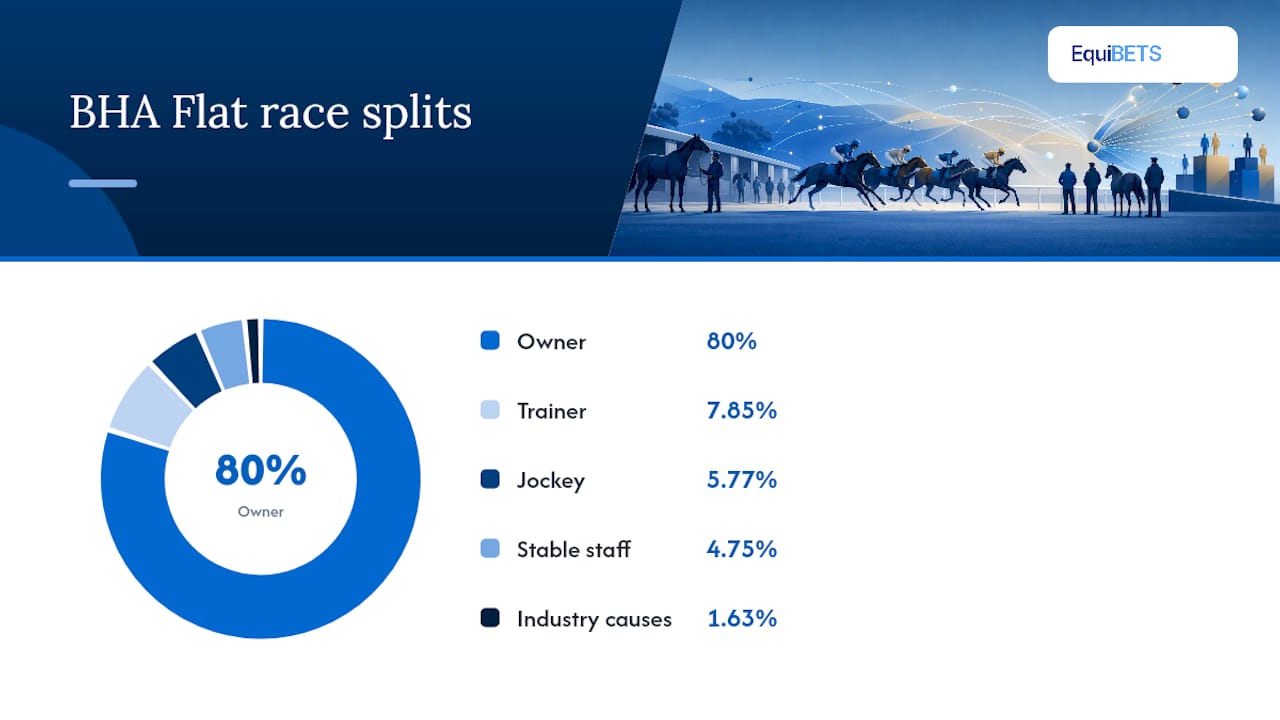
Those figures come straight from the BHA owners' toolkit, and they apply to the total prize fund, not to whatever is left after other costs. That distinction matters when you're explaining net figures to owners, because the announced TPF and the owner's actual bank receipt are two different numbers.
HRI's factbook illustrates why: after all standard deductions, Irish owners average a net share after deductions, noticeably lower than the headline percentage, trainers and riders have net shares somewhat below their headline percentages, well below the headline splits once pension contributions, agent fees, and administrative costs are stripped out.
Here's a worked example using a €10,000 TPF on a Flat race, applying BHA-style percentages:
- Owner gross share: €8,000 (80%)
- Trainer gross share: €785 (7.85%)
- Jockey gross share: €577 (5.77%)
- Stable staff share: €475 (4.75%)
- Industry causes: €163 (1.63%)
From the owner's €8,000, deduct any jockey agent fees, valet charges, or pension fund contributions before the net figure hits the owner's account. Trainer and jockey shares typically face their own deductions too, agent commissions on jockey fees are common and often invisible to owners unless you itemise them.
Pro Tip: Keep a running log of every secondary deduction (agent fees, valet charges, pension contributions) separate from the primary TPF split. Owners rarely query the big percentages, they query the small ones they didn't expect.
Syndicate distribution rules, set-offs, and timing
Syndicates carry extra complexity because prize money has to be shared pro-rata across members who may owe different amounts in unpaid fees. The BHA's rules on syndicate distribution require distributions to follow share percentages exactly, and permit managers to set off outstanding member fees against a member's entitlement before payment.
A syndicate agreement worth the paper it's printed on needs to include:
- Share percentage per member, stated precisely, not "roughly a tenth each"
- Bank account signatories and who can authorise a distribution
- Manager duties, including record-keeping and communication obligations
- A set-off clause explicitly authorising deduction of unpaid fees from winnings
- Dispute resolution procedure
- A distribution timetable, most yards run monthly
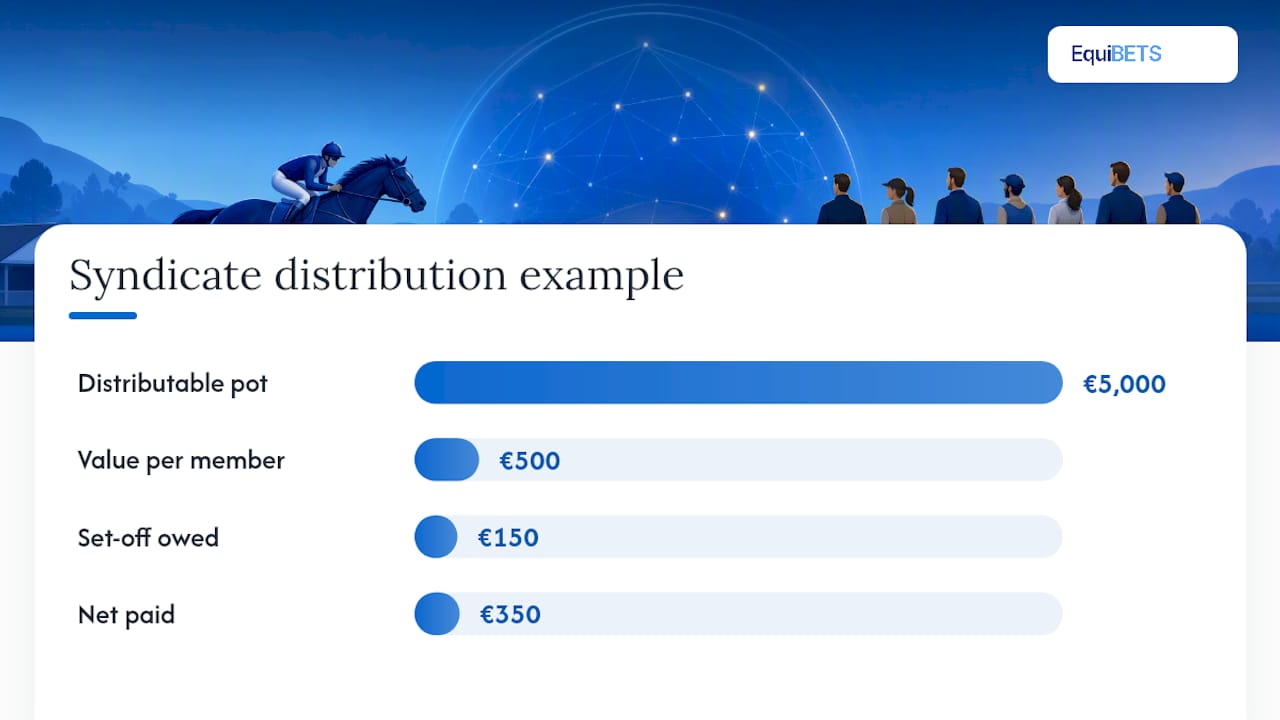
The pro-rata formula itself is straightforward: member share × total distributable pot ÷ total shares. If a syndicate holds 20 shares total and a member owns 2 shares, and the distributable pot after standard deductions is €5,000, that member is owed €500 before any set-off. If they owe €150 in unpaid monthly fees, you deduct it and pay €350, then note the set-off on their statement.
- Calculate the distributable pot after industry deductions
- Divide by total shares to find value per share
- Multiply by each member's shareholding
- Apply authorised set-offs
- Record the calculation and retain it for regulator review
Pro Tip: Save every pro-rata calculation as a dated spreadsheet, not a note on a whiteboard. The BHA can request proof of your distribution maths and payment timelines, and "I did it in my head" is not an acceptable answer.
Racing NSW's guidance mirrors this approach, requiring registered syndicates to distribute pro-rata with the same set-off authority for unpaid fees, alongside mandatory collection of each member's identification and bank details at registration.
Reporting prize money to owners with clear statements
An owner statement earns trust when it shows the whole journey from gross to net, not just a final number in a bank transfer.
Every statement should include:
- Gross prize amount and the race it relates to
- Regulatory and industry deductions applied
- Trainer, jockey and stable staff splits shown as line items
- Any set-offs applied and why
- Net payable amount and the payment date
Monthly distribution with digital statements works better than ad hoc payouts. Retain original race documentation and bank entries alongside each statement, industry commentary consistently points to itemised, transparent reporting as the single most effective way to reduce owner disputes.
An owner portal that generates these statements automatically, applies deduction templates consistently, and exports CSV records for audits removes most of the manual error risk. This is exactly the kind of workflow a platform like EquiBETS's stable manager tools is built to handle, tying race results directly to finance records.
Pro Tip: *Add one line at the bottom of every statement explaining any non-routine deduction in plain English.
Common causes of prize money disputes and how to prevent them
Most disputes trace back to a handful of repeat offenders: surprise set-offs nobody flagged in advance, unclear share records for syndicate members, distributions that run weeks late, missing bank evidence for a claimed payout, and verbal side-agreements nobody wrote down.
Prevention is mostly procedural, not clever:
- Get every syndicate agreement signed before the horse runs, not after a win
- Reconcile prize accounts against race results monthly, not quarterly
- Issue independent receipts for any payout above your yard's standard threshold
- Set a fixed internal trigger (say, any single payout over a defined amount) that automatically routes to professional review
Watch for red flags that need immediate escalation: a member disputing their shareholding percentage, a payment claim with no supporting bank record, or repeated late fee payments from a member who then queries a set-off.
When to bring in a solicitor, accountant or the racing authority
Escalate immediately when a payout is unusually large for your yard, when ownership itself is contested, when tax treatment is genuinely unclear, or when you suspect a regulator investigation is coming.
- Solicitor: ownership disputes, contested claims, syndicate agreement breaches
- Accountant: tax withholding questions, cross-border prize money, VAT treatment
- Racing authority: procedural compliance queries, distribution timeline disputes
Insurance and liability considerations for prize handling
Handling other people's money creates liability exposure most yards underinsure against. If a syndicate treasurer miscalculates a pro-rata split or misapplies a set-off, the yard can face a civil claim from the affected member, separate entirely from any BHA disciplinary action.
Professional indemnity cover for the person managing distributions is worth checking, particularly where a trainer or yard manager also acts as syndicate treasurer. Standard yard insurance rarely covers financial mismanagement claims, that's a different policy line entirely, and many operators discover the gap only after a dispute.
Cash handling itself carries risk too. Large prize payments sitting in a general operating account before distribution create exposure if the yard faces unrelated financial difficulty. A separate, clearly labelled syndicate or prize distribution account, required under Racing NSW's registration rules and good practice everywhere else, ring-fences those funds from the yard's own liabilities.
Bank signatory arrangements matter for liability too. A single signatory on a syndicate account concentrates both authority and risk in one person. Dual signatories or a documented approval step before any distribution reduces the chance of error, and gives you a paper trail if a member ever questions a payment.
Document retention has a liability dimension as well. If a claim arises two years after a distribution, your ability to defend the calculation depends entirely on whether you kept the original race documentation, bank entries and pro-rata working. Treat those records as insurance in themselves.
Handling disputes and appeals beyond the syndicate agreement
Not every dispute stays inside the syndicate agreement's own resolution clause. When a member disputes a regulator's own deduction or an official percentage applied by the racecourse, the syndicate agreement's internal process won't help, that's a matter for the racing authority itself.
The BHA and equivalent authorities in other jurisdictions maintain formal channels for querying a distribution calculation, and BHA rules explicitly give the authority power to request proof of how a syndicate arrived at its figures. If you're on the receiving end of a member complaint that escalates to the regulator, having your calculation documentation ready from day one is the difference between a quick resolution and a protracted investigation.
Appeals processes generally distinguish between disputing the regulator's own percentage splits, which are fixed and rarely open to appeal, and disputing how a syndicate or yard applied those splits, which is where most genuine grievances sit. Make that distinction clear to members early, because plenty of disputes start from a misunderstanding about which number is actually contestable.
Where a dispute involves a third party, an agent claiming an unpaid commission, or a former syndicate member disputing a historical share, mediation through the racing authority's own dispute mechanism is usually faster and cheaper than court. Most authorities require you to exhaust internal syndicate dispute resolution first, so a properly drafted agreement with a clear resolution clause isn't just good governance, it's often a procedural prerequisite before a regulator will hear an appeal at all.
Prize money's effect on other racing incentives and bonuses
Distribution decisions don't exist in isolation. Several bonus schemes, owner premium payments, and breeder incentive programs use recorded prize money totals as an eligibility threshold, so how and when you record a distribution can affect a horse's or owner's standing in schemes running alongside the standard prize structure.
Owner's premium schemes in several jurisdictions calculate bonus eligibility against a horse's cumulative prize money earned in a season or since registration. If your record-keeping lags behind actual distributions, or if you're inconsistent about whether a figure is recorded gross or net, you risk under-reporting a horse's earnings and disqualifying an owner from a bonus tier they'd otherwise qualify for.
Breeder and stallion incentive schemes work similarly, tracking progeny earnings against thresholds that trigger additional payments to breeders or stud farms. A delay in logging a distribution, or an error in which race's prize money gets attributed to which run, can throw off those calculations for parties who aren't even part of your yard's direct communication chain.
This is where accurate, timely record-keeping stops being just a compliance exercise and becomes something that protects other people's income too. Keep your prize money ledger current enough that it can support these external eligibility checks, not just your own distribution needs.
Accounting controls that keep your audit trail clean
Every distribution needs a paper trail that survives scrutiny months or years later, not just at the time of payment. That means matching three records for every payout: the racecourse or authority's payment confirmation, your bank statement entry, and your internal distribution calculation, all cross-referenced to the same race.
Segregation of duties helps more than most yards realise. The person calculating the distribution ideally shouldn't be the sole person authorising the bank transfer. Even in a small operation, a second set of eyes on the calculation before funds move catches the transposition errors that cause most disputes.
Reconcile your prize money account against race results monthly, not just when an owner asks. A simple spreadsheet comparing "races run" against "distributions issued" flags any prize money that arrived but never got processed, which happens more often than yards like to admit, particularly with smaller placed-horse payouts that don't trigger the same attention as a win.
Retain records for as long as your local racing authority's own query window requires, and longer if you're managing syndicates where a member might raise a historical question years later. Digital storage with dated, searchable entries beats a filing cabinet every time a regulator asks for evidence covering a specific race from eighteen months ago.
A practical note from the yard floor
Run distributions monthly, not whenever it's convenient. Owners forgive a modest payout far more readily than a delayed one, and a predictable cadence does more for retention than any single big cheque. The honest line to hold with owners is that prize money is variable, not a guaranteed return, and saying that plainly, early, and often heads off more disappointment than any spreadsheet.
How EquiBETS keeps prize distribution auditable
EquiBETS is built for yards that need to move from race result to owner statement without three separate spreadsheets and a prayer that nothing got missed. The owner portal generates itemised statements automatically, gross prize, deductions, net payable, all timestamped and archived without a manual export.

Finance tracking applies your standard deduction templates consistently across every horse and every race, so a jockey agent fee or a syndicate set-off never gets forgotten because someone was rushing before a distribution deadline. Syndicate templates handle the pro-rata maths and store the calculation for regulator review, and bank reconciliation exports mean your monthly audit trail is ready before anyone asks for it.
If you're still building owner statements manually, it's worth seeing what a dedicated stable manager platform does to that workload. Check the pricing page and start a trial to see how your next distribution cycle runs with the deduction maths already done for you.
Frequently asked questions
How is prize money distributed between owners, trainers and jockeys? Distribution follows fixed percentages of the total prize fund set by the relevant racing authority.
What's the difference between gross and net prize money for an owner? The gross figure is the owner's raw percentage of the announced total prize fund. The net figure is what actually lands in the owner's account after agent fees, pension contributions, and any syndicate set-offs are deducted, typically several percentage points lower.
How often should syndicates distribute prize money to members? Most professional syndicates run monthly distributions, aligned with fee collection cycles. This cadence lets managers apply set-offs for unpaid fees cleanly and keeps owner communication predictable.
Can a syndicate manager withhold a member's prize money for unpaid fees? Yes, provided the syndicate agreement explicitly authorises this set-off and the calculation is documented. BHA and Racing NSW rules both permit this practice when properly recorded.
What records should a yard keep for prize money audits? Retain original race documentation, bank receipt entries, distribution calculations, and owner statements for each payout, ideally in searchable digital form covering at least the period your racing authority's query window allows.
Sources
Keep these references bookmarked rather than relying on memory when a query comes in.
- Horse Racing Ireland Prize Money | Horse Racing Ireland
- Combined Syndicate registration update (Racing NSW)
Always confirm current figures with your own principal racing authority, splits and thresholds do get revised.