

A proper syndicate owner report covers three things: an itemised finance statement with three pro-forma outcomes, a plain-language performance summary with evidence attached, and a dated, exportable record for audits. The most reliable way to deliver all three is scheduled reporting through owner portal software, backed by downloadable finance exports. A purpose-built platform like EquiBETS handles this without a manager rebuilding a spreadsheet every month.
TL;DR:
- Consistent monthly reporting with attached source documents minimizes disputes and ensures transparency, especially when owners can access raw ledger data.
- Automated, scheduled reports via a dedicated platform like EquiBETS significantly reduce reconciliation time and manual errors compared to spreadsheet workflows.
- Including detailed finance, operational, and performance data with clear assumptions for multiple scenarios aligns owner expectations with actual results.
- Regulatory and tax reporting obligations vary depending on syndicate structure and offering type, requiring tailored, comprehensive documentation.
- Using software-first tools that ensure secure delivery, role-based access, and automatic backups supports compliance and operational efficiency.
Table of Contents
- What to include in every syndicate reporting horses update
- How do you build a monthly owner report step by step?
- Finance reporting: templates, calculations and disclosure best practice
- What performance metrics should you report to owners?
- Automating delivery, security and owner access
- Regulatory compliance and reporting standards specific to horse syndicates
- Legal considerations and ownership structure implications on reporting
- Tax reporting requirements and implications for syndicate members
- Practitioner perspective: why standardised, software-first reporting reduces disputes
- How EquiBETS puts this reporting playbook into practice
- Sources
What to include in every syndicate reporting horses update
Every routine report should follow the same skeleton, so owners know exactly where to look for what they need. Consistency is what separates a professional reporting on racehorses from one who fires off a different-looking email each month.
A well-built owner report typically has five parts:
- Owner summary: a short paragraph covering recent highlights, any incidents, and what's planned next.
- Finance snapshot: itemised costs for the period, distributions paid or owed, and the running balance.
- Operational log: workouts completed, vet treatments given, and any travel for races or trials.
- Attachments: invoices, vet notes, GPS ride files, or a short video clip if there's something worth seeing.
- Transparency signals: the assumptions behind any forward-looking numbers, and a note on how owners can pull the raw data themselves.
That last point gets skipped more often than it should. Owners who can see the underlying ledger, not just a summary figure, raise fewer disputes later. Syndicate owner transparency isn't a soft value add. It's a mechanical feature of the report structure itself.
Pro Tip: Attach the actual vet invoice PDF, not just a line item that says "veterinary $340." Owners trust a number less when they can't trace it back to a document.
How do you build a monthly owner report step by step?
The process is the same whether you're managing one horse or a dozen syndicate shares, and it works best when it's run in the same order every month.
- Collect and reconcile ledger entries. Pull every transaction for the period and attach the source invoice to each line. Anything without a matching document gets flagged, not guessed at.
- Compute per-owner splits. Apply each owner's percentage to net costs and distributions, then produce three pro-forma outcomes (a loss, a breakeven, and a modest-profit scenario) with the assumptions behind each one written down plainly.
- Summarise training and health data. Pick one trend, such as a workout time improving or a gait symmetry score, and present it as a single chart or a short bullet summary rather than a wall of numbers.
- Package and distribute. Export the report as a PDF, post it to the owner portal, and schedule a push notification so owners know it's landed. Read receipts confirm who's actually opened it.
- Archive it. Store a dated, exportable copy for accountants and for any future audit. This step gets forgotten constantly, and it's the one that saves a manager when a dispute lands months later.
Following this order matters more than the tools you use to do it. A manager working from spreadsheets can technically hit every step, but doing it manually every month is where errors creep in. This is where role-based software earns its keep. A customised syndicate portal built around this exact workflow has been shown to cut month-end reconciliation time significantly by centralising ownership records and attaching source documents automatically.
Finance reporting: templates, calculations and disclosure best practice
Owners judge a syndicate largely by whether the numbers add up and whether they can see how they were calculated. A finance statement template needs specific rows, not vague categories.
Include these fields at minimum: ownership percentage, capital contributions to date, expenses broken out by category (feed, farrier, vet, agistment, transport, race entries), prize money earned, management fees, and net distributions. Percentage splits get applied after held reserves or advances are deducted, and that deduction should be visible as its own line, not buried inside "other expenses."
- Calculate each owner's share by multiplying net distributable income by their ownership percentage, after reserves.
- Present three scenarios: a conservative loss case, a breakeven case, and a modest-profit case, with the assumptions for each spelled out in a sentence or two. Presenting three tiers this way is standard practice among syndicate accountants precisely because it stops owners reading a best-case number as a promise.
- Disclose related-party fees (if the manager or trainer earns a margin on services supplied to the syndicate), any transfer restrictions on selling a share, and where owners can access the original source documents.
- Keep an exportable CSV or PDF ledger ready for accountants, not just a locked internal spreadsheet.
Disclosure depth varies a lot depending on how the syndicate is structured and offered. Larger public-style offerings under Regulation A typically carry extensive offering circulars and ongoing reporting obligations, while smaller private placements under Reg D often disclose far less by default. Know which regime your syndicate falls under before setting owner expectations.
Project-based accounting, where purchase costs are separated from ongoing running costs and each owner has their own equity account reflecting their percentage, is standard advice from specialist syndicate accountants for exactly this reason.
What performance metrics should you report to owners?
Owners want proof, not just adjectives like "going well." The trick is picking a handful of metrics that actually mean something and presenting them consistently, rather than dumping every data point the yard collects.
- Workout summaries: date, distance, time, and a short rider or coach note. Flag anything unusual immediately rather than waiting for the monthly cycle.
- Vet log: a short condition note, the treatment given, and a realistic recovery timeline. Emergencies get flagged the moment they happen, not folded into the next scheduled report.
- Training analytics: show one clear trend, such as speed over a set distance or a gait symmetry score, rather than a dashboard of ten metrics nobody reads.
- Race readiness: upcoming entries, the target race, and the decision point for whether the horse actually runs.
Owners increasingly expect the kind of real-time, multimedia-backed updates that fractional ownership and micro-share platforms have normalised, including push alerts for vet updates and short workout clips rather than text-only summaries. A GPS map of a gallop or a fifteen-second clip does more to hold owner attention than another paragraph of prose ever will.
Automating delivery, security and owner access
Reporting on racehorses at scale breaks down fast if a manager is manually emailing PDFs to a dozen owners across every horse in the yard. Automation is what makes standardised reporting sustainable past two or three syndicates.
- Schedule monthly reports and push notifications so owners get updates on a predictable cadence, with immediate alerts carved out separately for veterinary emergencies.
- Use role-based permissions and secured manager access so owners see their own horse's data and nothing they shouldn't.
- Confirm delivery with read receipts, so a manager knows a report actually landed rather than assuming it did.
- Give field staff offline access for updates from the float or the property boundary where signal drops out, and keep an exportable audit trail for every report generated.
- Export CSV or PDF files for accountants on request, and keep backups that don't live solely on one laptop.
Pro Tip: Encrypt attachments at rest and set backups to run automatically. A lost vet report during a dispute is far worse than a slow month of training.
Regulatory compliance and reporting standards specific to horse syndicates
Regulatory expectations for horse syndicate reporting come mostly from securities law where a syndicate share qualifies as an investment offering, and from state or national racing authority rules governing ownership registration. The two overlap but aren't the same thing, and managers who conflate them tend to under-disclose on one side or the other.
On the securities side, the offering structure sets the bar. A syndicate marketed broadly, with shares sold to the public under a Regulation A style offering, typically carries a detailed offering circular and ongoing reporting obligations that a small private placement under Reg D doesn't require. That difference in disclosure depth is not a technicality. It determines what a manager is legally required to hand owners versus what's simply good practice.
Racing authority rules run alongside this. Most jurisdictions require registered ownership details, transfer notifications, and prize money distribution records to be lodged with the relevant racing body, separate from anything owners see in a private report. A syndicate manager needs both trails in order, and they rarely live in the same document.
Because rules differ by jurisdiction and by offering type, a manager should confirm the specific registration and disclosure obligations that apply to their syndicate's structure and location rather than assume one template fits every setup. Building reporting software around the strictest likely requirement, rather than the loosest, tends to save a lot of retrofitting later.
Legal considerations and ownership structure implications on reporting
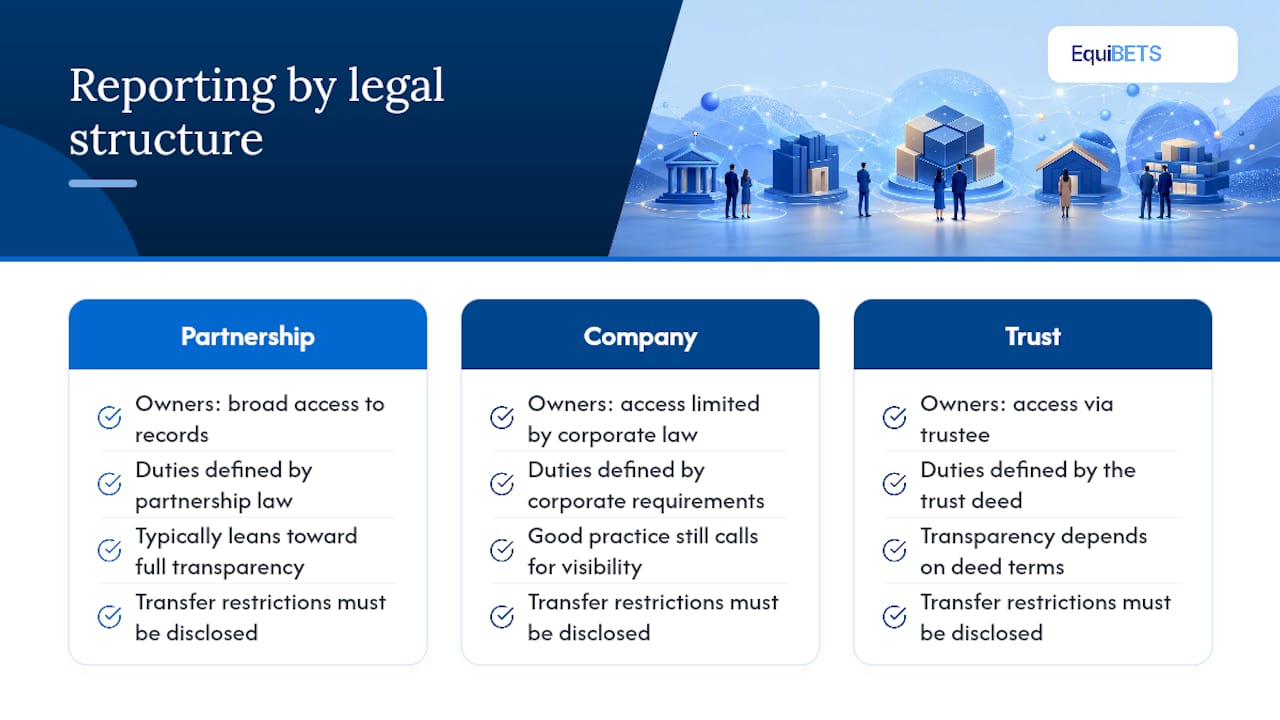
How a syndicate is legally structured decides what a manager is obligated to report and to whom. A partnership, a company, and a trust each carry different disclosure defaults, and the paperwork owners are entitled to see shifts accordingly.
In a straightforward partnership structure, owners typically have a broad right to see the partnership's financial records, which pushes naturally toward full transparency. A company structure, by contrast, may limit formal reporting to what's required under corporate law, even though good practice still calls for the same level of owner visibility. Trust structures add another layer again, with a trustee's reporting duties often set out in the trust deed itself rather than by general convention.
The ownership agreement is where most of this gets decided in practice, not the general structure type. A syndicate agreement should specify reporting frequency, the format reports take, what happens on a ownership transfer, and how disputes over reported figures get resolved. Vague or missing terms here are where disagreements escalate, because owners and managers each default to their own assumption about what "regular updates" means.
Transfer restrictions matter for reporting too. If a share can't be sold without manager approval, or carries a right-of-first-refusal clause, that restriction needs to be stated plainly in reporting material rather than discovered by an owner trying to exit. Getting legal advice specific to the syndicate's actual structure, rather than relying on a generic template, is worth doing once at formation rather than repeatedly during a dispute.
Tax reporting requirements and implications for syndicate members
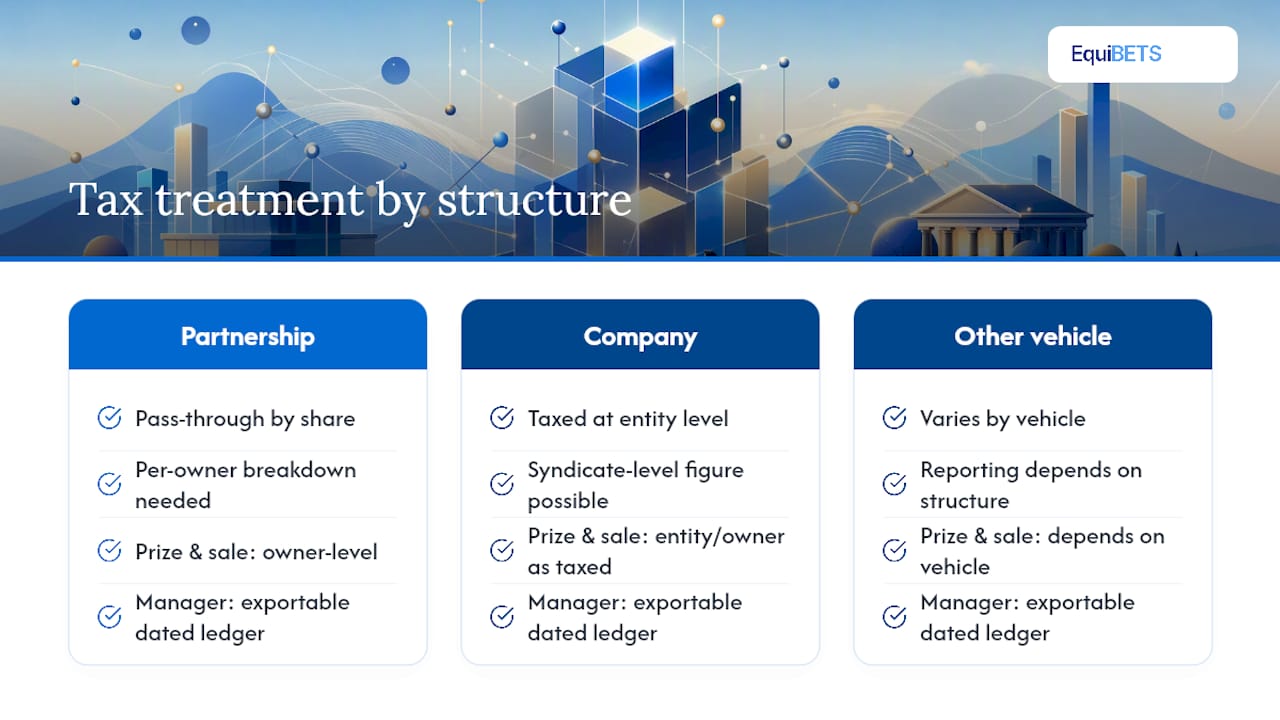
Shared ownership structures create tax obligations that differ meaningfully depending on whether the syndicate operates as a partnership, a company, or another vehicle, and a manager's reporting needs to reflect whichever applies. Clear agreements and accurate financial records are essential precisely because income, expenses, and any capital gain or loss need to be allocated to each owner consistently with how the structure is taxed.
In most partnership-style syndicates, income and deductible expenses pass through to individual owners in proportion to their share, meaning each owner needs their own breakdown for their personal tax return rather than a single syndicate-level figure. Prize money, and any gain on selling a share, generally needs to be reported at the individual owner level too, which is exactly why a per-owner distribution ledger matters more than a single syndicate total.
Deductibility of training fees, vet costs, and other running expenses depends heavily on jurisdiction and on whether the ownership is treated as a hobby, an investment, or a business activity for tax purposes. That distinction isn't something a manager should guess at inside an owner report. It's something each owner's own accountant needs to confirm for their specific situation.
What a manager can control is the quality of the records supporting that work: keeping a clean, dated, exportable ledger that separates capital costs from running costs, and that maps cleanly to each owner's percentage. Syndicate members should always be pointed toward their own tax adviser for filing decisions, but they should never be short of the documentation needed to make that filing accurately.
Practitioner perspective: why standardised, software-first reporting reduces disputes
Most disputes between owners and managers aren't about money lost. They're about a number nobody can explain six weeks after the fact. Structured reporting fixes that by making every figure traceable back to a document, which shortens dispute timelines because there's nothing left to argue about once the invoice is attached.
The operational payoff is easy to underestimate: fewer ad-hoc "what's this charge?" emails, faster distribution payments because owners aren't withholding sign-off, and a cleaner handover if a syndicate changes managers mid-season. The governance fix is simple. Name one person as the reporting owner, date every attachment, and review your pro-forma assumptions every quarter rather than letting last year's guess quietly become this year's fact.
— isaac
How EquiBETS puts this reporting playbook into practice
Everything covered above, scheduled reports, itemised finance exports, performance summaries, secure delivery, maps directly onto what EquiBETS was built to do for syndicate managers.

A typical month looks like this: generate the report inside the stable manager module, pull GPS ride clips and vet notes in automatically, attach the relevant invoices, then push it to the owner portal on a schedule with read receipts confirming who's opened it. Finance exports go out as CSV or PDF for the accountant without anyone rebuilding a spreadsheet from scratch. The same platform handles feed and nutrition tracking through its nutrition analysis tools, so a training trend and a feed change sit in the same record instead of two disconnected systems.
If you're running syndicate updates through email threads and spreadsheets right now, the fastest way to see the difference is to start a trial and generate one real monthly report through the platform. Most managers know within a single reporting cycle whether it saves the hours they think it will.
Sources
- Thoroughbred Daily News
- RacehorseOwnership101 — What is a syndicate prospectus?
- Streets Bloodstock — How shared ownership structures affect tax and financial reporting
- PKTechie — Horse syndicate portal case study