

Owner billing transparency means every horse owner can see a live, itemised ledger for their horse, whatever they were charged for, whether it's paid, and how any adjustment was reached, without ringing the office to ask. Your owner portal or invoice has to show that at a glance: itemised charges, current payment status, and a downloadable receipt trail. The detail of exactly which fields and what timing sits below, but that's the baseline.
TL;DR:
- Digital owner portals should display detailed, itemized charges for each horse, including metadata like invoice number, billing period, and payment status.
- Owners benefit from instant access to downloadable invoices and receipts, along with automated notifications for new, pending, or paid bills.
- Response to billing disputes must be logged, evidence attached, and resolved within 7 to 14 days, with clear labels for adjustments and credits.
- Moving beyond paper systems to purpose-built platforms reduces missing charges, speeds up payments, and simplifies reconciliation as yard volume increases.
- Implementing real-time balance visibility and offline forms ensures charges and receipts are accurate, consistent, and accessible regardless of connectivity.
Table of Contents
- What owner billing transparency looks like in practice
- Exact line items and invoice fields to show
- How owner portals should display charges, receipts and payment status
- Dispute handling and reconciliation: turning billing queries into a routine process
- Practical implementation checklist for yards
- What I've seen work in real yards
- Where a purpose-built platform fits
- Sources
- FAQ
What owner billing transparency looks like in practice
This applies to invoicing and owner portals specifically. It's not about your bookkeeping software choice or how you run payroll. It's about what the owner sees when they log in or open an email attachment.
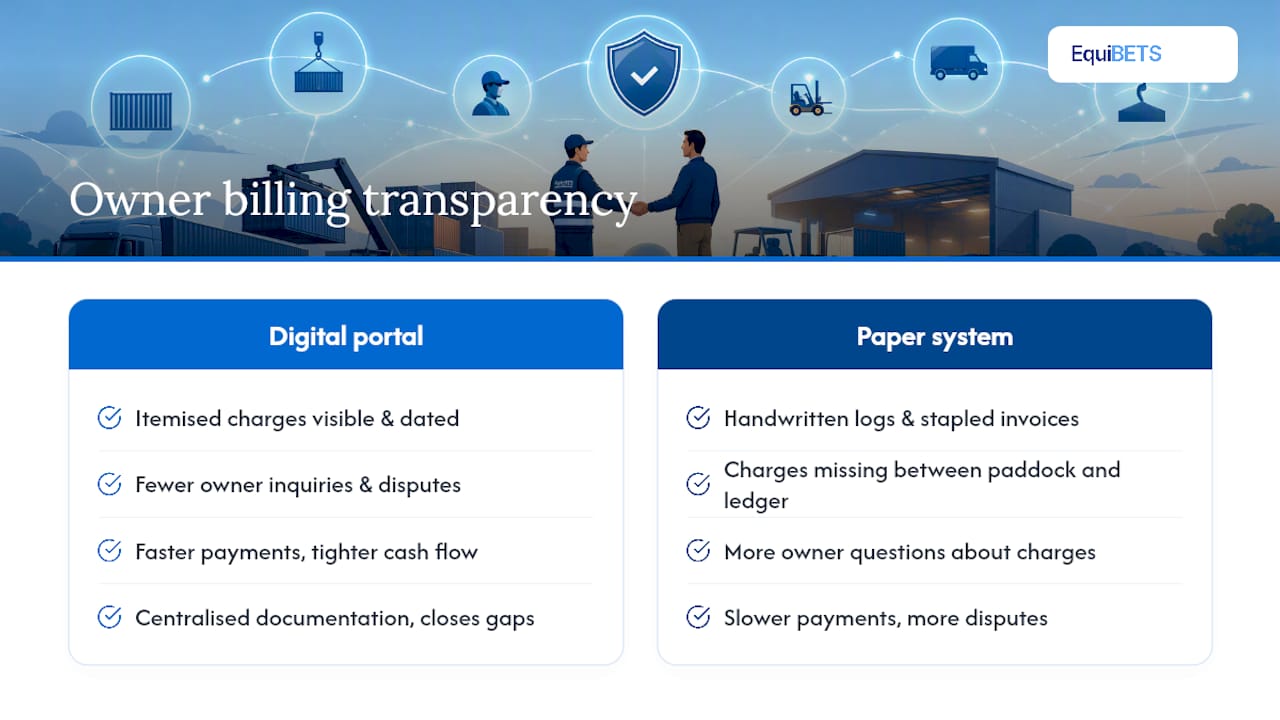
Get it right and the operational payoff is immediate. Owners who can see exactly what a lameness workup cost, and when it was billed, stop emailing to ask "what's this $340 charge?" Yards running clear, itemised portals report fewer disputes and faster payment, because owners aren't waiting on a phone call to understand their bill before they'll pay it. Cash flow tightens up when there's nothing to argue about.
The alternative is the paper-and-spreadsheet model still running in a lot of yards: a handwritten feed log, a farrier invoice stapled to a training diary, and a monthly total typed up by whoever had time. Charges go missing between the paddock and the ledger. Digital billing centralises documentation and closes those gaps that paper systems create almost by design, because every transition from notebook to invoice is a chance for a charge to disappear. Once volume grows past a handful of horses, that gap becomes expensive.
Exact line items and invoice fields to show
An itemised invoice needs to answer one question without follow up: what am I paying for, and why. That means breaking every charge into its own line rather than bundling everything into "monthly care."
Standard line items every owner invoice should carry:
- Board — daily or monthly agistment/livery rate, stated separately from add ons
- Training — sessions logged by date, trainer, and duration where relevant
- Feed and supplements — itemised separately from board, especially for special diets
- Veterinary — call out fee, treatment, medication, itemised per visit
- Farrier — trim, shoe, remedial work, dated to the visit
- Transport — float hire, fuel levy, driver time for competition or clinic runs
- Lessons — per session or package, with instructor name
- Sundries — rugs, supplements bought on the owner's behalf, one off purchases
Adjustments deserve their own visible line, not a silent edit to a total. If you're crediting a missed lesson or discounting a package, label it exactly ("Credit: lesson cancelled 14 March, staff illness") rather than just changing the number. An owner who sees an unexplained lower total trusts the invoice less than one who sees the original charge and the credit sitting side by side.
Every invoice also needs metadata that most paper systems skip: an invoice number, the billing period it covers, a horse identifier (especially important once an owner has more than one horse on the books), owner contact details, a due date, and a payment status flag. Miss any of these and you're the one fielding the "which horse is this for?" email.
How owner portals should display charges, receipts and payment status
A portal that just replicates a PDF invoice online isn't doing its job. Owners need a dashboard, not a filing cabinet.
At minimum, an owner logging in should see:
- Current account balance, front and centre
- A per horse ledger, if they have more than one on the books
- Downloadable invoice PDFs for every billing period, not just the current one
- Recent payment receipts, timestamped
- Scheduled or upcoming invoices, so nothing arrives as a surprise
Notifications matter as much as the dashboard itself. Owners should get an alert when a new invoice is issued, a reminder before something goes overdue, and a confirmation the moment a payment clears. Owner facing portals with automated billing and mobile access cut down the back and forth that eats into a stable manager's day, because owners stop needing to ask what they already have visibility into.
Rural yards can't assume constant connectivity. If your portal or app doesn't work offline, staff will fall back to paper the moment reception drops, and that's exactly where charges get lost. A platform with offline forms and mobile receipt capture means a farrier bill entered paddockside on a phone still makes it onto the invoice, signal or no signal.

Pro Tip: Give owners a downloadable, dated PDF for every invoice, not just a live web view. When a dispute comes up six months later, a PDF with a timestamp is far easier to point to than a portal screen that's since been updated.
Dispute handling and reconciliation: turning billing queries into a routine process
Every yard gets billing queries. What separates a transparent operation from a defensive one is having a process the owner can see working, rather than a manager fielding it ad hoc over text.
- Log the query the moment it lands. Note the date, the horse, the specific line item in question, and who raised it.
- Pull the evidence. That's the invoice, any attached vet or farrier receipt, and staff notes from the day the charge occurred.
- Attach everything to the invoice record. Notes and evidence stored against the original invoice, not in a separate email thread, are what create an audit trail an owner (or an accountant) can follow later.
- Respond within 48 hours, even if the answer is "still checking." Silence is what turns a question into a complaint.
- Resolve or escalate within 7 to 14 days. Setting a clear timeline and communication channel stops a billing question drifting into a trust problem.
If the resolution involves a credit or adjustment, label it on the invoice exactly as described earlier, don't just quietly amend the total. An owner who watches a dispute get logged, evidenced, and closed out on paper trusts the next invoice more than one who never sees the process at all.
Practical implementation checklist for yards
You don't need to rebuild your whole billing system this week. Sequence it.
- This week: standardise your line item labels across every invoice template, and require the metadata fields, invoice number, billing period, horse ID, due date, and payment status, on every bill you send.
- This month: turn on PDF downloads and receipt access if your current system supports it, even if you're not yet on a full owner portal.
- Next quarter: move to an owner portal with automated charge capture, integrated payment processing, and staff trained on entering charges as they happen rather than at month end.
- Ongoing: track your dispute rate, average days to payment, and owner satisfaction. If disputes drop and payment speeds up after each change, you know the transparency work is paying for itself.
Paper systems can hold up at very small scale, but every horse you add past that point is another chance for a charge to fall through the cracks.
What I've seen work in real yards
Owner portals earn their keep the first month a yard runs them, not eventually. The pattern is consistent: once owners can see a per horse ledger and a downloadable invoice themselves, the volume of "what's this charge" calls drops sharply, and the manager's week opens up for actual horse work instead of account queries.
The overlooked part is the audit trail. Most yards think about billing transparency as a display problem, showing the owner a nice invoice, when the real trust builder is what happens after a dispute. An owner who's watched one query get logged, evidenced, and resolved with a paper trail believes every invoice after that. Clear, boundaried communication does more for owner retention than any cosmetic redesign of the invoice itself.
Field reliability matters more than most software reviews give it credit for. A charge capture tool that fails the moment a paddock has no signal isn't transparent, it's just delayed and easy to lose.
— isaac
Where a purpose-built platform fits
Building all of this from a spreadsheet and a payment link is possible, but it's slow, and every manual step is another place a charge or a receipt goes missing. EquiBETS is built specifically for yards running the checklist above: owner portals with real-time balance visibility, finance tracking that itemises charges as they're entered, offline forms so a farrier bill logged paddockside still lands on the invoice, and an audit trail attached to every adjustment.

The Stable Manager feature set covers the portal, receipts, and payment status display owners expect, without you having to stitch three separate tools together. If you're weighing whether the switch pays for itself, the AUD calculator guide walks through the ROI math for yards moving off paper or spreadsheets. Start a trial and run your next billing cycle through it before you commit to anything.
Sources
- Paper vs Digital Billing in Equine Practices: 4 Critical Differences
- Horse Stable Operations and Digital Transformation 2026
- Effective client communication for barn managers
FAQ
What Is Owner Billing Transparency?
It's a visible, itemised ledger and invoice for each horse, shown through an owner portal or invoice, that lets an owner see every charge, payment, and adjustment without contacting the office.
What Line Items Should an Owner Invoice Include?
Board, training, feed and supplements, veterinary, farrier, transport, lessons, and sundries, each as a separate line, plus invoice metadata like invoice number, billing period, horse ID, and payment status.
How Quickly Should a Yard Respond to a Billing Dispute?
Acknowledge within 48 hours and aim to resolve or escalate within 7 to 14 days, a timeline drawn from established equine client communication practice.
Can EquiBETS Show Owners Their Payment Status in Real Time?
Yes. EquiBETS provides owner portals with finance tracking, downloadable invoices, and offline charge capture, so owners can see current balance and payment status without waiting on the office.
Do Small Yards Need a Digital Owner Portal?
Paper billing can work at very low horse volume, but as caseload grows, digital systems capture charges more consistently and make reconciliation far less time consuming.