
Weigh what you offer, weigh what's left, do it for seven days straight, and you'll have a wastage percentage that tells you exactly where your feed budget is leaking. That single number usually justifies whether a feeder purchase pays for itself inside a year. All you need to start today is a platform or hook scale and a notebook or spreadsheet.
TL;DR:
- Tracking feed wastage over seven days helps identify whether issues stem from containment, management, or a horse's health, guiding targeted solutions.
- Proper measurement of offered feed and leftovers requires weighing each portion and orts consistently, with multiple staff rotations to ensure accuracy.
- Using feeders with tighter openings can significantly reduce wastage, but payback periods can be as short as nine to twelve months depending on hay costs and herd size.
- Monitoring wastage percentage and estimated intake against bodyweight benchmarks allows early detection of ration or management issues before condition decline.
- Implementing a data-driven approach with centralized logging and KPI dashboards enables precise identification of wastage causes and maximizes return on investment in feeders.
Table of Contents
- Why feed wastage tracking matters for your budget and your horses
- How do you measure feed offered versus leftovers?
- Which feeder designs actually cut wastage, and do they pay for themselves?
- What KPIs should you track once you have baseline data?
- Building a checklist staff can actually follow
- A 7-day baseline protocol you can copy into a spreadsheet
- Measure first, buy later: how software fits the picture
- How EquiBETS turns feeding logs into a wastage report
- Where to read more on hay waste and feeder research
- Sources
Why feed wastage tracking matters for your budget and your horses
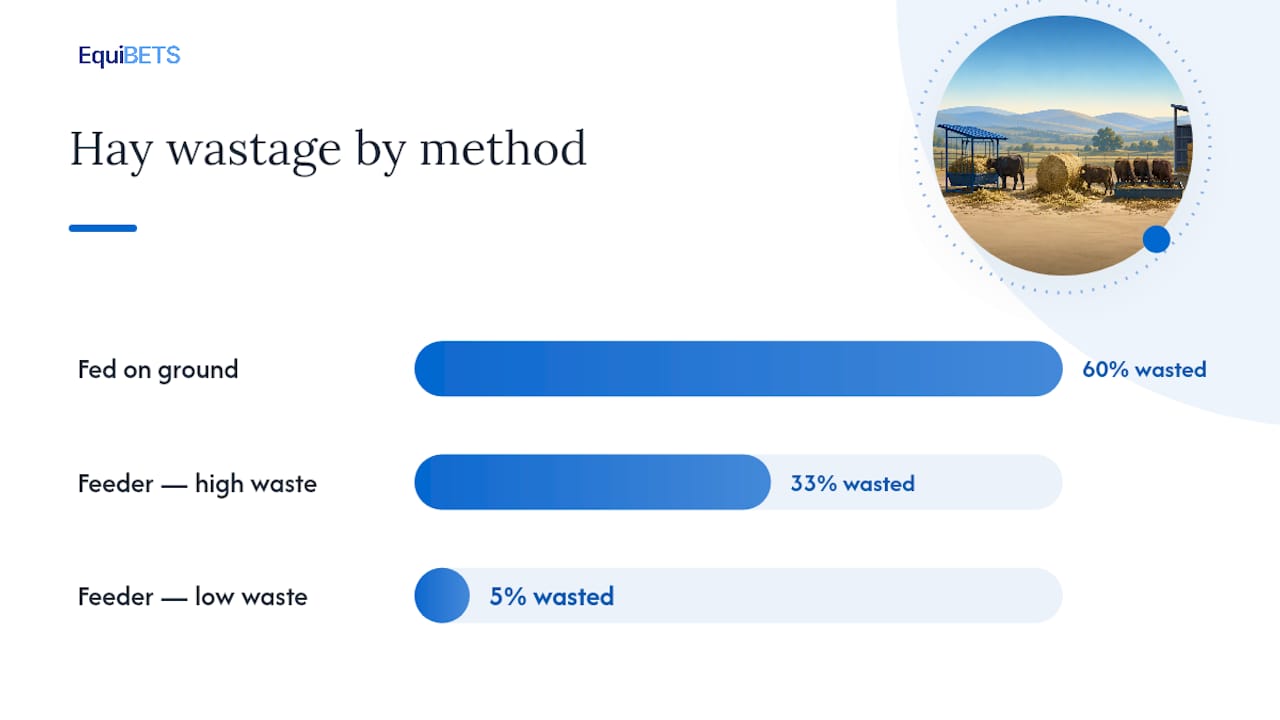
Hay fed on the ground without any containment can waste close to 60% of what you put down, according to Penn State Extension. Switch to a feeder and that figure drops to somewhere between 5% and 33%, depending on the design. On a yard running multiple horses through a Queensland or Victorian winter, that gap between "wasted on the ground" and "eaten" represents real tonnage, not a rounding error.
The financial case writes itself once you see the numbers, but the nutritional case matters just as much. Horses on restricted or fortified diets need the ration they're given, not 70% of it. If forage or a supplement is routinely trampled, soiled or blown away before a horse gets to it, you can correct a feed chart perfectly and still watch a horse drop condition. Wastage isn't just an efficiency problem. It's a silent variable in every ration calculation you make, and you can't fix a variable you haven't measured. Before spending on new feeders, mats or nets, get the baseline number first. It tells you whether you have a containment problem, a management problem, or a horse that needs a vet.
How do you measure feed offered versus leftovers?
Reproducible numbers come from a fixed process, not a guess at what's left in the corner of a stall. Here's the method:
- Weigh every flake or portion before it goes in. Use a platform scale for whole bales or hook scale for flakes and buckets, and tare your container or hay net first so you're not weighing plastic.
- Collect all leftovers (orts) before the next feed. In stalls, that's straightforward. In paddocks or dry lots, mark a collection radius and pick up loose hay before it's trampled into mud or mixed with manure.
- Weigh the orts separately from the feed offered. Never estimate by eye. A double handful of hay looks similar whether it's 200 grams or 800 grams.
- Run this for seven consecutive days minimum. One day tells you nothing. A week smooths out normal variation like appetite dips or a windy afternoon that blew hay into the yard.
- Sample every horse in a group-fed paddock on a rotation, not just the easy ones near the gate. Dominant horses can skew intake patterns that a partial sample will miss.
For concentrates, weigh feed into the bucket at the same point each time and use rack pans or a lipped tub to catch spillage. Grain bags reduce loss further when feeding in wind or on a slope.
Collect orts before you refeed and label the sample by horse or feeder location. Bedding, soil, or manure mixed into a sample inflates the apparent wastage and skews the whole baseline, a detail worth confirming with staff before day one.
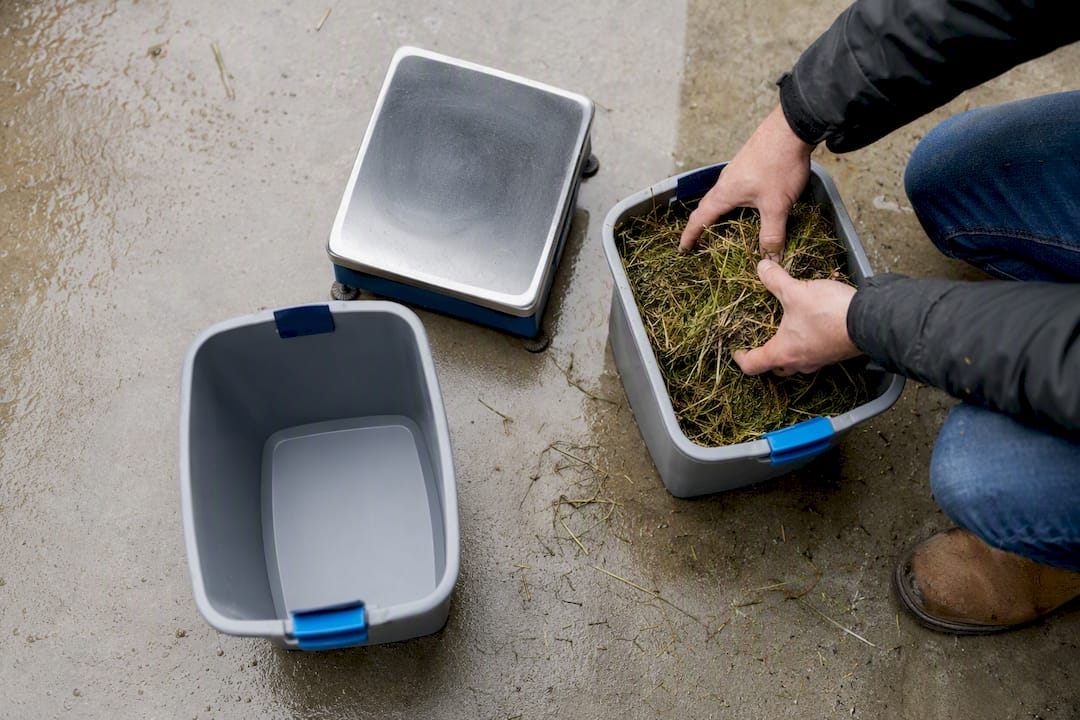
Pro Tip: Keep a spare tared bucket at each feeding point. Staff waste more time hunting for a scale than they do weighing feed, and a missing tool is the fastest way a 7-day baseline turns into a 3-day baseline.
Which feeder designs actually cut wastage, and do they pay for themselves?
Feeder design is the single biggest lever after containment itself, and the research on this is specific rather than vague. A University of Minnesota study using small square bales found:
- No feeder: 13% mean hay waste
- Hayrack: 5% waste
- Basket feeder: 3% waste
- Slat feeder: 1% waste
The same study estimated payback periods of roughly 9 to 12 months for many feeder types, depending on hay price and herd size. That's a fast return by any capital equipment standard, but the raw percentage isn't the whole story. Feeders with tight openings can trigger guarding behaviour in dominant horses, turning a group-feeding problem into a safety issue. Some designs are harder to muck out, which adds labour minutes that don't show up in a wastage spreadsheet but do show up in a wages bill.
Run your own payback sum using actual numbers. Say your yard uses a significant amount of hay annually, and ground feeding wastes far more compared to using a hayrack. That difference on the annual hay spend translates into substantial savings. A hayrack that costs $600 per stall pays for itself well inside twelve months, which lines up with the Penn State Extension guidance to calculate ROI on the yard's real annual usage rather than a single bale's worth of anecdote.
What KPIs should you track once you have baseline data?
Two formulas turn raw weights into numbers you can act on. Hay wastage percentage:
HW% = HW ÷ (HF − O)
Where HW is hay wasted (kg), HF is hay fed (kg), and O is orts collected separately from the wasted feed (used when your protocol separates "refused but clean" from "trampled and spoiled"). Estimated hay intake follows as:
EHI = HF − (O + HW)
Once you've got a wastage percentage, check it against a rough bodyweight benchmark: horses typically need forage intake around 1.5% to 2% of bodyweight daily. If your EHI sits well under that band and the horse's body condition score is dropping, wastage or ration size is the more likely culprit than metabolism, though a vet should confirm before you change the diet further.
| KPI | Healthy range | Action trigger |
|---|---|---|
| Hay wastage % | 5% to 33% | Above 15% for 3+ days |
| Estimated intake vs bodyweight | 1.5–2% | Below 1.5% sustained |
| Concentrate spillage | Under 5% | Around 13% |
| Body condition score trend | Stable or rising | Two consecutive drops |
A Mad Barn recommendation worth following here: weigh both sides of the equation, offered and leftover, every time. Estimating either number breaks the formula and every KPI built on it.
Building a checklist staff can actually follow
Data quality lives or dies on staff consistency, so the checklist has to be short enough that nobody skips steps on a busy morning.
Daily:
- Weigh and record feed offered per horse or group before turnout.
- Collect, weigh and label orts before the next feed.
- Note anomalies: weather, a new horse in the paddock, a feeder knocked over.
- Clean the scale and container between horses to avoid cross-contamination.
Weekly:
- Compile daily entries into the wastage percentage formula.
- A senior manager or nutritionist signs off the KPI sheet and flags outliers.
- Retrain any staff member whose entries show gaps or inconsistent taring.
Feeding frequency itself affects the numbers. Guidance from New Mexico State University notes that smaller, more frequent portions reduce trampling and contamination compared to one large daily feed, which is worth testing if your baseline wastage comes in high on the first pass.
Pro Tip: Rotate who does the weighing across the week rather than always assigning it to the same person. It exposes technique gaps fast and stops one staff member's habits from silently becoming your entire dataset.
A 7-day baseline protocol you can copy into a spreadsheet
Set up columns for: date, horse ID, bodyweight, feed offered (kg), orts collected (kg), feeder type, weather, and a free-text notes field for anything unusual.
Scale the same sheet across a herd by adding a paddock or barn identifier column, then export the weekly totals for your nutritionist or for an equine nutrition analysis if intake looks consistently low against bodyweight targets.
Measure first, buy later: how software fits the picture
Buying a feeder before you've measured anything is a guess dressed up as a solution. A data-first approach tells you whether the problem is containment, portion size, or a horse that needs veterinary attention, and it stops capital going toward the wrong fix. Yard-management platforms earn their place here by centralising feeding records, KPI dashboards and nutrition analysis in one workspace instead of three disconnected notebooks. A yard that measures 15% ground-feeding wastage, switches to a slat feeder, and remeasures at 2% has a payback case built on its own numbers, not a sales brochure.
— isaac
How EquiBETS turns feeding logs into a wastage report
A practical next step once you've proven wastage is worth fixing is to use a centralized platform that provides a single place to log feed offered, orts and feeder type per horse, then rolls it straight into KPI reports without anyone re-typing numbers into Excel on a Sunday night.

Feeding records logged in the app connect directly to equine nutrition analysis, so a wastage trend on one horse can trigger a ration review without waiting for the next paddock walk. The stable manager module handles the day-to-day staff workflow, including the daily and weekly capture routine covered above, and works offline for yards where the shed has no signal. If you're ready to see what a week of real data looks like on your own horses, start a trial through the EquiBETS platform and run your first 7-day baseline this week.
Where to read more on hay waste and feeder research
For deeper reading beyond this protocol: the Penn State Extension and University of Minnesota studies cover feeder design testing in detail, while TheHorse covers when to involve a vet.
Sources
- Hay feeders and the potential to reduce hay waste — Penn State Extension
- Maximizing equine forage utilization through reduction of hay waste — University of Minnesota study
- Reducing hay waste — Mad Barn