
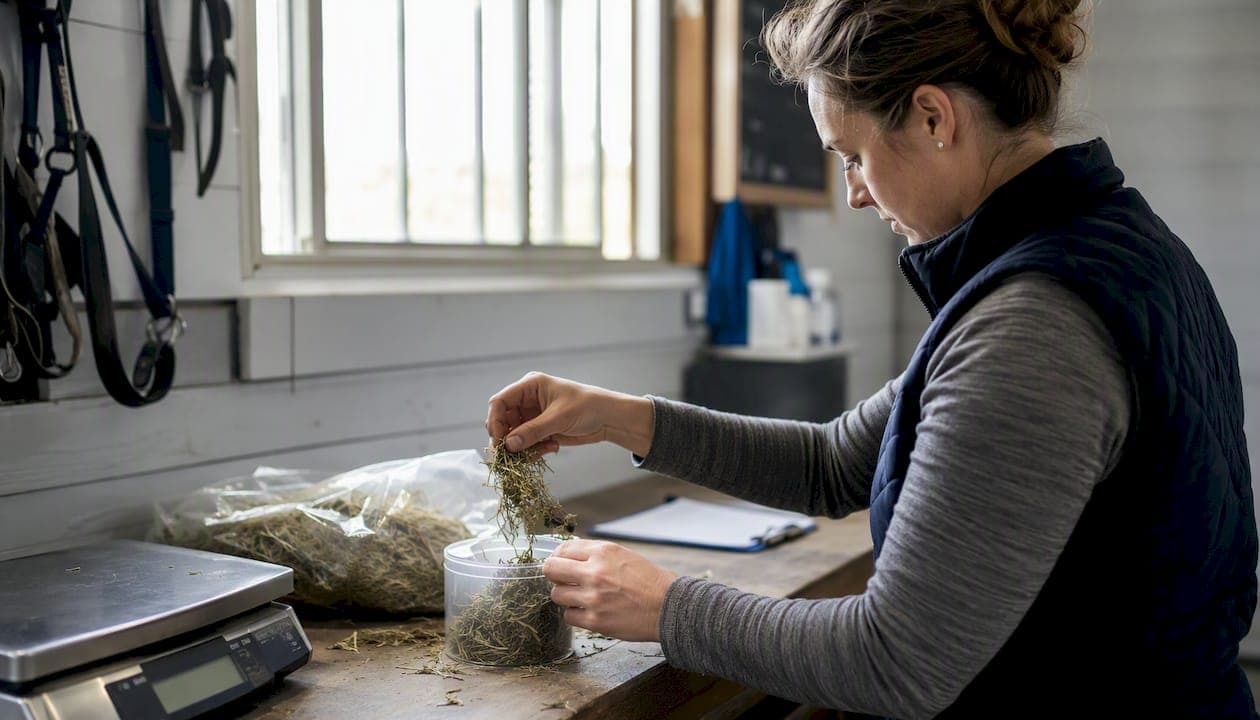
Non-structural carbohydrates (NSC) in horse feed are calculated as starch + water-soluble carbohydrates (WSC). That single formula is the number you need on every hay analysis and feed label. For metabolic horses — those with equine metabolic syndrome (EMS), insulin dysregulation, or a history of laminitis — ACVIM-aligned guidance recommends keeping total diet NSC below 10–12%. Healthy, working horses can tolerate moderate NSC levels of roughly 10–20%, depending on workload and body condition.
What to look for at a glance:
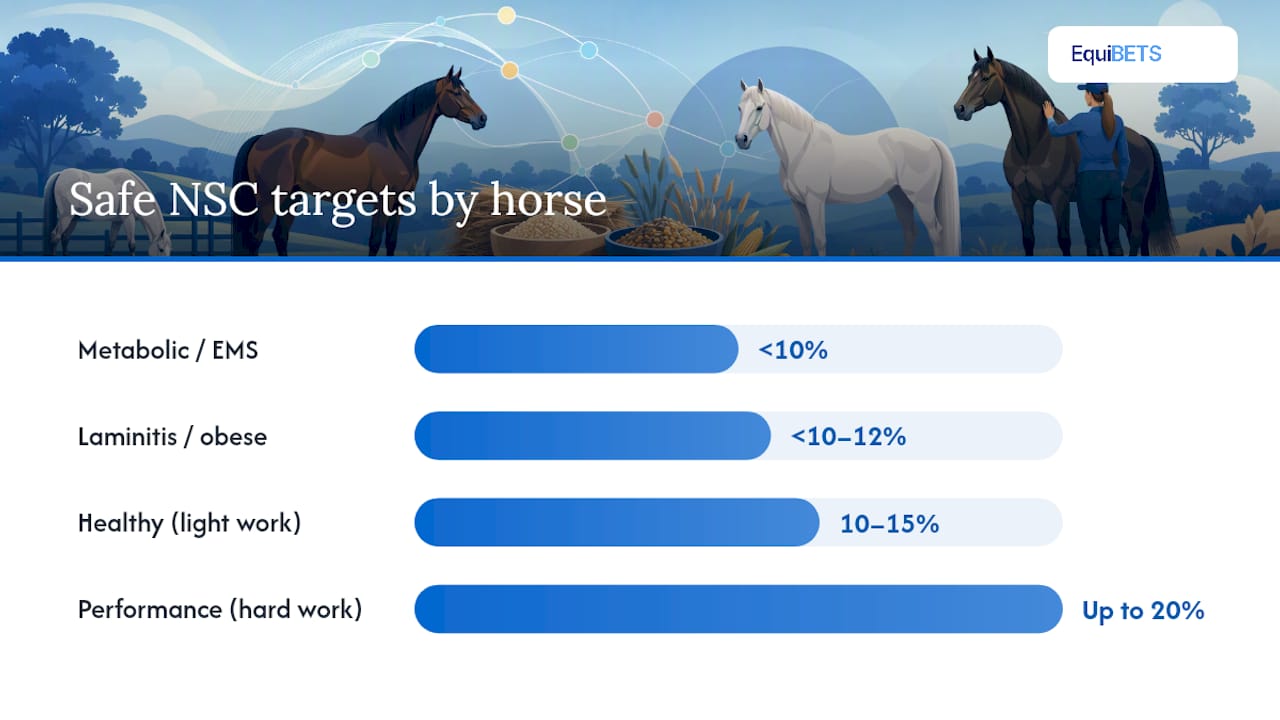
- Metabolic/laminitis-prone horses: target total diet NSC below 10%, with some severely insulin-dysregulated horses possibly needing much lower intake
- Healthy horses in light to moderate work: 10–15% NSC is generally well tolerated
- Performance horses in hard work: up to 20% NSC is often acceptable, with forage as the base
To calculate NSC from a lab report, find the WSC column and the starch column, then add them: NSC (%) = WSC (%) + Starch (%). If the report shows ESC instead of WSC, note that ESC understates NSC for forages because it misses some fructans — more on that distinction below.
Key takeaways
| Point | Details |
|---|---|
| Test every hay lot | Lab testing is the only reliable way to know NSC; request WSC and starch assays, not just ESC. |
| Use the right formula | NSC = WSC + starch; ESC + starch understates NSC in grass forages and can give a false sense of safety. |
| Count grams, not just percentage | Total grams of NSC per meal per kg bodyweight determines insulin response — a low-% hay fed in bulk can still exceed safe thresholds. |
| Manage pasture timing | Graze in early morning; avoid frost-affected or stressed pasture when NSC accumulates highest. |
| Consult vet and nutritionist | Recurring laminitis, unexplained weight gain, or muscle stiffness warrant professional assessment before dietary changes alone. |
| Equibets for record-keeping | Equibets logs lab results, feeding histories, and grazing schedules in one platform to help yards spot NSC-related patterns early. |
Table of Contents
- What NSC in horse feed actually comprises
- Safe NSC targets for different horses
- How to read a feed label and calculate NSC per meal
- How to test hay and pasture for NSC
- Practical ways to lower NSC intake
- Health risks from high NSC and when to call a vet
- Tools that help with NSC calculation and diet planning
- A practitioner's view on managing NSC day to day
- How Equibets supports NSC tracking and diet management
- Sources
What NSC in horse feed actually comprises
NSC is an umbrella term for the carbohydrates a horse can digest enzymatically or ferment rapidly in the hindgut. Understanding its components helps you read lab reports without guessing.
Key nutrition terms used across lab reports and feeding guides:
- WSC (water-soluble carbohydrates): simple sugars plus fructans. Extracted in water; the preferred assay for forages.
- ESC (ethanol-soluble carbohydrates): simple sugars only. Does not capture fructans, so it consistently underestimates NSC in grass hays.
- Starch: a storage carbohydrate dominant in cereal grains and concentrate feeds; digested enzymatically in the small intestine.
- Fructans: a type of fructose polymer stored in cool-season grasses. Fructans pass through the small intestine undigested and ferment rapidly in the hindgut, which is why they matter for laminitis risk.
According to Rutgers NJAES, WSC + starch is the standard NSC formula because it captures fructans that ESC misses. Using ESC + starch instead gives a lower number that can create a false sense of safety for horses on grass hay.
The calculation in plain terms: Take a hay analysis showing WSC = 8.2% and Starch = 1.4%. NSC = 8.2 + 1.4 = 9.6% — just under the 10% threshold for metabolic horses. If the same report showed ESC = 5.9% instead, using ESC + starch would give 7.3%, which looks safer but is not the full picture.
Feed type matters too. Straw sits at the low end of the NSC range; cereal grains sit at the high end. Legume hays (lucerne/alfalfa) often run higher in NSC than grass hays, and assay data from Kentucky Equine Research confirms that NSC concentrations vary substantially by feed category, which is why relying on feed-type generalisations rather than actual lab results is risky for sensitive horses.
Safe NSC targets for different horses
There is no single "safe" NSC percentage that applies to every horse. The right target depends on metabolic status, body condition, and work level.
| Horse category | Target total diet NSC | Notes |
|---|---|---|
| Metabolic/EMS/insulin-dysregulated | Below 10% | Some cases require below 10%; gram-based limits may apply |
| Laminitis history, obese, cresty-necked | Below 10–12% | Forage NSC is the priority; limit or eliminate concentrates |
| Healthy, light to moderate work | 10–15% | Monitor body condition; adjust if weight creeps up |
| Performance/hard work | Up to 20% | Higher starch in concentrates acceptable; forage base still important |
ACVIM-aligned research and extension guidance consistently place the metabolic horse threshold at 10–12% total diet NSC, with some studies citing gram-based targets as low as 0.1 g NSC/kg bodyweight per meal for horses with severe insulin dysregulation. That gram figure matters because a 10% NSC hay fed in large quantities can still deliver an unsafe NSC load per meal.
Key points by condition:
- EMS and insulin dysregulation: the primary risk is post-prandial insulin spikes. Kentucky Equine Research recommends a forage-based diet with limited concentrates and a low-intake ration balancer to cover vitamins and minerals without adding significant NSC.
- Laminitis-prone horses: pasture is often the biggest NSC source, not hay. Grazing management is as important as hay selection.
- Performance horses: glycogen replenishment is slow in horses compared to humans, so high-NSC "carb loading" strategies used in human sport do not translate — rapid NSC swings are often ineffective and can increase colic risk.
How to read a feed label and calculate NSC per meal
Most commercial feed labels and hay analysis reports list nutrients on a dry matter (DM) basis. Here is how to extract what you need.
- Find the WSC (or ESC) and starch values on the report. Both are usually listed as a percentage of DM.
- Add WSC + starch to get %NSC. If only ESC is listed, use ESC + starch as a minimum estimate and note it may understate true NSC for grass forages.
- Convert to grams per kg of feed by multiplying %NSC by 10 (e.g. 9.6% NSC = 96 g NSC per kg of feed DM).
- Calculate grams per meal by multiplying grams per kg by the weight of feed offered per meal.
- Check against bodyweight: divide grams of NSC per meal by the horse's bodyweight in kg to get g NSC/kg BW per meal.
Worked example 1 — hay analysis: A 500 kg horse receives 5 kg of this hay per meal. Per kg bodyweight = 445 ÷ 500 = 0.89 g NSC/kg BW per meal. For a severely insulin-dysregulated horse, that may still exceed safe gram thresholds even though the percentage looks fine.
Worked example 2 — concentrate label: A 500 kg horse receives 1 kg per meal. Per kg BW = 0.45 g NSC/kg BW. High NSC percentage, but the small meal size keeps the gram load manageable.
Pro Tip: *If a lab report only shows ESC and not WSC, contact the lab and request a WSC assay on the same sample.
OSU Extension guidance recommends targeting forages with NSC under 10% for horses on a low-sugar diet — and that target is only meaningful when calculated using WSC, not ESC.
How to test hay and pasture for NSC
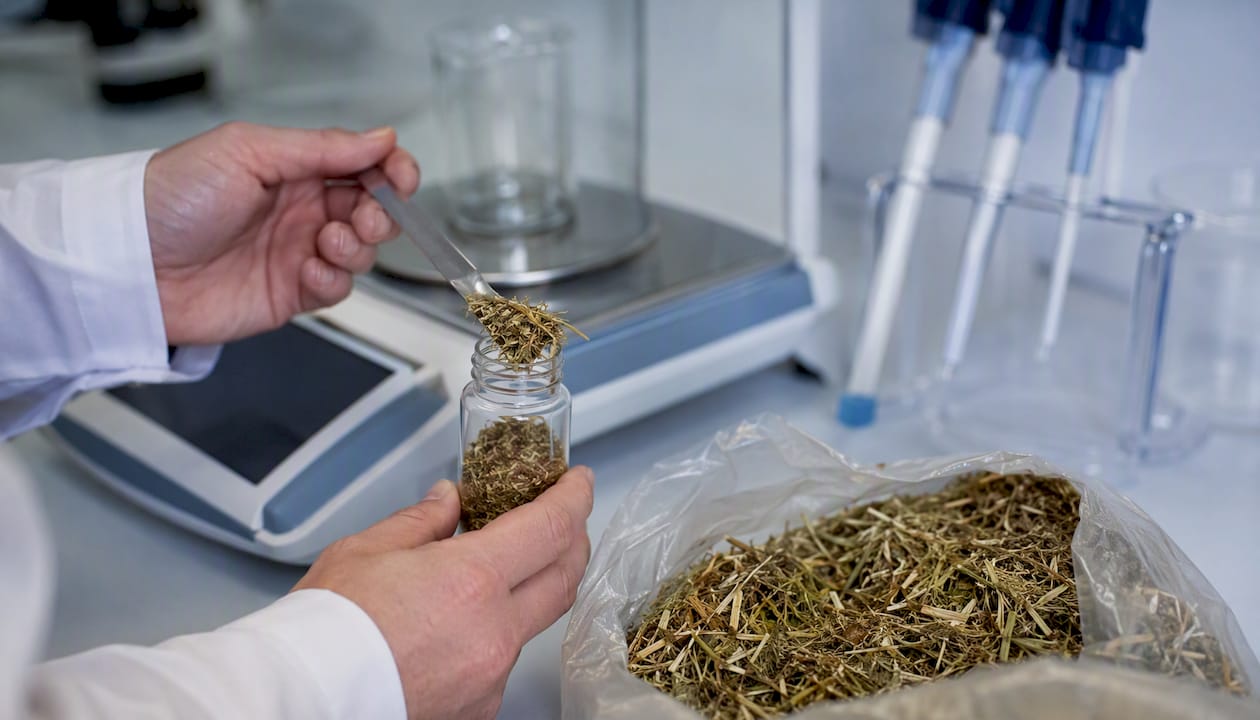
Laboratory testing is the only reliable way to know the NSC content of conserved hay. Visual inspection, colour, and smell tell you nothing about sugar levels.
| Sample type | Reliability | Practical use |
|---|---|---|
| Hay (lab tested) | High | Test every new lot; results are stable for that batch |
| Pasture (lab tested) | Low to moderate | Snapshot only; NSC changes daily and within hours |
| Feed tags / databases | Low | Useful for rough estimates only; not adequate for metabolic horses |
Sampling best practice for hay:
- Core-sample at least 12–20 bales from a single lot using a hay probe.
- Combine cores into one composite sample and submit to a forage-testing laboratory.
- Request WSC, starch, and ESC assays (not just a standard forage panel).
- Store samples in a sealed bag, refrigerated, and submit within 24–48 hours.
Pasture NSC is far less stable. OSU Extension notes that NSC in pasture grasses can shift noticeably between morning and evening on a normal day, and by more after cold nights or frost events. Cold temperatures slow plant respiration, causing fructans to accumulate overnight — so a frost-affected pasture grazed in the morning can carry significantly higher NSC than the same pasture on a mild afternoon. This is why pasture testing, while useful for baseline data, cannot reliably predict what a horse is eating at any given time.
Always ask hay sellers for a current forage analysis before purchase. If none is available, test before feeding to a metabolic horse.
Practical ways to lower NSC intake
Reducing NSC intake is rarely a single fix. It usually requires adjustments across forage, pasture, concentrates, and feeding routine.
Forage strategies:
- Choose grass hays with tested NSC below 10% for metabolic horses. Warm-season grasses (teff, bermudagrass) often run lower in NSC than cool-season species, but species alone is not a guarantee — test regardless.
- Avoid legume hays (lucerne) as the primary forage for insulin-dysregulated horses; they tend to run higher in NSC and calories.
- Soaking hay in cold water for 30–60 minutes reduces water-soluble carbohydrates, but results vary by hay type and initial NSC. Extended soaking leaches more water-soluble carbohydrates but also removes potassium and other minerals. Testing after soaking is the only way to confirm the result meets your target.
Pasture management:
- Graze in the early morning when NSC is typically at its lowest after overnight respiration.
- Avoid grazing after frost, during drought stress, or in spring when growth flushes push NSC up sharply.
- Use a grazing muzzle to slow intake rate without eliminating turnout entirely.
- Avoid close grazing; short, stressed grass concentrates NSC near the base of the plant.
Concentrate and feeding routine:
- Limit concentrate meal sizes relative to bodyweight to avoid overwhelming starch load.
- Choose ration balancers over grain-based feeds; they supply vitamins and minerals with minimal NSC contribution.
- Avoid feeds containing molasses, corn, barley, or oats as primary ingredients for metabolic horses.
- Feed multiple small meals rather than one or two large ones. A large starch load delivered to the small intestine at once increases the risk of hindgut overflow and osmotic disruption.
Pro Tip: After soaking hay, discard the water immediately and feed within a few hours. Soaked hay left sitting becomes a hygiene risk, and the mineral loss compounds if you soak repeatedly without supplementing.
Health risks from high NSC and when to call a vet
High NSC intake is not just a weight issue. The conditions it drives are serious and, in some cases, irreversible.
- Endocrinopathic laminitis: the most common form of laminitis in horses today, driven by insulin dysregulation triggered by high post-prandial insulin spikes from NSC-rich feeds and pasture.
- Equine metabolic syndrome (EMS): a cluster of signs including regional adiposity, insulin dysregulation, and laminitis susceptibility, all worsened by sustained high-NSC diets.
- Polysaccharide storage myopathy (PSSM): a muscle condition in certain breeds where abnormal glycogen storage is exacerbated by high-starch diets; low-NSC forage-based diets are a core management strategy.
- Hindgut acidosis and colic: large starch loads that overflow the small intestine ferment rapidly in the hindgut, dropping pH and disrupting the microbial population.
When to act immediately: digital pulses that are bounding, hooves that are warm to the touch, reluctance to move or a "rocking back" stance, and sudden weight gain or a cresty neck that appears quickly are all signs warranting same-day veterinary contact. Do not wait for a scheduled appointment if laminitis is suspected — the lamellar damage can progress within hours.
Seek veterinary assessment any time a horse has unexplained recurring laminitis, fails to lose weight on a restricted diet, or shows muscle stiffness and tying-up episodes. Add an equine nutritionist to the team when dietary changes alone are not producing the expected results, or when balancing a very restricted diet without creating deficiencies.
Tools that help with NSC calculation and diet planning
Several tools make NSC calculations faster and reduce the risk of arithmetic errors, though none replaces accurate sampling and professional oversight.
- FeedXL: a diet-formulation platform that calculates NSC using WSC and starch values, balances vitamins and minerals, and flags when a ration exceeds target thresholds. It is most useful when you have accurate lab data to enter.
- Laboratory portals: most accredited forage labs (Equi-Analytical in the US, Dairy One, and similar services in Australia and the UK) provide online portals where you can view and download results, compare batches, and track NSC trends across hay lots.
- Interactive calculators: basic NSC calculators are available through university extension sites and allow quick manual entry of WSC and starch values to check a single feed or ration.
Where tools save time: batch calculations across multiple feeds, meal-planning for horses on complex rations, and tracking mineral balance when forage is restricted. Where they fall short: rapidly changing pasture NSC cannot be captured by any tool without fresh sampling data, and ESC vs WSC assay differences can produce meaningfully different outputs depending on which value you enter.
No tool compensates for poor sampling. Entering an inaccurate lab result produces a confident-looking but wrong answer.
A practitioner's view on managing NSC day to day
The most common mistake horse owners make is fixating on the percentage NSC figure while ignoring total grams per meal. That is not safe for a severely insulin-dysregulated horse regardless of the percentage.
The order of priorities matters. Test hay first — it is the largest single NSC source in most horses' diets and the one you can actually control. Then look at concentrate starch. Pasture management comes next, and it is genuinely difficult to get right because the NSC in grass changes faster than any testing schedule can track. Grazing muzzles and timed turnout are imperfect but practical.
Soaking hay is often treated as a guaranteed fix. It is not. The reduction in WSC is real but variable, and the mineral loss is a genuine trade-off that needs to be managed, not ignored. If you are soaking hay for a metabolic horse, test a post-soak sample at least once per hay lot to confirm it is actually hitting your target.
The other underestimated piece is record-keeping. Knowing what a horse ate, when it grazed, and what the lab results were for each hay lot is what lets you spot patterns — a horse that keeps showing elevated insulin despite a "low-NSC" diet often turns out to be getting more pasture than the owner realised, or the hay lot changed without a new test. That kind of pattern only becomes visible when the data is actually recorded somewhere.
How Equibets supports NSC tracking and diet management
Managing NSC properly means keeping accurate records across hay lots, pasture schedules, concentrate rations, and lab results — and that data needs to be accessible when you are standing in the stable at 6 AM, not just at a desk.

Equibets's AI-powered nutrition analysis lets yard managers log forage test results, track feed quantities per horse, and monitor NSC trends across ration changes over time. The platform's feeding logs and stable management tools make it straightforward to record grazing windows, note hay lot changes, and flag when a new batch needs testing before it goes into the feed room. Owner portals keep the horse's caretakers informed without requiring a separate communication chain.
For yards managing multiple horses with different NSC requirements — a performance horse alongside an EMS case, for example — having all feeding histories in one place is what makes pattern recognition possible. Start a free trial at Equibets or review the pricing page to see what is included.
Sources
- Understanding sugar and nonstructural carbohydrates in equine pasture and hay (OSU Extension)
- PubMed article (reference linking to ACVIM-related guidance)
- FS1340: Non-structural Carbohydrates and Equine Warm‑season Grass Pastures (Rutgers NJAES)
- Nutrition terms to know when managing metabolic horses (The Horse)
This article is general information, not a substitute for advice from a qualified doctor. Consult a qualified healthcare professional about your own circumstances before acting on anything here.