

Horse management software saves time, cuts missed health events, and gives you clear per-horse finances in one place. Instead of chasing paper diaries, group chats and spreadsheets, you get automated reminders, searchable medical timelines and owner communication that runs itself. The sections below break down exactly how those benefits show up in a working yard.
TL;DR:
- Horse management software consolidates health, training, and financial records into one accessible platform, reducing gaps and manual tracking errors.
- Automated task reminders and recurring scheduling save staff time, prevent missed health events, and improve accountability for routine procedures.
- Owner portals with role-based permissions enhance communication, providing timely updates while minimizing unnecessary phone calls and misunderstandings.
- Offline capability, GPS ride tracking, and scalable features allow the system to function reliably across paddocks, arenas, and growing yard sizes.
- Integrating with veterinary, compliance, and hardware tools ensures comprehensive, accurate records that support legal, clinical, and performance needs.
Table of Contents
- Horse management software benefits: why one platform beats fragmented tools
- Efficiency and time management: task boards and automated reminders
- Comprehensive health and medical records: timelines and compliance
- Improved communication and team coordination
- Scheduling, ride tracking and training analytics
- Financial tracking and inventory control
- Scalability, accessibility and offline capability
- EquiBETS evidence: how a purpose-built platform delivers these benefits
- Getting started: a quick trial checklist
- Integration with other equestrian tools and platforms
- Customisation options for different types of horse management needs
- Support and customer service quality
- Case studies and real-world results
- What I'd tell any yard adopting this for the first time
- Try EquiBETS with a trial before you commit
- Sources
- FAQ
Horse management software benefits: why one platform beats fragmented tools
Most yards run on a patchwork: a paper diary in the tack room, a WhatsApp group for owners, a spreadsheet for feed costs, and a whiteboard nobody updates after 9am. Each tool works fine alone. Together, they create gaps, and gaps are where a missed farrier appointment or an unlogged medication dose slips through.
A single equine management platform closes those gaps by putting everything against the horse, not the tool.
- One record per horse, visible to everyone with the right permission.
- Automated reminders replace memory and whiteboards.
- Health, training and financial data live in the same place vets, owners and staff can check.
- Offline access means a poor signal at the far paddock doesn't stop anyone logging a task.
The rest of this guide walks through each of those outcomes in detail, starting with the one every yard manager asks about first: time.
Efficiency and time management: task boards and automated reminders
Recurring tasks (rugging checks, worming schedules, stall mucking rotations) don't need a human to remember them every single day. Horse management software sets them once as recurring events, assigns them to a staff member, and sends the reminder automatically. That single change removes a huge chunk of the mental load a yard manager carries.
A mid-sized yard running six or seven horses through a manual system typically loses 20 to 30 minutes per staff member per day just confirming who did what and when. Task boards with timestamped completions remove that back-and-forth entirely, because the record itself answers the question.
- Set recurring events for feeding, farrier and vet visits so nothing relies on memory.
- Assign tasks to named staff, not a general list, so accountability is built in.
- Use automated push reminders rather than a paper checklist that can be missed or lost.
- Review completed tasks at the end of the day instead of chasing verbal updates.
Pro Tip: Order your reminders by consequence, not convenience. A missed worming dose is an inconvenience; a missed pre-competition medication withdrawal window can disqualify a horse. Set your most severe consequences to fire first.
Comprehensive health and medical records: timelines and compliance
A searchable medical timeline turns years of vaccination records, medication doses and injury notes into something you can filter in seconds rather than dig through a filing cabinet for. That matters most in the moments you're least prepared for: an emergency vet call, an insurance claim, or a competition steward asking for withdrawal documentation.
- Vaccine and medication entries with dosage, date and administering person recorded against each horse.
- Injury and treatment timelines that show response to treatment over time, not just a single entry.
- Searchable history that a vet or insurer can review without a phone call to the yard manager.
- Withdrawal period tracking tied to specific medications and competition dates.
The FEI requires documented medication and withdrawal records for international competition eligibility, which turns accurate logging from a nice habit into a compliance requirement for competition yards.
Beyond competition, accurate and accessible records matter clinically. The AAEP points to accurate, accessible medical histories as central to sound veterinary decision making, because a vet working from a full timeline diagnoses faster than one working from memory or a fragmented paper trail.
Improved communication and team coordination
Miscommunication in a yard rarely comes from bad intentions. It comes from information sitting with one person who forgot to pass it on. Owner portals with role-based permissions fix that by giving each person exactly the view they need, without giving everyone the same access to sensitive financial or medical detail.
- Owners see health updates, upcoming appointments and invoices for their own horse.
- Riders see training plans, ride history and any relevant health flags.
- Staff see task assignments, feeding instructions and medical alerts.
- Viewers (a vet on a one-off visit, a farrier) see only what's relevant to that visit.
A common scenario this solves: an owner calls the yard manager to ask if their horse saw the vet last week, because nobody thought to mention it. With a portal, that update is already sitting in their feed, timestamped, before the phone even rings.
Scheduling, ride tracking and training analytics
GPS-logged rides turn a subjective sense of "she worked hard today" into an actual record: distance covered, pace, gait distribution, duration. Stored over weeks, that becomes a ride bank a trainer can use to spot patterns rather than guess at them.
- Log each ride with GPS distance, duration and gait split.
- Build a ride bank that shows training load across weeks, not just single sessions.
- Compare current output against a horse's own baseline to catch early signs of overwork.
- Flag sudden drops in performance that might warrant a vet check before an owner even notices.
Pro Tip: Cross-reference ride data with vet notes rather than looking at either in isolation. A drop in distance covered right after a medication change often tells you more than either record does alone.
Financial tracking and inventory control
Per-horse expense tracking is where a lot of yards lose money without realising it, because feed, farrier and vet costs get logged against the yard as a whole rather than against the horse that actually incurred them. That makes owner invoicing a guessing game and budgeting close to impossible.
- Log expenses by category (feed, farrier, vet, bedding) against each horse individually.
- Attach a photo of the receipt at the point of purchase, so nothing gets lost by month end.
- Generate per-horse cost reports that owners can be invoiced against directly.
- Track tack and equipment inventory alongside maintenance schedules to catch replacement costs before they become emergencies.
Clear per-horse costing doesn't just help owners trust their invoices. It gives a yard manager the numbers to know which horses, or which services, are actually profitable.
Scalability, accessibility and offline capability
A platform that only works with strong signal is a liability at most yards, because paddocks, arenas and stable blocks are exactly where mobile reception drops out. Offline-first design means a staff member can log a task, a treatment or a ride in the field, with the record syncing the moment signal returns.
- Offline sync means no lost data at the far end of the property.
- Per-horse billing lets a one-horse owner and a forty-horse yard both use the same platform without paying for capacity they don't need.
- Free guest roles for owners mean the platform doesn't cost anything extra to bring family or co-owners into the loop.
- Simple task boards and clear navigation mean new staff can be productive within a day, not a week of training.
That combination (pay for what you use, works without signal, onboards fast) is what actually determines whether a platform scales from one horse to a full professional operation, as industry reviews of stable management software point out.
EquiBETS evidence: how a purpose-built platform delivers these benefits
Every benefit above maps directly to a specific EquiBETS feature. AI-powered movement analysis supports the training analytics section; owner portals with role permissions deliver the communication benefits; offline mobile access covers the scalability point; and integrated finance tracking handles per-horse costing without a separate spreadsheet.
- Stable task management on EquiBETS is reported to save professional yards around 30 minutes a day on routine coordination.
Getting started: a quick trial checklist
The measurable wins are consistent across yards: time saved on daily admin, fewer missed health events, and finances that are visible per horse rather than buried in one account. None of that requires a long rollout.
- Import your current medical records for each horse before anything else.
- Set three recurring reminders (feeding, farrier, vet) to test the automation.
- Invite one staff member and one owner to see the portal from their side.
- Review after a week and add the rest of your horses once the workflow feels right.
Integration with other equestrian tools and platforms
A management platform doesn't operate in isolation from the rest of a yard's toolkit, and it shouldn't need to. The most useful integrations tend to fall into three categories: veterinary and compliance systems, financial tools, and hardware like GPS trackers or wearable sensors already in use on the property.
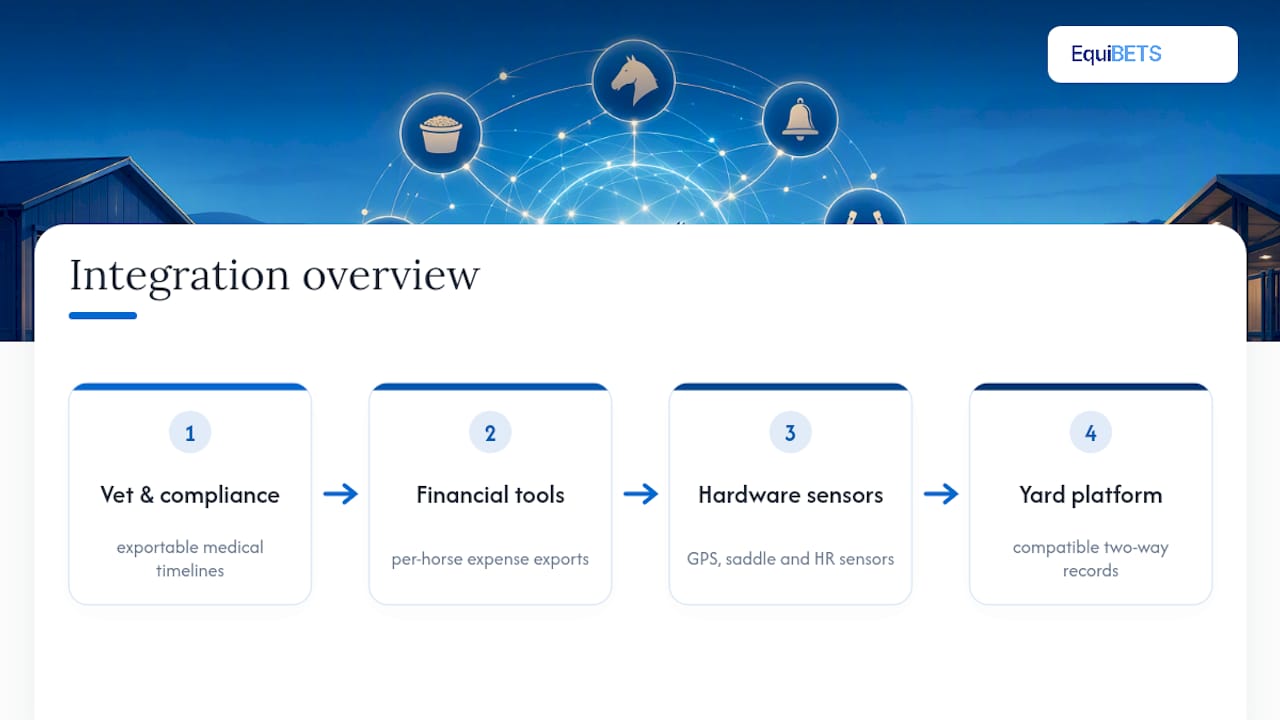
Veterinary integration matters because vets increasingly expect digital records rather than a paper folder handed over at the gate. A platform that exports medical timelines in a format a vet's own practice management system can read saves everyone a re-entry step. The same logic applies to competition compliance: EU regulation 2021/963 sets out rules for official veterinary controls and movement documents, and software that keeps records in a compatible, exportable format makes producing those documents on request far less stressful than digging through paper files.
On the financial side, per-horse expense data becomes more useful when it can feed into a broader accounting system rather than living only inside the yard app. Not every platform handles this well, and it's worth checking before you commit whether expense exports are a simple download or a manual re-entry job.
Hardware integration is the newer frontier. GPS collars, saddle sensors and heart-rate monitors are becoming common in performance yards, and the platforms that read data directly from that hardware save a step compared to manually transcribing numbers off a separate device. If your yard already owns tracking hardware, ask specifically whether a platform reads that data automatically or requires manual entry, because the difference shows up in daily use within the first week.
Customisation options for different types of horse management needs
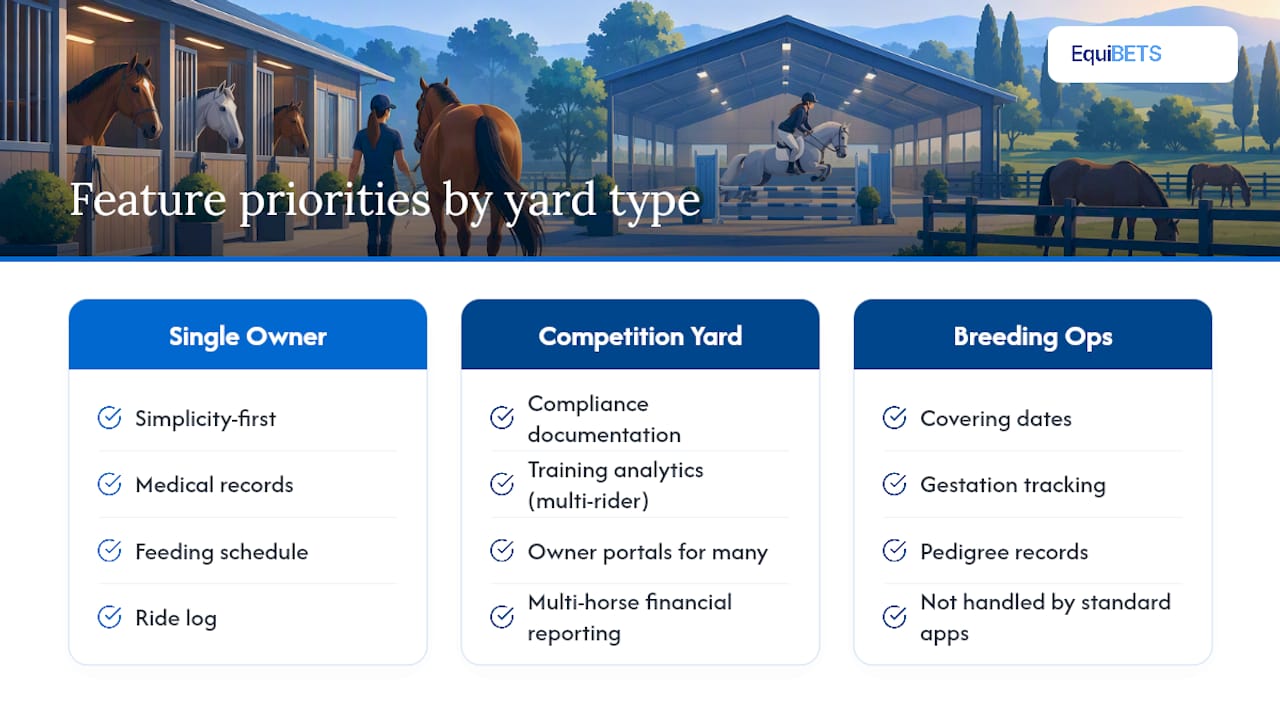
A single-horse owner and a forty-horse competition yard need fundamentally different things from the same software, and a platform that treats both identically usually ends up frustrating one or the other. The better approach is modular: core record-keeping stays the same for everyone, but the features layered on top adjust to scale and purpose.
For an individual owner, the priority is usually simplicity: medical records, a feeding schedule and maybe a ride log, without the clutter of staff task boards or multi-horse financial reporting. For a competition yard, the priority shifts toward compliance documentation, training analytics across multiple riders, and owner portals that keep a dozen or more owners informed without a dozen separate phone calls a week.
Breeding operations have their own distinct needs again: covering dates, gestation tracking, and pedigree records that neither a casual owner's app nor a training-focused platform typically handles well out of the box. A platform built to flex across these use cases, rather than one designed narrowly for a single segment, tends to hold up better as a yard's operation changes over time, whether that's adding horses, adding staff, or shifting from pleasure riding into competition.
The practical test is straightforward: can you turn features on and off as your needs change, or does the platform lock you into a fixed feature set regardless of whether you're running one horse or fifty? That flexibility, more than any single feature, tends to separate software that grows with a yard from software a yard eventually outgrows.
Support and customer service quality
Software that manages medical records and competition compliance carries a different risk profile than a general productivity app, because a support delay during a health emergency or a competition weekend has real consequences. That makes support quality a genuine evaluation criterion, not an afterthought.
A few practical questions are worth asking before committing to any platform: is support available on weekends, when most competitions and many emergencies happen? Is there a direct line for urgent issues, separate from a general ticket queue? And does the support team understand equine-specific workflows, or are you explaining what a withdrawal period is to someone reading from a general software script?
Onboarding support matters just as much as ongoing support. A platform that leaves a yard manager to figure out data migration alone, particularly moving years of medical history from paper or spreadsheets, creates a barrier that stops adoption before it starts. The better providers offer guided onboarding, whether through documentation, live support or a structured import process, specifically because they know a messy first week kills adoption faster than any missing feature.
Response time during a free trial is often the clearest signal of what paid support will actually look like. If a question during the trial period takes days to answer, that's a reasonable preview of the support experience once you're a paying customer.
Case studies and real-world results
The clearest evidence for any of these benefits comes from watching how a yard's daily rhythm changes after adoption, not from a features list. A yard that moves from a paper diary to automated task boards typically sees the change show up first in fewer repeated conversations: staff stop asking "did anyone feed the greys yet?" because the answer is logged, timestamped and visible to everyone with access.
The financial side tends to show results more slowly but more durably. Once a yard has a full quarter of per-horse expense data, patterns emerge that were invisible in a shared account: a particular horse consistently costing more in farrier visits, or a feed supplement that's being over-ordered relative to actual use. That kind of insight doesn't come from a single month of data. It comes from having the habit of logging established long enough that the numbers mean something.
Owner satisfaction is the third measurable shift, and it's often the fastest one to appear. Owners who previously relied on a phone call for updates report far fewer "just checking in" calls once a portal gives them direct visibility into their horse's health and training record. That reduction in interruption is one of the more underrated returns on adopting this kind of platform, because it frees a yard manager's phone time for the calls that actually need a human conversation.
What I'd tell any yard adopting this for the first time
The biggest mistake I see is treating rollout as a technical task rather than a habit change. Import your records properly first, then get one enthusiastic staff member using it daily before asking the whole team to switch. Software doesn't fail because of missing features. It fails because nobody built the habit of checking it before checking the whiteboard.
— isaac
Try EquiBETS with a trial before you commit
The platform brings offline mobile access, owner portals, GPS-based training analytics and per-horse finance tracking into one workspace, so a yard manager isn't stitching together multiple separate tools to get the outcomes covered above.

If your yard is still running on a paper diary and a group chat, the practical next step is testing whether a single platform actually closes those gaps for your operation specifically. EquiBETS offers a free trial before any paid commitment, and the EquiBETS Complete plan runs at $9.99 AUD per month once you're ready to subscribe, covering unlimited horses and team members under one licence. Start with the stable manager feature set to see exactly which modules map onto your current pain points, then invite one staff member and one owner into the trial to test the portal experience firsthand.
Sources
FAQ
What are the main benefits of horse management software?
The main benefits are time saved on daily admin, fewer missed health or medication events, clearer team communication through owner portals, and accurate per-horse financial tracking. Platforms like EquiBETS add GPS training analytics and offline access on top of those core gains.
What is the best software for equine breeding management?
Breeding-specific needs (covering dates, gestation tracking, pedigree records) are best served by a platform with dedicated breeding modules rather than a general training or ownership app. Check whether a platform's customisation options extend to breeding workflows before committing, since not all equine software covers this use case equally well.
What is the best farm management software?
There's no single universal answer, because the best choice depends on whether the operation is a breeding farm, a competition yard, or a mixed-use property. A yard-focused platform like EquiBETS suits operations centred on horse care, training and owner communication rather than broader crop or livestock farm management.
What is the 20% rule in horse riding?
Ride tracking software that logs distance and duration over time makes this rule far easier to follow, because the data needed to calculate the increase is already recorded rather than estimated.
How much does EquiBETS cost?
EquiBETS Complete is priced at $9.99 AUD per month and includes all platform features under a single subscription. A free trial is available before any payment is required.