
Stable task management is the practice of assigning, scheduling and tracking every recurring job a yard runs on: feeding, turnout, medication, training, farrier and vet visits, plus the staff rotas and owner updates that hold it all together. The single best first step is consolidating tasks and horse records into one horse-centric platform with offline access, rather than juggling whiteboards, group chats and paper diaries. Everything below builds on that starting point.
TL;DR:
- Stable task management consolidated into one platform can reduce errors and improve accountability for feeding, medication, and vet visits.
- Offline mobile access ensures emergency records and incident logs remain accessible, even in areas with poor Wi-Fi signals.
- Tracking time saved, medication error rates, owner satisfaction, and costs per horse provides measurable proof of system effectiveness.
- Purpose-built equine management platforms like EquiBETS offer horse-centric records, owner portals, and rehab analytics, unlike generic or paper systems.
- Piloting the system on a small group of horses during normal busy weeks boosts staff buy-in and helps refine the process before wider rollout.
Table of Contents
- What does stable task management actually cover?
- How do you build a reliable stable task system?
- What records do you need for emergencies and rehab?
- Which numbers prove the system is working?
- How does EquiBETS support this in practice?
- What counts as a 'stable task' worth prioritising?
- How do you monitor task completion and follow-up?
- How do you manage horses and staff as one system?
- How do you choose a task management platform for a stable?
- How do the main software options compare?
- The organisational and emotional labour behind good systems
- Ready to try it? Start here
- Sources
- FAQ
What does stable task management actually cover?
Most yards already do task management. They just do it in someone's head, on a whiteboard that gets wiped on Sunday, or across three different WhatsApp groups. Formalising it means every recurring job has an owner, a deadline and a record that someone else can check without a phone call.
A complete system needs to handle several distinct layers at once, because a missed feed and a missed vet callback are different failure modes with different consequences.
- Care tasks: feeding, turnout, mucking out, grooming, rugging and exercise, each tied to a specific horse and time window.
- Health tasks: medication administration, farrier visits, vet checks and competition prep, each carrying a compliance risk if skipped.
- Staff tasks: assignment, checklists, sign-off and accountability, so a supervisor can see who did what and when.
- Owner-facing tasks: portal updates, photos, progress notes and billing summaries that keep clients informed without a phone call.
- Records: horse profiles, medical logs, rehab progress and GPS ride data that build a history worth referring back to.
- Field access: offline forms and emergency plan attachments for the moments when the yard's Wi-Fi is the least of anyone's problems.
The Labour, leisure and love study of 52 yard managers found the job is dominated by organisational and emotional labour, not just horse care. Managing an owner's anxiety about a limping pony takes as much energy as treating the limp. A system that only tracks feeding schedules misses half the actual workload. The gap between what gets written down and what gets carried in someone's head is where mistakes happen, and where good staff burn out.
How do you build a reliable stable task system?
Most yards do not need a total overhaul. They need to convert what already works informally into something that survives a staff change, a busy Saturday, or the manager taking a week off.
- Audit current tasks against horses and roles. List every recurring job, who actually does it now, and how often it gets missed or done late. This exposes the gaps before you build anything.
- Build templates for recurring jobs. A feeding checklist, a medication protocol, a pre-competition prep list. Standard templates mean a relief groom can follow the same routine as your most experienced staff member.
- Design rotas around zones, not individuals. Cluster feeding, turnout and mucking tasks by physical area rather than assigning one person to run between opposite ends of the yard all morning. Zoning and task batching cuts the walking distance that eats into paid hours without anyone noticing.
- Set permissions and simple mobile workflows. Staff need to tick off their own tasks from a phone in the yard, not report back to an office terminal at the end of the shift.
- Pilot on a subset of horses first. Run the new system on ten or fifteen horses for two weeks, gather feedback from the staff actually using it, then roll out wider.
Pro Tip: Run your pilot during a normal week, not a quiet one. If the system holds up when three horses are on box rest and a farrier visit gets rescheduled twice, it will hold up in general.
Yards that pilot small before rolling out wide tend to get faster staff buy-in and cleaner data once pricing decisions come around, because the early adopters become the ones training everyone else.
What records do you need for emergencies and rehab?
An emergency plan that lives in a filing cabinet is not an emergency plan. It is a filing cabinet.
Every horse's emergency record needs to be reachable from a phone, in the paddock, with no signal. That means:
- Vet and farrier contact details, plus an out-of-hours number.
- Current medication list and known allergies or critical alerts.
- A site map showing water shutoffs, gate access and the nearest vehicle route for a trailer or ambulance.
- Insurance and ownership details for fast decision-making.
Offline incident logs matter just as much. A pre-sync checklist for field data means a timestamped note taken during a colic episode at 6am syncs to the main record the moment signal returns, rather than living on a scrap of paper that gets lost by lunchtime.
Rehab tracking benefits from the same discipline. Consistent exercise logs and instrumented gait tracking catch small asymmetries sooner than occasional subjective notes, which lets vets adjust a programme before a minor issue becomes a setback. When it's time to hand a case over to the treating vet, a concise, dated summary of medication, exercise load and observations beats a verbal recap every time.
Which numbers prove the system is working?
Instinct tells you the new rota is smoother. Numbers tell your bookkeeper and your insurer.
Worth tracking from week one:
- Time saved per task, measured against the old routine for the same jobs.
- Overtime hours, since unseen administrative work is one of the biggest hidden costs yard owners carry.
- Medication error rate, ideally trending to zero within a month of using structured checklists.
- Owner satisfaction, tracked through portal engagement or simple feedback prompts.
- Cost per horse, covering feed, farrier, vet and staff time allocated against that specific animal.
Linking horse-level costs to what you actually charge is where a lot of yards lose money without realising it. If a horse on rehab needs twice the staff attention of one in a standard turnout routine, and your livery pricing doesn't reflect that, you're subsidising the harder cases with the easier ones. A strategic pricing review built on real cost data, rather than a gut-feel annual increase, tends to close that gap fairly quickly.
A quick worked example: if structured rotas save a groom time each day across a typical workweek, this can add up to several hours per month. At a loaded staff cost of an hourly rate, this represents significant recovered time per staff member, which can go toward better pay, more horses per staffing hour, or simply fewer weekend callouts. Transparent, timestamped records also cut down the "he said, she said" disputes with owners over missed turnout or extra farrier visits, because the answer is in the log, not in someone's memory.
How does EquiBETS support this in practice?
Some platforms have been specifically designed to meet these requirements, rather than being assembled from generic project software.
- Offline mobile access keeps task checklists, medication records and incident logs working in paddocks with no signal, syncing once connectivity returns.
- Owner portals handle the real-time updates and reports that used to eat into a manager's evening phone calls.
- Staff rota tools apply the same zoning and batching logic covered above, aimed specifically at cutting walking distance and overtime.
- Medical records and rehab analytics flag movement asymmetries early, using GPS ride tracking and gait data rather than relying on someone remembering a horse "looked a bit off" three days ago.
- Finance tracking ties horse-level costs directly to the services delivered, feeding straight into the pricing conversation above.
If you're weighing up whether a platform like this fits your yard, the Stable Manager page walks through how the pieces connect for day-to-day operations.
What counts as a 'stable task' worth prioritising?
Not every job on a yard deserves the same level of tracking. A stable task worth formal management meets at least one of three criteria: it happens on a recurring schedule, it carries a health or welfare risk if missed, or it needs a record another person can check later.
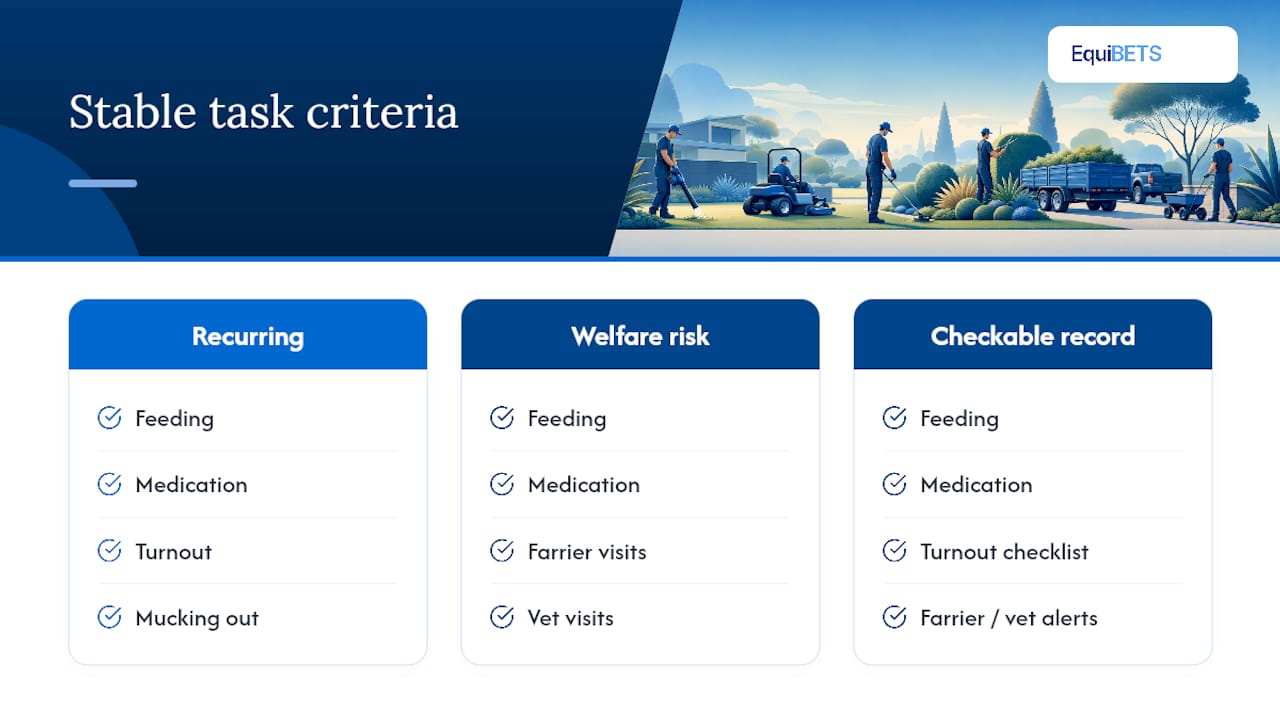
Feeding and medication sit at the top of that list because both criteria apply at once: they're daily, and a missed dose or wrong feed has real consequences. Turnout and mucking out are recurring and lower risk, but still worth a checklist because consistency affects a horse's wellbeing over time. Farrier and vet visits are lower frequency but higher stakes, which is why they need their own alert system rather than living on a general to-do list.
Owner communication tasks deserve separate prioritisation again. They're not about the horse's physical care directly, but about trust, and the emotional labour research makes clear that managing that trust is a genuine workload, not an afterthought. A useful filter for any yard: if a task's failure would show up as a welfare issue, a client complaint, or a legal exposure, it belongs in the formal system. If its failure is mildly annoying but harmless, a simple reminder is enough.
How do you monitor task completion and follow-up?
Assigning a task is the easy part. Knowing it was actually done, and done properly, is where most informal systems fall apart.
Checklists with a mandatory sign-off, rather than a verbal "yep, done", give you a timestamped record instead of a guess. Photo or note attachments on completion add another layer for tasks like wound checks or feed changes, where a written tick doesn't capture enough detail. Automated flags for overdue tasks matter more than most yards think. A medication that's an hour late needs a different alert than a stall that hasn't been mucked by 10am, and a good system distinguishes between the two rather than treating every delay the same.
Follow-up is where accountability actually lives. A weekly review of incomplete or late tasks, even just fifteen minutes with a supervisor, tends to surface patterns: a specific shift that's consistently understaffed, a template that's unrealistic for the time allotted, or a staff member who needs more support. Without that review, the same tasks slip every week and nobody connects the dots.
How do you manage horses and staff as one system?
Treating horse care and staff scheduling as separate problems is where a lot of yards get stuck. The two are the same system viewed from different angles: a horse's needs set the task list, and staff capacity sets how that list gets delivered.
Matching skill level to task complexity matters more than raw headcount. A junior groom can run a standard turnout and feeding rota; a horse on a structured rehab programme needs someone who can spot subtle changes in gait or attitude and knows when to escalate. Rotating staff across zones, rather than locking one person to one string of horses indefinitely, spreads that knowledge instead of concentrating it in one head that might hand in notice next month.
Rest and workload balance belongs in the same conversation as horse welfare, not a separate HR issue. The Horse & Hound reporting on livery yard pressures points to the same conclusion: managers under sustained strain make worse decisions, and that includes decisions about horses. A rota that consistently runs staff into unpaid overtime is a welfare risk twice over, for the people and the animals both.
How do you choose a task management platform for a stable?
Generic project management tools weren't built for horses, and it shows the first time you try to log a farrier visit or a rug change in one.
The criteria that actually matter for a yard:
- Offline functionality, because paddocks and arenas rarely have reliable signal.
- Horse-centric records rather than generic task cards, so a medical history, a training log and a feeding plan all sit against the same animal.
- Owner portal access built in, not bolted on as a separate app.
- Staff permission levels, so a junior groom sees today's checklist while a manager sees the full financial and medical picture.
- Rehab and movement analytics, if the yard handles any rehabilitation or performance work at all.
- Straightforward mobile use, since a system nobody wants to open on a cold morning gets abandoned within a fortnight.
Cost matters too, but less than most people expect. The ROI calculation usually comes down to hours saved and errors avoided rather than the subscription price itself. A platform that saves even one staff member 30 minutes a day pays for a modest monthly fee within the first week.
How do the main software options compare?
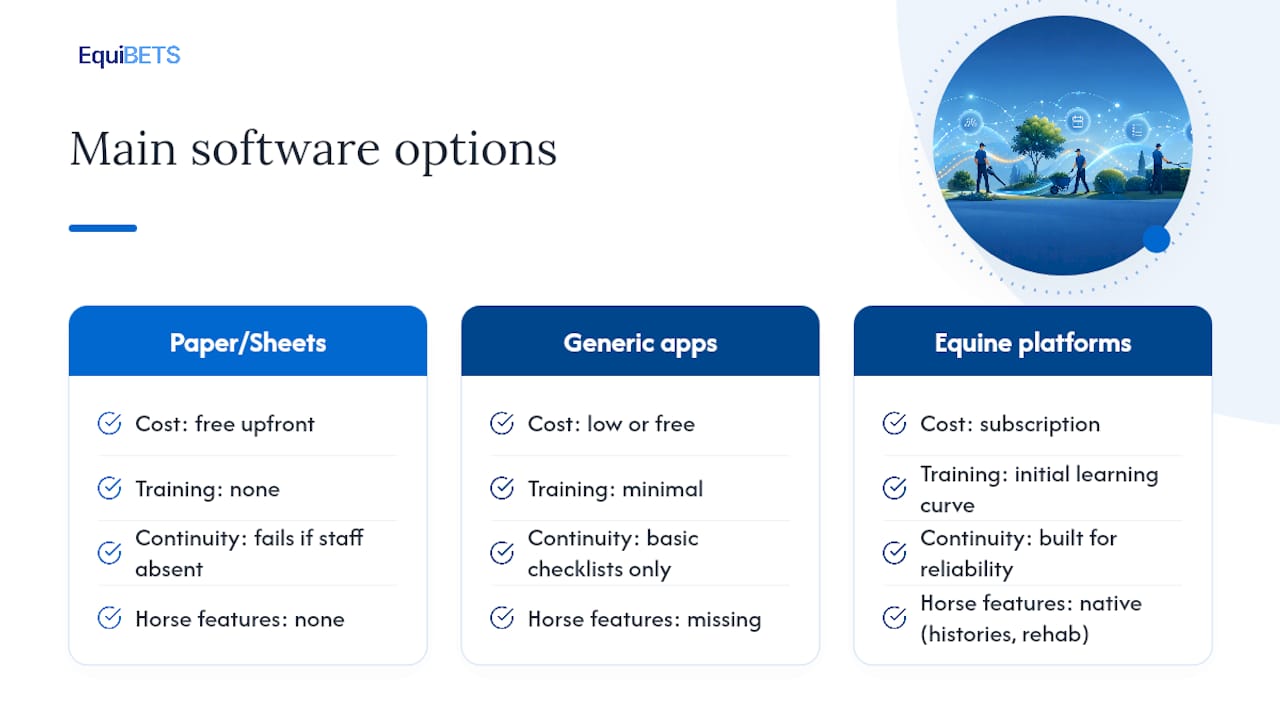
Yards generally choose between three broad categories, and each comes with real trade-offs.
Paper and spreadsheet systems cost nothing upfront and need no training. They fall apart the moment a staff member is off sick and nobody else knows the routine, and they offer zero offline reliability because they were never online to begin with.
Generic task or project apps built for offices handle basic checklists reasonably well and often integrate with calendar tools staff already use. They lack horse-specific fields, medical history structures and owner portals, so yards end up running a second system alongside them anyway.
Purpose-built equine management platforms, EquiBETS among them, are built around the horse rather than a generic task card, with offline access, rehab analytics and owner communication native to the design rather than added later. The trade-off is a learning curve in the first few weeks and a subscription cost that spreadsheets don't carry, though yards that centralise scheduling, medication and financials in one platform typically report less manual effort than running several disconnected tools side by side.
The organisational and emotional labour behind good systems
Yard management is emotional labour as much as horse care. Every welfare decision gets negotiated with an anxious owner, often at the worst possible time of day. A formal system does not remove that labour, but it turns memory and opinion into timestamped fact, which makes those conversations shorter and fairer for everyone. Build the system for your staff's sanity as much as for efficiency. If you've found something that works differently in your own yard, that's worth sharing.
— isaac
Ready to try it? Start here
If you're running task lists across three chat apps and a whiteboard, the fastest fix isn't a better whiteboard. It's putting feeding, medication, rotas and owner updates into one horse-centric workspace that works whether you've got signal or not. That's the specific gap Equibets was built to close for professional yards.

Before you start a trial, pull together a short prep list: your current horse roster, emergency contacts for each vet and farrier you use, your recurring task list, and the top three pain points you want solved first, whether that's overtime, missed medications, or owner complaints. During a demo or trial, expect to walk through setting up horse profiles, staff permissions and at least one owner portal, and set yourself a simple 30 day success measure, such as fewer overdue tasks or fewer after hours calls from owners. Head to the Stable Manager page to see how the features map to your yard, or start from the main EquiBETS platform overview if you're still comparing options.
Sources
- Labour, leisure and love: An exploration of UK livery yard management and decision-making around equine care
- Livery yard owners and managers facing increasing challenges | Horse & Hound
- Why Should You Invest in Stable Management Software in 2026?
FAQ
What is stable task management?
It's the practice of assigning, scheduling and tracking recurring yard jobs, from feeding and turnout to medication and vet visits, alongside staff rotas and owner communication, ideally centralised in one horse-centric platform.
How do I stop staff missing medication or farrier appointments?
Use standardised checklists with mandatory sign-off and automated overdue alerts rather than verbal confirmation, so a missed dose triggers a flag rather than staying invisible until someone notices.
Can task management software work without internet access in the paddock?
Yes, platforms built for yards, including EquiBETS, offer offline mobile access that logs tasks and incident notes locally and syncs once connectivity returns.
How much does EquiBETS cost?
Current pricing is listed on the EquiBETS website, with a free trial available before committing to a subscription.
What's the fastest way to test a new task system without disrupting the whole yard?
Pilot it on a small subset of horses for two to three weeks, gather feedback from the staff using it daily, then expand once the templates and rotas hold up under normal pressure.