
Use a structured, mobile-first equine EMR that supports offline access, multi-owner profiles and audit trails, not a folder of paper cards or a shared spreadsheet. That single decision fixes most of the continuity, compliance and handover problems that plague busy yards and ambulatory practices.
The next 48 hours matter more than the next 12 months. Pick one horse with a messy or scattered history, pull every paper record, invoice and vet note you have on that animal, and try to reconstruct a full year of care from it. If that takes more than 15 minutes or you find a gap, you've just found the reason to fix your equine medical records management system now rather than after an audit, a dispute, or an emergency forces the issue.
Getting this right pays off in three ways immediately:
- Continuity of care improves the moment a relief vet or new staff member can see the full history in one place, not scattered across three notebooks and someone's memory.
- Regulatory readiness becomes near effortless, because medical records are essential to mitigating liability risk when kept accurately and completely from the start.
- Team efficiency rises because staff stop re-asking questions that were already answered in a record nobody could find.
Key Takeaways
Equine medical records management works best when a single structured, mobile-first system replaces paper and spreadsheets, capturing clinical, administrative and inventory data in one auditable place.
| Point | Details |
|---|---|
| Audit one record now | Pick your messiest horse profile and rebuild a full year of history to expose gaps immediately. |
| Enable offline entry | Test a field SOAP note without signal to confirm your system syncs reliably once reconnected. |
| Standardise before migrating | Build SOAP templates and required fields before importing any historical data. |
| Ask vendors about portability | Confirm export formats, offline support and multi-owner billing before signing up. |
| Equibets covers the checklist | Offline access, multi-owner profiles, owner portals and inventory tracking address the core requirements in this guide. |
Table of Contents
- What belongs in every equine medical record
- Recordkeeping best practices for clarity, continuity and legal defensibility
- Legal, regulatory and administrative considerations for equine records
- How record requirements change by setting
- Key EMR features to look for in an equine medical records system
- How to migrate to a digital EMR and what to budget
- Practical templates and minimum fields for common record types
- Security, backups, privacy and data ownership
- Operational workflows: owner portals, team roles and handovers
- Inventory, supply chain and medication tracking for clinical safety
- How a modern equine management platform implements these requirements
- What running the records desk actually teaches you
- How Equibets helps you get this right
- Frequently asked questions
- Sources
What belongs in every equine medical record
An equine record earns its keep only if it's structured enough to search, audit and hand over without a phone call. That means every horse profile needs a consistent set of identifiers, clinical entries and administrative metadata, whether you're a solo ambulatory vet or a 40 horse competition yard.
Start with identifiers. Every profile needs the registered name, barn name, microchip number, breed, colour, date of birth, sex, current stable or barn location, and every owner with a defined contact role (primary decision maker, billing contact, emergency contact). Multi-owner horses, syndicate shares and lease arrangements are common in performance yards, and a record system that only allows one "owner" field will cause billing and consent headaches within the first month.
Clinical components are where most of the actual medical value sits. SOAP notes (Subjective, Objective, Assessment, Plan) should be the default structure for every visit, backed by vitals, a full vaccination history with lot numbers and expiry dates where relevant, dental records, deworming and farrier entries, reproductive history for breeding stock, lameness and performance logs, references to diagnostics and imaging, lab results, and a record of every procedure performed.
Administrative components are the part clinics forget until an audit or dispute forces the issue: informed consent documentation, treatment authorisations, controlled-substance logs, invoices linked directly to the clinical entry that generated them, and audit trail metadata showing who entered or edited each record and when. Standardised record structures support better clinical decision-making, and that structure only works if the administrative layer is as disciplined as the clinical one.
| Record type | Minimum fields | Why it matters |
|---|---|---|
| Identification profile | Name, microchip, breed, DOB, owner(s) with roles | Prevents mismatched treatment and billing across shared or leased horses |
| Vaccination entry | Vaccine name, date, lot number, expiry, administering vet | Supports competition eligibility checks and recall tracing |
| Lameness/performance log | Date, presenting issue, gait findings, treatment, farrier notes | Builds a longitudinal picture that a single visit note can't show |
| Controlled-substance log | Drug, dose, batch, date, administering vet, invoice reference | Required for anti-doping compliance and audit defensibility |
| Diagnostic/imaging reference | Type, date, findings summary, file link | Keeps clinical reasoning traceable without re-running tests |
Recordkeeping best practices for clarity, continuity and legal defensibility
Timeliness is the rule most practices break first. Document at the point of care, not at the end of the day from memory, because records need to be clear, concise, complete, timely and legible to hold up in both clinical and legal contexts. A note written six hours later, after three more farm visits, is reconstructed history, not documentation.
Clarity and legibility matter just as much as timing. Structured entries with defined fields beat free-text shorthand every time, because shorthand that makes sense to you at 3pm on a Tuesday means nothing to a locum reading it eight months later. Completeness means every diagnostic result and every prescription gets linked back to the visit that generated it, not filed separately where the connection gets lost.
A few workflow habits make these standards stick rather than slip:
- Use standardised SOAP templates for every visit type, so nobody has to decide from scratch what to record.
- Enforce required fields on critical entries (medication doses, controlled substances, vaccination lots) so the system won't let a record save incomplete.
- Reconcile invoices against clinical notes weekly, not quarterly, so billing disputes get caught while the details are still fresh.
- Run an annual full record review across a sample of profiles to catch drift in how staff are documenting.
Staffing is the other half of this. New hires need a short onboarding checklist that covers exactly how your practice structures a note, role-based access so junior staff aren't editing controlled-substance logs, and audit logging switched on from day one rather than added after something goes wrong.
Pro Tip: Voice-to-text during a barn visit is faster than typing on a phone screen with wet or muddy hands, but never let it replace structured fields. Dictate into the free-text portion of a SOAP note, then run a 30-second verification pass before saving so drug names and doses transcribed incorrectly by voice recognition don't end up locked into a controlled-substance log.
Legal, regulatory and administrative considerations for equine records
Record retention rules, anti-doping obligations and audit access requirements vary by jurisdiction and by discipline, so treat any specific retention period or reporting rule as something to confirm with your local veterinary board or racing authority rather than a fixed global standard. What doesn't vary is the underlying principle: if a regulator or an opposing party in a dispute asks for a record, you need to produce it, complete and unaltered, within the timeframe they specify.
Racing and competition environments carry the heaviest documentation burden. Medication logs need to show drug name, dose, batch, administering vet and exact timing relative to competition, because regulators are checking for compliance with withdrawal periods, not just confirming a horse was treated. Ambulatory and general practice settings still need equivalent discipline, just with less regulatory scrutiny day to day.
Three practical steps keep most practices audit-ready without extra administrative burden:
- Maintain a single, timestamped medicines register that can't be edited retroactively without leaving a visible audit trail.
- Split billing records clearly where ownership is shared, so an invoice dispute doesn't become a records dispute.
- Keep an export-ready format on hand (PDF and structured data) so a regulator or a transferring owner can get a complete history without a week of manual compilation.
Accurate, complete medical records reduce liability exposure and directly support animal welfare transparency when regulators or new owners need to verify a horse's treatment history. Practices that treat recordkeeping as a compliance chore rather than a clinical asset tend to discover the gap only when it's expensive to fix.
How record requirements change by setting
A racetrack, a performance barn and an ambulatory solo practice are managing the same underlying data, but the priorities shift hard depending on where the horse lives and what it does.
Racetrack and competition contexts demand the tightest drug-entry logs in the industry. Every medication needs an induction time recorded, not just a date, because stewards and regulators are checking timing against withdrawal windows down to the hour in some jurisdictions. Export formats need to match whatever the regulating body specifies, and audit turnarounds can be measured in hours rather than weeks when a positive test or a dispute triggers a review.
Performance horses need longitudinal logs that connect the dots between soundness, training load and shoeing changes over months and years, not isolated visit notes. A lameness that resolves after a farrier change only makes sense in the record if the shoeing history and the lameness entries are linked, not filed in separate systems that never talk to each other.
Ambulatory practice runs on a completely different constraint: connectivity. A vet doing eight farm calls in a day across patchy mobile reception needs a record system that works fully offline and syncs later, fast entry templates that don't require typing a paragraph per visit, GPS or location tags that confirm where a visit happened, and the ability to attach field images (a swollen fetlock, a wound) without waiting for a signal. Clinical and ambulatory realities mean equine records must support offline field access and multi-owner relationships as a baseline requirement, not a nice-to-have add-on.
Key EMR features to look for in an equine medical records system
Not every feature vendors advertise actually matters for day-to-day equine work. Filter for these three categories and most other differences turn out to be cosmetic.
The must-haves start with structured horse profiles that support multiple owners properly, not as a workaround field. Offline mobile access is non-negotiable for anyone doing farm calls. SOAP templates need to be built in rather than bolted on, imaging and lab attachments should link directly to the visit record, medication tracking needs full dose history, and audit trails should log every edit automatically without staff having to remember to note who changed what.
Operational features determine whether the system actually gets used consistently. Appointment scheduling built for ambulatory rounds (not a generic calendar), owner portals that give clients read access without needing a phone call for every update, split billing for shared-ownership horses, invoices that link automatically to the clinical entry that generated them, and inventory integration that ties medication stock to what's actually being administered.
Search and reporting is where a good system saves hours a week. You want fast filters by barn, by owner, by discipline, by date range, and by clinical tag so you can pull every lameness case from the last six months in seconds, not by scrolling. Exportable reports matter for audits, for referrals to specialists, and for transferring a horse's history when it changes hands or yards.
How to migrate to a digital EMR and what to budget
Moving from paper or spreadsheets to a proper digital system is a project, not a weekend task, but it doesn't need to disrupt clinical work if you sequence it properly.
- Discovery and data audit. Inventory what records exist, in what format, and how complete they are. This is also when you decide what history is worth migrating versus starting fresh.
- Template and workflow design. Build your SOAP templates, required fields and access roles before you import a single record, so data goes in structured rather than needing rework later.
- Data migration. Import existing records, prioritising active patients over historical or inactive files that can be added later as needed.
- Staff training. Run hands-on sessions covering the actual daily workflow, not just a feature tour, so staff are confident before go-live.
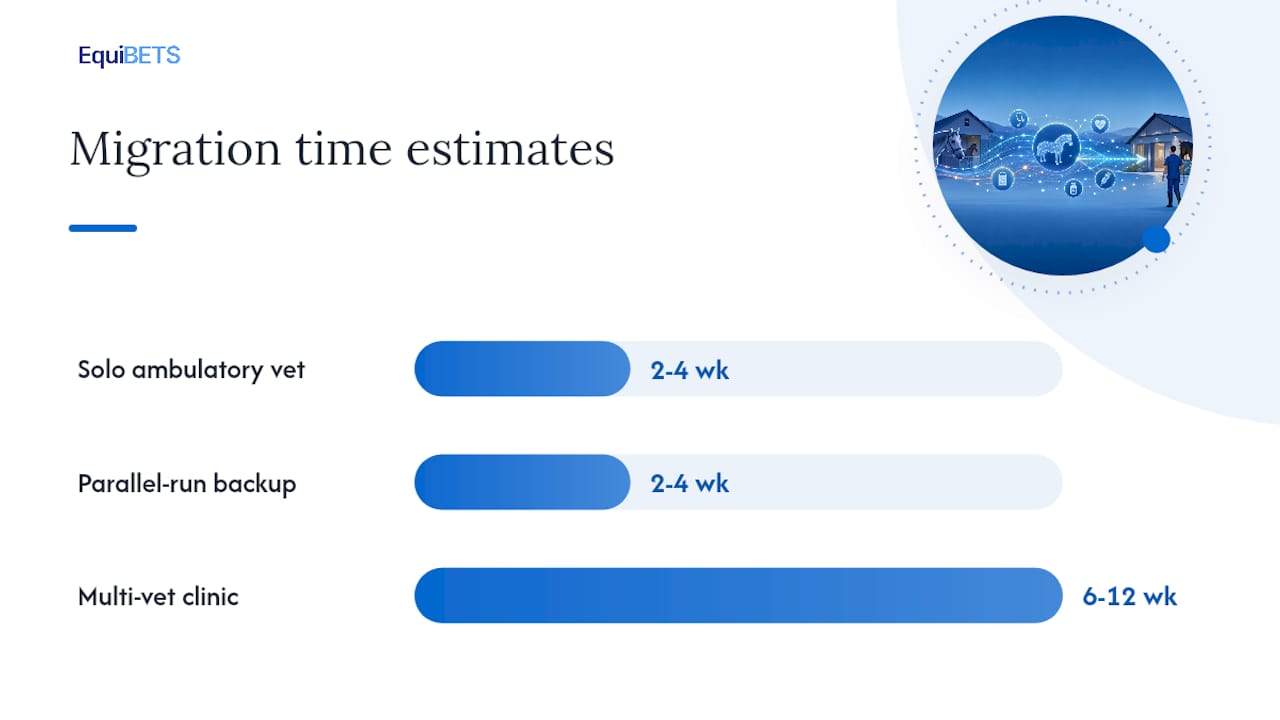
- Parallel run. Keep the old system as a backup reference for two to four weeks while the new one becomes the primary record.
- Go-live and review. Set a 30 and 90 day checkpoint to catch workflow friction early and adjust templates or permissions before bad habits form.
A solo ambulatory vet can realistically complete this in two to four weeks. A multi-vet clinic with several hundred active patients and multiple support staff should budget six to twelve weeks, mostly because training and parallel-run periods need to accommodate more schedules.
Budget across four categories: the subscription itself, any paid migration support for large historical data imports, devices if staff need tablets or new phones for field entry, and paid training hours if your team needs structured onboarding rather than self-guided learning. Compare subscription pricing against a fixed-price onboarding package versus hourly support. A fixed price is easier to budget but assumes a clean, simple migration. Hourly support suits practices with messy legacy data but needs a cap agreed in advance. The return on investment shows up as reduced admin hours per week, fewer missed or delayed invoices, and faster audit responses. Track those three metrics for 90 days post go-live and the business case for the change usually writes itself.
Practical templates and minimum fields for common record types
Every record type needs its own minimum field set, because a vaccination entry and a controlled-drug log serve completely different purposes even when they're both "medical records."
| Record type | Minimum fields |
|---|---|
| SOAP note | Date, subjective complaint, objective vitals/findings, assessment, plan, attending vet |
| Vaccination entry | Vaccine, date given, lot number, expiry date, next due date, administering vet |
| Procedure record | Procedure name, date, anaesthesia/sedation used, outcome notes, follow-up plan |
| Medication entry | Drug name, dose, route, batch number, date/time administered, prescribing vet |
| Imaging record | Type (radiograph/ultrasound), date, body region, findings summary, file reference |
A free, printable equine health record template is a genuinely useful starting point for owners and smaller yards who aren't ready for a full digital system, covering vaccinations, vitals and common treatments in a format anyone can fill out by hand. If you're building your own template from scratch, structure fields for searchability from day one: use consistent tags (lameness, dental, reproductive) rather than free-text descriptions, standardise date and time formats across every record type, and name files consistently (horse name, date, record type) so a search actually returns what you're looking for.
Security, backups, privacy and data ownership
A record system that can't survive a lost laptop, a lapsed subscription, or a vendor going out of business isn't a record system, it's a liability waiting to surface.
Core technical controls should include encryption both in transit and at rest, role-based access so junior staff can't edit controlled-substance logs, multi-factor authentication on every account with clinical access, and locally cached data for offline work that syncs securely once connectivity returns. Interoperability and data portability are recurring priorities in health informatics guidance and equine records should meet the same standard as human health records on this front, even though the regulatory pressure is lighter.
Backup and export policy is where practices get caught out. Automated backups mean nothing if nobody has ever tested a restore. Run a test restore at least twice a year. Ownership and portability terms should be documented in writing before you sign up with any vendor, so if you ever change systems, you know exactly how to extract every record, in what format, and how long that export will take.
A short privacy checklist covers most of what matters when records get shared beyond your own team:
- Give owners a plain-language privacy notice explaining what's recorded and who can see it.
- Limit trainer and third-party access to view-only summaries unless there's a clear clinical reason for more.
- Redact or restrict controlled-substance details when sharing a summary externally, unless the recipient has a legitimate regulatory need to see them.
Operational workflows: owner portals, team roles and handovers
The best record system in the world fails if the access design doesn't match how your team actually works day to day.
Owner portals should give clients a clean, view-only summary of clinical history and upcoming care, without exposing internal notes or pricing they don't need to see. Staff need role-based editing so a groom can log a farrier visit without being able to alter a medication log. Emergency access overrides matter for the 2am call when the on-call vet isn't the horse's usual clinician, but every override needs to leave an audit trail showing who accessed what and when. Standard handover notes at shift change stop information falling through the cracks between the day team and the night team.
A few workflow examples show how this plays out in practice. A farm visit checklist should prompt the vet through identifiers, presenting complaint, findings and plan before they leave the property, not after. Informed consent captured in the field works best as a structured digital form with an owner signature or verbal-consent timestamp, logged at the point of care rather than chased up later by phone. A good ambulatory handover note after a shift covers every horse seen, any pending results, and any follow-up owed, so the next vet on isn't starting cold.
Pro Tip: Configure a one-tap emergency summary for every horse profile that surfaces allergies, current medications, and critical contact numbers on a single screen. In a genuine emergency, nobody has time to scroll through a full history. This single feature can shave minutes off a crisis response, and those minutes matter.
Inventory, supply chain and medication tracking for clinical safety
Medication errors and controlled-substance discrepancies are two of the most preventable risks in equine practice, and both come down to whether your inventory system talks to your patient records.

Track batch and lot numbers on every dose administered, not just every bottle purchased, along with expiry dates, controlled-substance entries logged at the point of administration, current stock levels, and re-order thresholds set before you actually run out. The goal is a system where a drug leaving the shelf automatically shows up against the patient it was given to and the invoice that bills for it.
Integration is what makes this work without extra admin. Link medication consumption directly to the patient entry that triggered it, set automatic low-stock alerts rather than relying on someone noticing an empty shelf, and reconcile physical counts against system records monthly to catch discrepancies before they become a compliance problem.
| Date | Horse | Drug | Dose | Batch | Administering vet | Invoice ref |
|---|---|---|---|---|---|---|
| Example row | Barn name | Drug name | Dose amount | Lot number | Vet name | Invoice number |
How a modern equine management platform implements these requirements
Every checklist in this guide points toward the same underlying need: one system that holds structured clinical data, works without signal in a paddock, and gives the right people the right level of access. That's the exact gap Equibets is built to close for professional yards.
Offline mobile access solves the ambulatory problem directly, letting a vet or stable manager log a SOAP note, a medication dose or a lameness finding in a field with no reception, syncing automatically once connectivity returns. Multi-owner horse profiles handle syndicate and lease arrangements without the workarounds that generic systems force. Owner portals give clients real-time visibility into their horse's care without staff fielding constant update calls, and integrated finance tracking links invoices directly to the clinical entries that generated them.
Picture a realistic ambulatory lameness consult. The vet arrives at the yard, pulls up the horse's full history offline on a tablet, including the last farrier visit and prior lameness notes. They log vitals, gait findings and a treatment plan directly into a SOAP template during the visit. Medication administered gets logged against the patient and the inventory count simultaneously. The invoice generates automatically, linked to that specific visit, and the owner sees a clinical summary appear in their portal within minutes of the vet leaving the property. Follow-up reminders get scheduled without anyone needing to remember to set them.
A few of the platform's capabilities map directly onto the needs covered throughout this guide:
- AI-powered movement analysis supports objective lameness and gait tracking rather than relying solely on subjective visit notes.
- Nutrition analysis tools connect diet planning to clinical records for horses on restricted or therapeutic feeding plans.
- GPS ride tracking and farm mapping add location context to field visits and training logs.
- Emergency plans give vets and first responders immediate access to critical horse information without needing full system credentials.
What running the records desk actually teaches you
The single biggest lesson from watching equine records fail isn't about software at all. It's that the gap between "we have records" and "we have usable records" only becomes visible at the worst possible moment, an emergency, an audit, a dispute over a horse's history when it changes hands. Practices assume their system is fine right up until someone needs a complete answer in under five minutes and it takes forty.
The most common pitfall isn't lack of effort, it's fragmentation. A vaccination history on paper, a lameness note in a text message to the trainer, and an invoice in accounting software that never mentions what it was for. None of those pieces is wrong individually, but none of them is useful alone either. If there's one action worth taking tomorrow, it's picking your worst-documented horse and rebuilding a single, complete profile for it as a test case, because that exercise will show you exactly where your current system breaks down before a regulator or a dispute does it for you.
How Equibets helps you get this right
Equibets is a records system built specifically for the workflow this whole guide has described: offline-capable, multi-owner, and structured around clinical entries rather than a generic notes field bolted onto a scheduling app. If you've been managing horses across paper cards, group chats and a spreadsheet nobody fully trusts, that gap is exactly what the platform closes.

The core features map directly onto the checklist covered above. Offline mobile access means field visits get documented at the point of care, not reconstructed from memory that evening. Multi-owner horse profiles handle syndicates and leases without workarounds. Owner portals give clients real-time visibility without extra phone calls, and integrated finance tracking links every invoice back to the clinical work that generated it, closing the reconciliation gap that causes most billing disputes. Inventory tracking ties medication stock directly to patient records, supporting the controlled-substance logging covered in the legal and regulatory section above.
If you want to see how these pieces fit your own yard or practice, start with the Equibets platform overview and compare its feature set directly against the checklist in this guide. A free trial gives you enough time to import a handful of horses, test an offline field entry, and confirm it solves the specific gap you identified in your own records this week.
Frequently asked questions
What is the minimum information every equine medical record must include? Every record needs core identifiers (name, microchip, breed, owner details), a clinical history covering vaccinations, dental, deworming and lameness entries, and administrative data including consent forms and audit trail metadata showing who entered each record.
How long should equine veterinary practices retain medical records? Retention periods vary by jurisdiction and by discipline, particularly for racing and competition horses subject to anti-doping rules, so confirm the specific requirement with your local veterinary board or regulatory authority rather than assuming a universal standard.
Can equine medical records be managed offline for ambulatory practice? Yes, and for ambulatory work it's close to essential. A system that caches records locally and syncs once connectivity returns lets vets document at the point of care during farm visits, rather than reconstructing notes from memory later.
What features matter most when choosing equine record keeping software? Prioritise offline mobile access, multi-owner profile support, structured SOAP templates, medication and inventory tracking, and exportable reports for audits or referrals. Data portability terms matter just as much as day-to-day features if you ever need to change vendors.
How does digitising horse medical records improve compliance? Digital systems create automatic, timestamped audit trails showing every edit, which paper records can't reliably do. That audit trail is what regulators and courts look for when assessing whether a practice's records are complete and unaltered.
Sources
A handful of external resources are worth bookmarking alongside your own system setup. The free printable equine health record is a solid starting template for smaller yards or owners not yet ready for a full digital system, covering vitals, vaccinations and common treatments in a format you can adapt by hand or digitise later.
For a deeper look at the legal and clinical case for structured recordkeeping, the analysis in Medical Records in Equine Veterinary Practice is worth reading in full, particularly the sections on liability and record completeness. The preventive-care checklist approach covering vaccination, dental and parasite management schedules is useful for building your own annual review calendar. Keep a local, downloaded copy of any template or checklist you rely on regularly, so a website change or a lapsed link never leaves you without the document you need mid-consult.
- Medical Records in Equine Veterinary Practice
- The Importance of Medical Recordkeeping in Equine Practice
- Free, printable equine health record
- Clinical Veterinary Equine journal article (record-keeping analysis)