
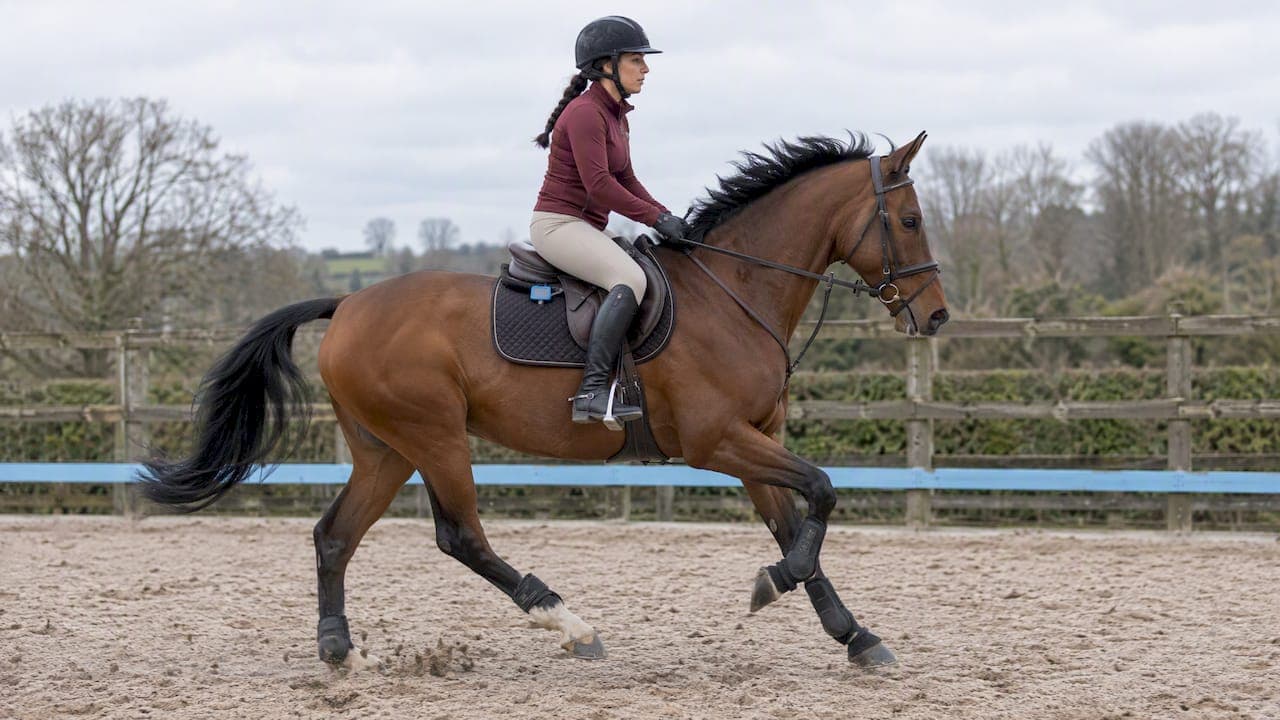
GPS intervals for horses mean structured bursts of faster work, each followed by a recovery period, with a GPS unit logging the pace, distance and time of every effort. The unit takes over the stopwatch and the guesswork. It does not decide the programme, and it does not tell you how the horse is coping. Used well, it gives you a repeatable record of each interval. Used alone, it can hide the signs that matter most.
This guide covers how to set intervals up, what to record, where GPS falls short, and how a professional yard can keep the data usable across a whole string of horses.
TL;DR
- An interval is a short, harder effort followed by a recovery. For example, trotting for 2 minutes or cantering for 1 minute, then walking until the horse recovers.
- Introduce formal intervals only after a base of steady work. The British Horse Society places them in the later phase of a fitness programme, around weeks 6 to 9.
- Change one variable at a time: frequency, intensity or duration. Never push speed and distance up together.
- GPS gives you pace, distance and time. Pair it with heart rate and recovery observations, and with your vet's judgement, before you call a horse fit.
- Log every session the same way each time, so you can compare like with like across weeks and across horses.
Table of Contents
- What an interval session looks like with GPS
- When to start intervals
- Setting the work and recovery
- What about the 3-3-3 and 1-2-3 rules?
- What GPS tells you, and what it does not
- A worked example: building a four-week block
- Watching load across the week
- Choosing and using a GPS tracker in Australia
- Our perspective
- Keeping the record in one place
- Running intervals and GPS records with EquiBETS
- Common mistakes with GPS intervals
- FAQ
- Sources
What an interval session looks like with GPS
A GPS interval session has four parts: a warm-up, a set of work intervals, recovery between them, and a cool-down. The GPS unit marks the start and finish of each effort, and you read the numbers afterwards.
The British Horse Society describes interval training as short bursts of high-intensity exercise followed by recovery periods, with the aim of improving the efficiency of the heart and lungs. As fitness builds, trainers lengthen the work and shorten the recovery. That is the whole principle. GPS simply makes each of those variables measurable.
A simple example for a horse already doing regular trot and canter work:
- Warm up in walk and trot until the horse is loose and moving freely.
- Canter for 1 minute, noting distance and average pace.
- Walk on a long rein until the horse has settled and breathing is back near normal.
- Repeat for the number of sets your plan calls for.
- Cool down in walk, then record the session.
The numbers above are an illustration of the structure, not a prescription. Your horse's age, history, discipline and current fitness set the real figures, and your trainer or vet should sign off the plan.
When to start intervals
Intervals come after a base, not before it. The BHS fitness programme starts with a slow and steady phase of controlled walk work on a level surface, and treats the later phase, weeks 6 to 9, as the standard time to bring in formal interval work. A horse returning from a spell off, or an older horse, may need longer on the base.
A few checks before adding intervals:
- The horse is sound and comfortable in the steady work it has already been doing.
- Heart and breathing rates return to resting levels in a reasonable time after work. The BHS notes that recovery times should shorten as cardiovascular fitness improves.
- The surface, footing and tack are suited to faster work.
- Your vet is aware of the plan if the horse has any history of injury.
If you want a full staged structure to hang intervals on, our guide to a phased training plan for horses walks through it.
Setting the work and recovery
There are three levers on any interval session: how hard each effort is, how long it lasts, and how long the recovery is. A fourth, how often you do it each week, sits above them.
Change one thing at a time
The most common mistake is to raise speed and distance together. The BHS approach is to change only one variable at a time, whether that is frequency, intensity or duration, because stacking increases is how conditioning injuries happen. With GPS this is easy to police. If last week's canter intervals averaged a certain pace over a certain distance, this week you might hold the pace and add one repetition, or hold the repetitions and shorten the recovery. Not both.
Use recovery as your guide
Recovery is where the information is. A horse that settles quickly between efforts is coping. A horse that takes longer than last time to come back, with the same work, is telling you something. GPS timestamps give you the recovery duration precisely, but the reading of the horse's breathing and heart rate is still yours.
Match intervals to the workload
Intervals sit inside a wider weekly load. The BHS classifies work levels, and for horses in heavy work such as eventers and showjumpers it describes 4 to 5 or more hours a week made up of roughly 20% walk, 50% trot, 15% canter and 15% gallop or jumping. A GPS log that shows time in each gait lets you check whether the real week looks like the planned one.

What about the 3-3-3 and 1-2-3 rules?
Readers often search for these. Neither is a standard veterinary or racing protocol for interval training. Conditioning is built on standard workload classifications and gradual progression, as set out in the BHS developing a fitness programme guide. If someone quotes you a number rule, ask what it is based on before you build a horse's programme around it.
The 20% rule is a different thing again. It is a guide to the maximum rider-to-horse weight ratio, where the combined weight of rider and tack should not exceed 20% of the horse's ideal body weight. It is about welfare under load, not about interval length.
What GPS tells you, and what it does not
GPS is good at distance, duration, average speed, route and time in gait. It is less good at the things you most want during short, fast intervals.
Peak speed on short efforts
GPS units record position at a set rate and then calculate speed from it. On short laps and brief bursts, that calculation can smooth out the peaks. Published comparisons of GPS and stopwatch timing for horses on short laps have reported GPS speeds that differ from timed speeds. The practical lesson is to check your own device: time a measured straight with a stopwatch, compare, and note the gap. Then treat GPS pace as a consistent yardstick for comparing your horse with itself, not as a laboratory-grade top speed.

Workload is more than speed
A horse can hold a pace and still be working too hard to do it. Researchers studying Thoroughbreds in the field have combined heart rate with GPS velocity to measure changes in fitness, because speed on its own does not show how hard the body is working. For a professional yard, that points to a clear rule: record heart rate or recovery observations alongside the GPS numbers whenever you can. Research on eventing horses has likewise looked at heart rate and blood lactate responses during interval sessions in relation to competition performance, which shows how much physiology sits behind the pace figure.
Technology supports the trainer
In a webinar on heart rate monitors and similar devices, Dr David Marlin and Dr Gillian Tabor made the point that sensors can provide a lot of data, such as time in gait, symmetry and stride length, but the value lies in how practitioners interpret it. Data supports the trainer's feel and the vet's oversight of recovery. It does not replace either.
A worked example: building a four-week block
Here is how a yard might structure one horse's block, using GPS to hold the variables steady. The numbers are illustrative only.
| Week | Change made | What stays the same | What you check in the GPS log |
|---|---|---|---|
| 1 | Baseline: set number of canter efforts | Pace, effort length, recovery | Average pace per effort, recovery time |
| 2 | Add one effort | Pace, effort length, recovery | Does pace hold in the last effort? |
| 3 | Shorten recovery slightly | Number of efforts, pace, effort length | Does the horse settle as fast as in week 2? |
| 4 | Easier week | Lower volume | Compare with week 1 baseline |
Each week only one lever moves. If the horse struggles in week 3, you know exactly why, and you can step back without guessing. Review each session against the last using the same measures. If you run many horses, a tool that lets you compare training sessions using sets and filters saves a great deal of time over spreadsheets.
Watching load across the week
Intervals are one session in a week. The risk is not usually one hard session but several piled up after a quiet spell. Tracking the ratio of recent load to your longer-term average is one way to see a spike coming. We cover this in horse training load and speed spikes, including how to flag a jump before it becomes a problem.
There is a research angle here too. The American Association of Equine Practitioners has reported on a study of two-year-old Thoroughbreds in which wearable sensors captured movement data during fast work, and describes the sensors as showing potential for early injury detection. Horses flagged with yellow or red sensor statuses were reported to be about twice as likely to sustain musculoskeletal issues. That is racehorse research, and it complements rather than replaces the clinical eye of the vet and trainer, but it shows where the industry is heading: from fitness tracking towards proactive health monitoring.
Choosing and using a GPS tracker in Australia
A few practical points for Australian yards:
- Coverage. Test the unit in the paddocks, arenas and tracks you actually use. Tree cover and hilly ground can affect the signal.
- Mounting. Decide whether it goes on the rider, the saddle or the horse, and keep it the same every time. A moved unit changes the data.
- Battery and syncing. A device that dies mid-session or will not sync in a rural area is worse than a stopwatch.
- Export. You want the numbers to land in your yard records, not stay trapped on one person's phone.
We have a longer rundown in our guide to GPS horse tracking for Australian owners, which covers how to choose a tracker.
Our perspective
We build yard software, and the pattern we see is not a shortage of data. It is data that never gets used. A GPS file sits on one rider's phone, the heart rate lives in a notebook, and the recovery observation was said aloud in the yard and forgotten by Friday.
So we hold a few firm views.
Consistency beats precision. A modest GPS unit used the same way every session will teach you more than a premium one used haphazardly. The question is always: is this effort comparable with the last one?
Evidence first. We prefer features grounded in published research over features that simply look clever. That is why we describe GPS as one input among several, and why we say plainly that it can miss physiological stress.
The trainer stays in charge. Movement and nutrition analysis should help a professional notice things earlier, never override them. A graph is a prompt to go and look at the horse.
Records must work where the horses are. Yards are often out of signal. Capture has to work offline and sync later, or people stop logging. Our piece on offline data capture for professional yards explains why this matters so much.
Owners and vets should see the same story. When intervals, ride tracking and recovery notes sit in one workspace, an owner update or a vet call takes a minute, not an afternoon.
— isaac
Keeping the record in one place
A workable logging routine for each interval session needs only a few fields:
- Horse, rider, date, surface and weather
- Planned intervals versus what was actually done
- GPS distance, duration and average pace for each effort
- Recovery time between efforts
- Heart rate or breathing observations, if taken
- A one-line note on how the horse felt and finished
If you also track asymmetry, you can line up interval load against movement changes. Our article on rehab tracking for yards and vets shows how small asymmetry changes can show up before they become obvious, and horse movement analysis for clinicians shows how trot data becomes a usable record for a vet.
For teams, a weekly review matters more than any single session. A weekly benchmarking workflow keeps everyone looking at the same measures.
Running intervals and GPS records with EquiBETS
EquiBETS is a single workspace for professional yards: horse records, GPS ride tracking, AI-powered movement analysis, nutrition and feed planning, owner portals, finance tracking, emergency plans and team chat, with offline mobile access. For interval work, that means GPS ride data sits next to the horse's record, the team sees the same numbers, and owners can be kept informed without a phone call.
There is one plan, EquiBETS Complete, at 9.99 AUD per month, with all features and modules included, and a free trial before you subscribe. You can see the details on the EquiBETS pricing page. If you are still weighing up the broader case, offline horse management software for pro yards explains what changes day to day.
Common mistakes with GPS intervals
- Raising speed and distance together. Move one lever per week.
- Trusting peak speed to the decimal. Calibrate your device against a stopwatch over a measured distance.
- Ignoring recovery. The time to settle is as informative as the pace.
- Skipping the base. Intervals are a later-phase tool, not a fitness shortcut.
- Changing the setup. A different mounting position or device mid-block muddies comparisons.
- Leaving the vet out. Share trends with your vet, especially after any change in the horse's way of going.
- Logging in different places. If the data is in three apps and a notebook, nobody reviews it.
FAQ
How long should horse intervals be?
The BHS gives examples such as trotting for 2 minutes or cantering for 1 minute, followed by a recovery period. The right length for your horse depends on its current fitness, age, discipline and your vet's advice. Start short, and extend the work or shorten the recovery, not both at once.
Is GPS accurate enough to time horse intervals?
It is accurate enough for distance, duration and consistent comparison of a horse with itself. On short, fast efforts, GPS speed can differ from stopwatch timing, so check your device over a measured distance. For a fuller picture of workload, combine it with heart rate and recovery observations.
Do I need heart rate monitoring as well as GPS?
It is strongly worth having. Speed alone does not show how hard the horse is working to achieve it, which is why Thoroughbred field studies have paired GPS velocity with heart rate. If you cannot monitor heart rate, at least record how quickly breathing and heart rate settle after each effort.
What is the 20% rule for horses?
It is a guide that the combined weight of rider, tack and equipment should not exceed 20% of the horse's ideal body weight, with the best performance typically below that. The BHS notes that an overweight horse needs a lower percentage. It relates to welfare under load rather than to interval design.
Sources
- BHS: Implementing a fitness programme
- BHS: Developing a fitness programme
- BHS: Horse Health Day
- Measurements of fitness in Thoroughbred racehorses using heart rate and GPS velocity
- Heart rate and blood lactate response during interval training sessions in eventing horses
- AAEP: Wearable biometric sensors and injury detection in racehorses
- AskAnimalweb: Heart Rate Monitors and Gizmos webinar