
Complete injury rehab tracking is a single, team-shared source of objective evidence that guides safe pivots and timely return-to-work decisions. It means recording gait, physiology and daily context alongside a vet's clinical eye, not replacing one with the other. Platforms like EquiBETS exist because spreadsheets and memory can't hold that much detail consistently across a whole team.
TL;DR:
- Objective gait and physiological data, such as stride length, limb loading, and heart rate, must be recorded consistently for accurate progress tracking.
- Daily context like surface type, tack, rider, and exercise completion should be logged to explain setbacks or plateaus effectively.
- Implementing simple, fast routines for yard staff and weekly trend reviews helps maintain consistency and enables timely vet interventions.
- Sensor tools like IMUs and AI video analysis provide reliable data but require validation, practicality, and seamless integration into daily workflows.
- Centralized platforms like EquiBETS consolidate data streams, improve record accuracy, and facilitate collaboration among handlers, vets, and owners.
Table of Contents
- Why does objective rehab progress tracking beat gut feel?
- What should you record during a rehab case?
- How do you build a workflow that yards will actually use?
- Which tracking tools actually work in a working yard?
- What's a sensible recheck schedule and daily checklist?
- What actually breaks rehab tracking in busy yards?
- How EquiBETS consolidates rehab tracking for your yard
- Sources
Why does objective rehab progress tracking beat gut feel?
Subjective impressions are still the industry default. A survey of equine physiotherapists found 82.2% reported using outcome measures in practice, yet most of those measures were visual lameness scoring or palpation rather than anything genuinely quantified. That gap matters because two experienced eyes can watch the same trot and reach different conclusions, especially when a horse is only mildly off.
Digitised, team-shared tracking closes that gap. When a trainer, a stable manager and a vet all see the same stride length and symmetry numbers, disagreements about "is this horse ready" become conversations about a trend line instead of a guessing match. Clinical commentary in The Horse pushes vets toward exactly this: validated, multimodal outcome measures rather than reliance on how a horse "looked" that morning.
Objective, validated outcome measures, integrated across IMUs, force data, heart rate and AI analytics, give a fuller and more honest picture of recovery than any single observer's impression.
The payoff is earlier intervention. Catching a two percent asymmetry shift on day 12 rather than a visible limp on day 20 is the entire point of rehabilitation progress tracking.
What should you record during a rehab case?
Every rehab file needs three layers of data: objective gait metrics, physiological markers, and daily operational context. Skip any layer and you lose the ability to explain a setback when a vet asks why.
Objective gait and diagnostic metrics:
- Stride length and gait symmetry, measured consistently at the same gait and surface each session
- Limb loading patterns, particularly asymmetry between injured and sound limbs
- Heart rate at rest and during controlled exercise, as a fitness and stress proxy
- Ultrasound cross-sectional area of the affected tendon or ligament, tracked serially
- Range of motion at the affected joint, logged at the same points in the protocol
Daily context fields:
- Surface type and going (arena, track, firm, soft)
- Tack and any modifications (boots, bandages, shoeing changes)
- Handler or rider, since technique affects loading
- Whether the prescribed exercise was completed in full or modified
Wearable sensors and AI video tools now let yards quantify stride length, symmetry and limb loading with far more consistency than eyeballing a trot-up, which is the whole argument for adopting them in the first place.
Pro Tip: Log the "did not complete" days as carefully as the good ones. A skipped session or a shortened lunge tells a vet more about a stalled recovery than five perfect ones in a row.
Red flags that justify an earlier vet call include any sudden asymmetry increase, heat or swelling that wasn't there the day before, a heart rate that won't settle post-exercise, or a horse refusing a movement it managed easily the week before. None of these need to wait for the next scheduled recheck.
How do you build a workflow that yards will actually use?
A tracking system only works if the people doing the daily grind can follow it without a training manual in hand. Assign roles clearly and keep the fields short enough to complete in under two minutes per horse.
- Handler or groom logs surface, tack, exercise completion and any obvious behavioural change immediately after the session.
- Rider or trainer records subjective feel (willingness, stiffness, hesitation) and any gait observation worth flagging.
- Stable manager checks entries daily for gaps or inconsistencies and chases missing data before it's forgotten.
- Vet or physio reviews the compiled trend at scheduled rechecks, not just raw daily entries.
Weekly, someone needs to turn seven days of raw entries into a one-page snapshot: a trend line for the key gait metric, heart rate recovery, ultrasound measurement if taken that week, and a short red-flag list. That one page is what a vet actually wants to see, not a spreadsheet of 200 rows. Practitioner guidance from EquiManagement makes this point directly: daily execution sits with barn staff and owners, so centralised, low-friction records matter more than the sophistication of any single tool.
Rechecks and pivots get scheduled off that snapshot too. If the trend is flat or improving, the next phase of loading goes ahead. If it's plateaued or reversing, the vet review gets pulled forward rather than waiting for the calendar date.
Start small. Pilot the whole workflow on one horse, get the handler and rider comfortable with the fields, then roll it out yard-wide once the kinks are ironed out. Trying to convert every horse in work on day one is how tracking systems die within a fortnight.
Which tracking tools actually work in a working yard?
Sensor and software options fall into a few practical categories, each with genuine trade-offs rather than a clear winner.
- Inertial measurement units (IMUs): strapped to poll, pastern or sacrum, these give continuous stride and symmetry data but need consistent placement to stay comparable session to session.
- Smart hoof boots: useful for loading and impact data during turnout or hacking, though less common and pricier per horse than body-mounted sensors.
- Portable force plates: high validation value for limb loading but impractical for daily use outside a clinic setting.
- AI video gait analysis: works from a phone camera, lowering the barrier to entry, and integrated remote-review workflows let a vet compare footage between visits without a farm call, similar to the model described by Sleip's rehabilitation monitoring use case.
- GPS ride logs: track distance, speed and route for hacking and cross-training phases, useful once a horse moves past controlled arena work.
The trade-off across all of them is validation versus practicality. A force plate is more rigorous than a phone video, but nobody's hauling one into a paddock every morning. What actually decides whether a tool survives past week two is whether it works offline, trains staff quickly, and feeds into one place instead of five different apps. That's the gap an integrated yard platform closes: consolidating sensor exports, video clips, daily forms and vet-facing reports into a single medical record instead of a scatter of PDFs and text messages.
Rollout follows the same pilot logic as the workflow itself: trial on one case, lock in a standard capture protocol, then invite the treating vet to view reports directly rather than emailing screenshots.
What's a sensible recheck schedule and daily checklist?
Daily: exercise completed (yes/partial/no), surface, tack notes, any heat, swelling or behavioural change, subjective rider feel.
Weekly: trend snapshot of the primary gait metric, heart rate recovery pattern, compliance rate against prescribed sessions, any red flags logged.
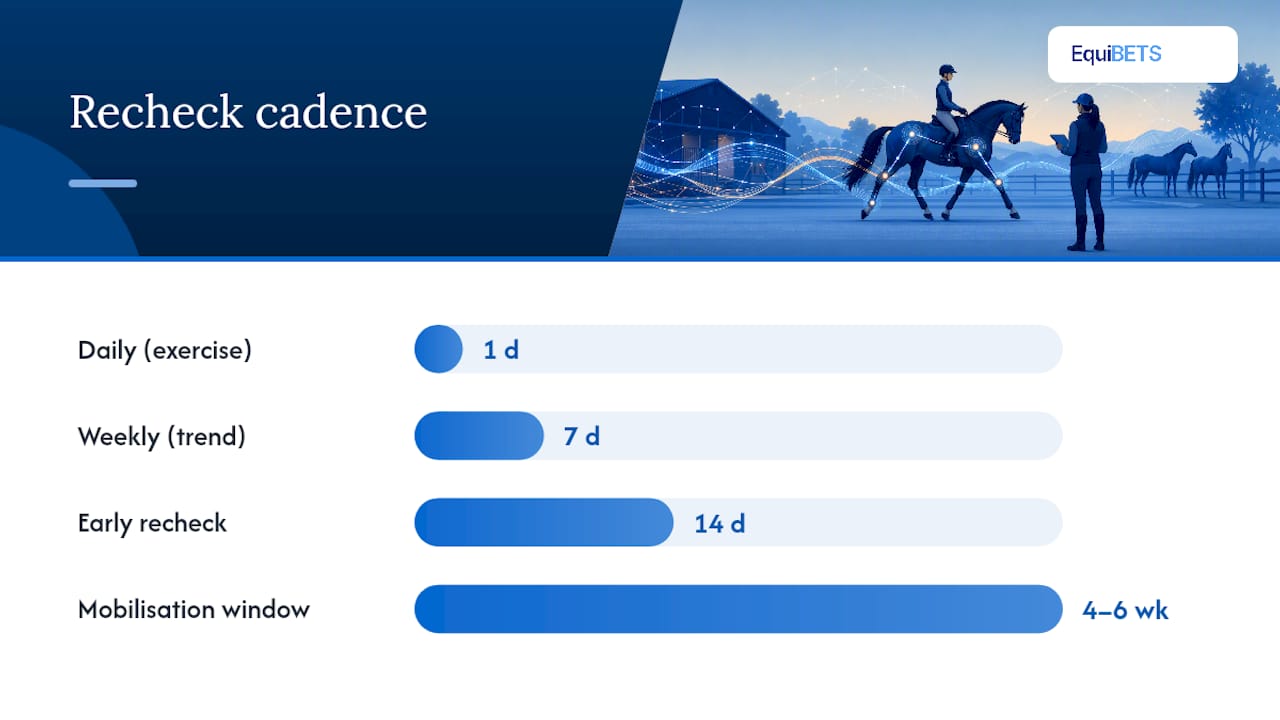
Recheck cadence isn't one-size-fits-all, but a sensible baseline holds across most soft tissue cases:
| Recovery stage | Typical recheck interval | What gets reviewed |
|---|---|---|
| Early pain mitigation | Every 2 weeks | Pain response, swelling, compliance |
| Mobilisation and strengthening | Every 4–6 weeks | Ultrasound, gait trend, ROM |
| Sport-specific preparation | Around key loading transitions | Full trend review, pivot decision |
That 4–6 week window for ultrasound and lameness reassessment reflects common clinical practice, with tighter two-week checks around major transitions such as returning to canter work or reintroducing jumping. EquiManagement's rehab guidance frames this cadence as the standard way to catch setbacks before they become re-injuries.
What actually breaks rehab tracking in busy yards?
The barrier is never the technology. It's the third week, when the novelty's worn off and someone starts skipping fields because they're rushing to muck out before the farrier arrives. The fix is boring but effective: fewer fields, same time each day, one person accountable for chasing gaps.
The other quiet failure is starting without a baseline. Capture stride and heart rate data while a horse is sound, not after the vet's already been called, so a deviation actually means something against a documented normal rather than a guess.
For syndicates managing multiple owners and a vet team who've never met, centralised records aren't a nice extra. They're the only way anyone outside the yard can trust the numbers.
— isaac
How EquiBETS consolidates rehab tracking for your yard
If your rehab data currently lives across three notebooks, a group chat and someone's memory, the fix isn't another spreadsheet template. It's one place where sensor exports, video clips and daily forms land automatically, so nobody has to reconstruct a trend line the night before a vet visit.

EquiBETS brings AI-powered movement analysis, offline mobile forms for when the arena has no signal, GPS ride logs, and owner portals that keep everyone current without another phone call. Emergency plans sit in the same platform, so a vet or first responder has the horse's history the moment they need it, not after a search through old messages.
The sensible way in is a one-horse pilot. Run your current rehab case through EquiBETS for a few weeks, invite the treating vet to view the reports directly, and see whether the weekly snapshot actually saves time compared to what you're doing now. Check the Stable Manager feature set and the single-plan pricing to start a free trial.
Sources
- Rehabilitating equine soft tissue injuries — EquiManagement
- Objective measurement in equine physiotherapy — Hartpury (2018)
- How to measure horses’ rehabilitation progress objectively — The Horse (2020)