
For most horses returning to work or building toward moderate competition, a phased 10 to 12 week plan that starts with long slow distance and progresses into interval and strength work is the safest, most effective route. Horses doing only light conditioning can shorten this to 8 to 10 weeks. Before you touch a stopwatch, run through a short safety pass: a vet sign off if there's been any recent injury, illness or a long spell off work, a basic soundness check, and a look at whether your arena, hacking routes or hills can actually support the plan you're picturing.
Once that's sorted, the plan you pick comes down to two things: where your horse's fitness sits right now, and what you're building toward.
- Coming back from time off or building basic fitness? Start with the 10 week return to work structure and its long slow distance base.
- Already hacking and schooling comfortably? Skip ahead into the conditioning and strength phases.
- Prepping for a specific event? Use the 12 week competition build and count backwards from your target date.
Key Takeaways
A phased 10 to 12 week horse training plan built on long slow distance, intervals, strength work and measured recovery reduces injury risk and produces reliable fitness gains.
| Point | Details |
|---|---|
| Get baseline data first | Record resting heart rate, recovery time and gait tolerance before writing any schedule. |
| Follow the four phases in order | Preparation, conditioning, strength and competition peaking each build a different capacity. |
| Change one variable at a time | Increase duration or intensity weekly, never both, to avoid overload injuries. |
| Watch recovery, not just effort | A slower heart rate recovery than the previous week means repeat, don't progress. |
| Centralise your training records | Equibets lets yards log sessions, nutrition and movement data in one shared, offline capable system. |
Table of Contents
- Assessing your horse's fitness and setting a training schedule for horses
- What are the core phases of an effective horse training plan?
- Sample 10 to 12 week horse training schedules you can adapt
- How do you monitor a horse's fitness and know when to adjust the plan?
- What are the biggest mistakes to avoid when conditioning a horse?
- The research behind phased horse training and equitation science
- Track training, nutrition and movement data in one place
- Frequently asked questions about horse training plans
- Sources
Assessing your horse's fitness and setting a training schedule for horses
Guessing at fitness is how horses end up sore in week three. Before writing a single session into your horse training plan, get a clear read on the animal in front of you, not the one you remember from last season.
Run through this before you start:
- Confirm the vet sign off. Anything more than two weeks off work, a past injury, or unexplained weight loss deserves a check before loading tissue again.
- Check farriery and dental work are current. A horse cannot condition properly on sore feet or an uncomfortable mouth, and neither issue shows up cleanly in an heart rate reading.
- Take baseline measures. Resting heart rate (most healthy horses sit between 28 and 44 beats per minute at rest), how quickly the pulse drops in the first minute after work, and how long the horse comfortably holds walk, trot and canter without blowing.
- Write down a concrete goal and a date. "Fit enough for weekend hacks" and "ready for a novice one day event on October 3" require entirely different training schedules.
- Start a logbook. Record date, duration, gaits worked, terrain, heart rate recovery, and any behavioural notes. Three weeks of this data is worth more than any plan template on its own.
That baseline decides everything downstream. A horse with slow recovery and limited canter tolerance needs a longer preparation phase than one that's simply been out of a program for a few weeks.
What are the core phases of an effective horse training plan?
Every workable horse training plan runs through four phases, and skipping one is the single fastest way to end up with a lame or burnt out horse. Each phase builds a different physical capacity, and each has its own risk if you rush it.
Phase 1: Preparation and long slow distance (LSD). This is aerobic base building, mostly walk and steady trot on safe, forgiving footing. Think 30 to 45 minute hacks, gradually extended. This phase develops tendons, ligaments and the cardiovascular system before anything more demanding gets asked of them, and it usually runs 2 to 4 weeks depending on starting fitness.
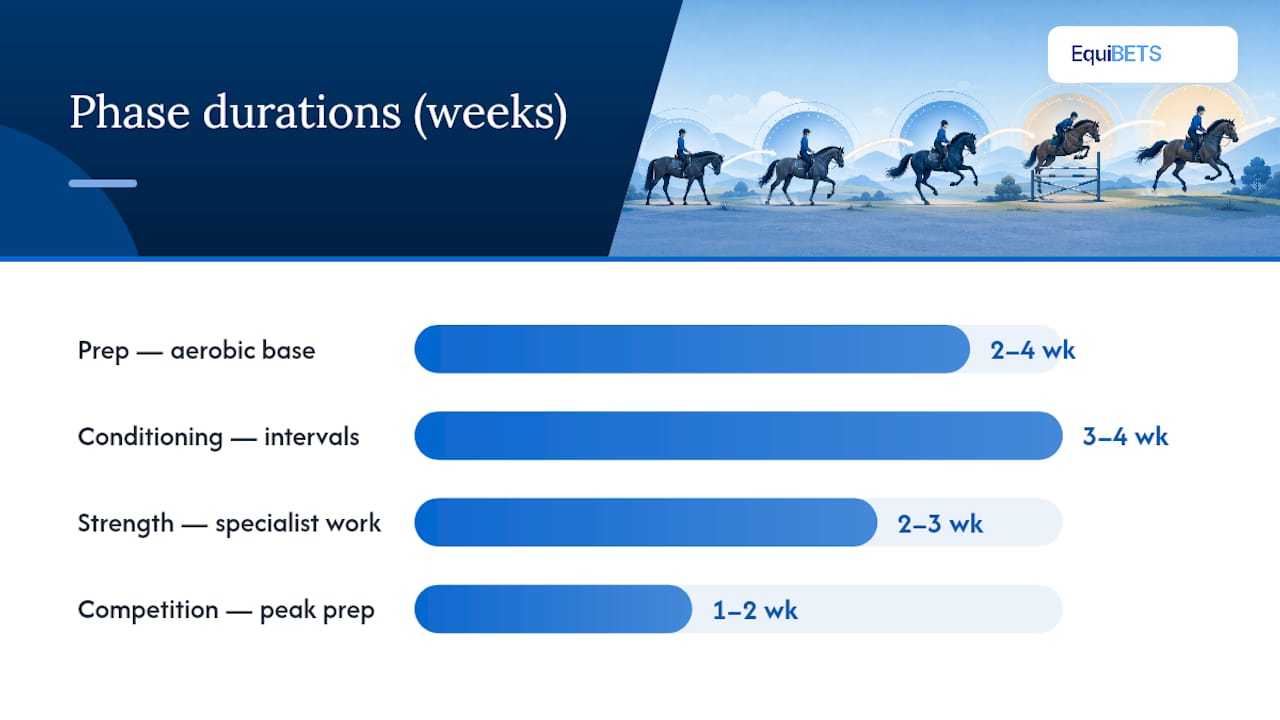
Phase 2: Conditioning and intervals. Short bursts of trot or canter work, separated by walk recovery, sharpen cardiovascular fitness faster than steady work alone. A typical set might be three minutes of working trot, two minutes of walk, repeated four to six times. This phase runs 3 to 4 weeks and is where heart rate recovery data starts earning its keep.
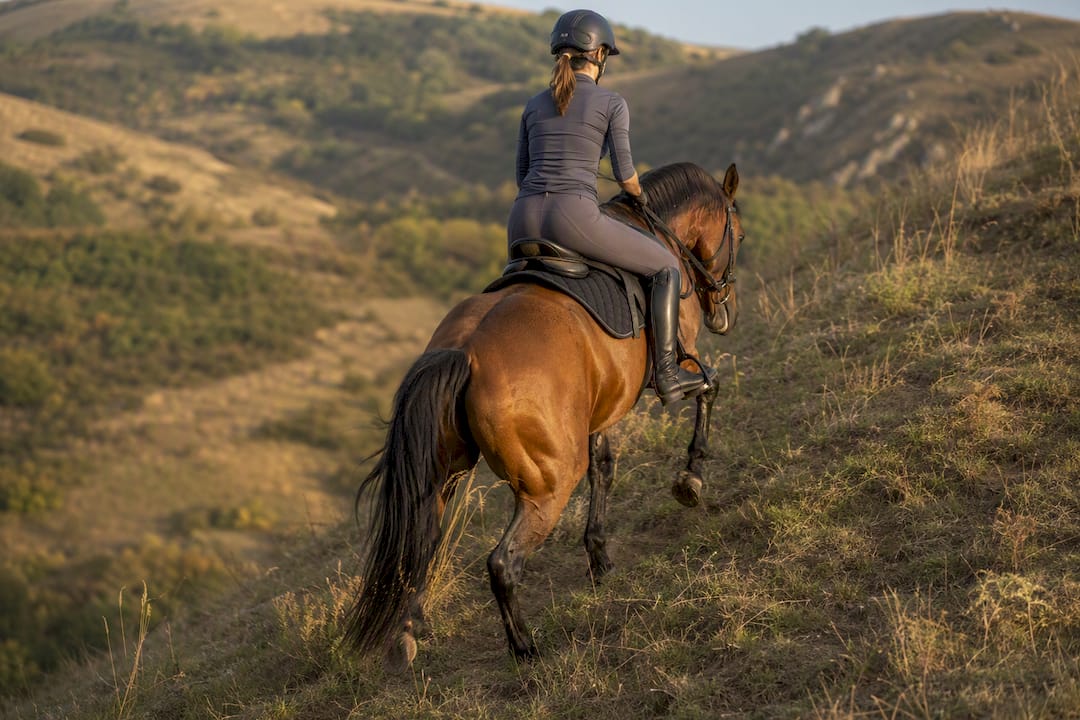
Phase 3: Strength and specialist work. Hill work, pole exercises and discipline-specific schooling (light jumping, lateral work, collected canter) load muscle and tendon in ways flat interval work doesn't. Hill work in particular builds power and hindquarter engagement that arena work struggles to replicate, according to conditioning research from Mad Barn. Expect 2 to 3 weeks here, layered on top of continuing conditioning work rather than replacing it.
Phase 4: Competition prep and peaking. Volume drops, intensity sharpens, and the final week or two before an event should feel almost easy for the horse. This is where overtraining shows up if the earlier phases were rushed.
The British Horse Society's fitness guidance recommends conservative, measurable progression through exactly this structure, with planned recovery weeks built in rather than added as an afterthought.
- Change one variable at a time. Increase duration this week, or intensity next week. Never both.
- Keep weekly increases to roughly 10 to 20% in either duration or intensity, and treat that as a guide, not a formula to hit every week regardless of how the horse feels.
- Build in at least one full rest day and one light hacking day per week, and space strength sessions at least 48 hours apart to let tissue recover.
Pro Tip: If your arena or paddock has no hills, structured interval sets and raised pole sessions create a similar strength stimulus with far less concussive load on joints, a substitution Your Horse's fitness guide backs for yards without access to good hacking terrain.
Sample 10 to 12 week horse training schedules you can adapt
Templates only work if you're willing to shift a week sideways when the horse tells you to. Use these as a starting skeleton, not a script.
10 week return to work plan:
- Weeks 1 to 2: Walk only, 20 to 40 minutes, flat ground, building duration daily.
- Weeks 3 to 4: Introduce short trot sets within hacks, 5 to 10 minutes total trot per session.
- Weeks 5 to 6: Add canter in short bursts (60 to 90 seconds), begin one interval session per week.
- Weeks 7 to 8: Introduce hill work or pole sets, two conditioning sessions and one strength session weekly.
- Weeks 9 to 10: Consolidate, add light schooling specific to discipline, assess readiness against your baseline metrics.
12 week competition build, once base fitness from the plan above is in place:
- Weeks 1 to 4: Conditioning phase, two interval sessions weekly, one hack, one rest day.
- Weeks 5 to 8: Strength phase, hill or pole work twice weekly, discipline schooling introduced.
- Weeks 9 to 10: Peak volume, combine conditioning and specialist work, this is the hardest fortnight of the whole program.
- Weeks 11 to 12: Taper. Cut volume by roughly a third, keep intensity but shorten sessions, final week should feel light.
For a single week's structure, three levels look roughly like this. A returning horse manages four sessions: two 30 minute walk hacks, one 40 minute walk/trot hack, one rest day, and two full days off. A moderately fit horse handles five sessions across the week including one interval set, one hill or pole session, two steady hacks and a rest day. A competition ready horse runs six sessions: two conditioning sets, one strength session, one discipline schooling session, one recovery hack and one full rest day.
Where hills aren't available, swap them for structured pole grids or arena interval sets, but stay alert to surface. Deep or uneven ground multiplies strain on tendons far more than a well maintained hill.
How do you monitor a horse's fitness and know when to adjust the plan?
Numbers only matter if you act on them. Track resting heart rate, how far it drops within the first one to five minutes after work, respiratory rate, gait quality, and appetite and behaviour after each session. A horse that's eating less or turning sour under saddle is usually telling you something the heart rate monitor hasn't caught yet.
Run a quick check after every session: pulse, breathing, any heat or filling in the legs, and a general read on attitude. Weekly, look back across the week's notes rather than judging off any single ride.
A workable rule of thumb: if heart rate recovery is slower than the previous week's equivalent session, or the horse needed longer to settle back to resting rate, hold that week's intensity rather than progressing, and repeat it before moving on.
- Repeat the current week if recovery times worsen or the horse seems flat.
- Drop intensity, not just volume, if soundness looks borderline rather than clearly wrong.
- Book a vet review for anything that doesn't resolve within 48 hours of rest.
- Keep every reading in one place. Trends across weeks catch problems that a single day's numbers hide.
A shared, timestamped log matters more in a multi horse yard than most people expect, because the person riding Tuesday's session is rarely the person reviewing Friday's numbers.
What are the biggest mistakes to avoid when conditioning a horse?
Most conditioning failures trace back to a small handful of repeated errors, not bad luck. Rushing into strength work before an aerobic base exists is the most common one: hill work and heavy poling before week five or six routinely produces sore backs and hind end strain. Changing two variables at once, more distance and more speed in the same week, is the second, because it makes it impossible to tell which change caused a setback if one appears.
Hard or uneven surfaces deserve more caution than most riders give them, and hacking on tarmac or frozen ground for extended trot work is a fast route to concussive injury.
Watch for these red flags and act immediately:
- Lameness at any grade, even subtle, means stop and call the vet before the next session.
- Heart rate that won't drop within five minutes post exercise signals overreach. Cut that week's plan and repeat it lighter.
- Heat, filling or swelling in a leg warrants at least 48 hours rest and a vet look if it persists.
- Marked behavioural change, sourness, reluctance, or sudden spookiness, often precedes a physical problem by days.
The research behind phased horse training and equitation science
Good conditioning plans aren't just tradition. The International Society for Equitation Science's Ten First Principles call for training that respects normal equine behaviour, uses clear and consistent cues, shapes responses gradually, manages arousal, and builds toward self-carriage rather than forcing outcomes through pressure alone. Applied to fitness work, that means reading the horse's state before asking for more, not just following a printed schedule.
There's a strong case for structuring sessions in short bursts too.
A 2021 field study comparing training methods found spaced practice, short work periods with rest between them, produced a high success rate on a novel task, substantially better than for horses trained in one massed block, a difference the study's authors attribute to reduced stress and better retention under spacing.
That's the same logic behind interval sets: short effort, real recovery, repeat. Long slow distance builds aerobic capacity and connective tissue tolerance; intervals sharpen cardiovascular fitness; hill work adds strength and engagement. Each does a different job, and rest between them is when the actual adaptation happens, not an interruption to it.
Making a training plan work in a real yard, not a spreadsheet
Ideal plans assume perfect weather, unlimited time and a horse that never has an off day. Real yards don't get that. When time is short, protect the interval or strength session over the long hack. Twenty focused minutes of well ridden intervals does more for fitness than an hour of aimless walking, and consistency across the week matters more than any single heroic session.
Short, deliberate work beats long, distracted work almost every time, particularly in the conditioning and strength phases where the horse needs to actually work within its aerobic zone rather than plod through it. If a horse's behaviour shifts, energy drops without explanation, or soundness looks borderline for more than a couple of days, that's the point to call in a vet or physio rather than pushing on and hoping the next rest day fixes it. Waiting too long is the far more common mistake than calling too early.
— isaac
Track training, nutrition and movement data in one place
Paper logbooks work until three people are riding the same horse across a week and nobody's notes match up. Equibets gives yards a single place to record every session, heart rate reading, and soundness note against the phased plan you're actually running, so a slower recovery time on Thursday doesn't get missed until Monday.

The platform's Stable Manager tool schedules sessions and vet or farriery checks across a whole yard, while AI powered movement analysis flags subtle gait changes earlier than a rider glancing over a stable door usually can. Nutrition analysis tools help match feed to workload as a horse moves through conditioning and strength phases, and owner portals keep everyone, rider, groom and owner, looking at the same numbers instead of three different memories of how last week went. Offline mobile access means none of that logging stops just because the arena has no signal. If you're running a phased plan across more than one or two horses, start a trial and see whether the feedback loop tightens.
Frequently asked questions about horse training plans
How long should a horse training plan be for return to work? Most horses need 10 to 12 weeks to return safely to full work, though light conditioning after a short break can take as little as 8 weeks if baseline fitness was already reasonable.
How often should a horse rest during a training schedule? Build in at least one full rest day weekly, plus a lighter hacking day, and space strength or interval sessions at least 48 hours apart.
What heart rate recovery indicates good fitness in horses? A fitter horse's heart rate drops noticeably within the first one to five minutes after exercise. Watching the trend across weeks matters more than any single reading.
Can the same training plan work for dressage, jumping and endurance horses? The four core phases apply broadly, but specialist work in phase three should shift toward the discipline's demands, collected work for dressage, grid work for jumping, and longer steady distance for endurance.
What's the biggest sign a horse needs a break from training? Lameness at any level, heart rate that won't settle within five minutes, or a marked change in behaviour or appetite all call for reduced work and, if it persists beyond 48 hours, a vet review.
Sources
- Equitation science review: ISES principles (peer-reviewed)
- Study on spaced vs massed training in horses (2021)
- Developing a fitness programme | British Horse Society
- Fitness plan: experts advise how to get a horse fit — Your Horse