

For most Australian horse owners, a GSM/4G GPS collar or tag covers everyday paddock and ride tracking at the lowest cost. Satellite trackers are the right call for remote properties where mobile coverage drops out. A platform like Equibets sits above both: it ingests GPS ride data and connects it to yard management, owner portals and AI movement analysis in one place.
Quick picks by use-case:
- Remote grazing (no mobile coverage): Satellite tag, such as CERES GEN6 or RANCHER via 4Tags. Higher device cost, but works where nothing else does.
- Paddock and ride tracking (mobile coverage available): GSM/4G collar or tag, such as GrazerTrack or a 4G multi-GNSS device. Modest monthly data fee, good update rates.
- Ride safety and theft recovery: Compact GSM tracker clipped to tack, such as Tracki Pro, TrackiPet or Jiobit. Low entry price, subscription required.
- Yard and multi-horse operations: Platform-first approach with Equibets, which combines GPS ride tracking with stable management and owner portals under a single subscription.
Price bands run from roughly $30–$80 AUD for entry-level consumer trackers up to several hundred dollars for satellite hardware, plus ongoing data fees that vary widely by technology.
The single most important buying decision: match the tracker technology to your coverage, not your budget. A cheap GSM tracker on a remote property is useless the moment the signal drops.
Key takeaways
Satellite trackers are the only reliable option for remote Australian properties without mobile coverage; GSM/4G covers most paddocks and rides where signal exists.
| Point | Details |
|---|---|
| Match tech to coverage first | Satellite for remote properties, GSM/4G where mobile coverage exists, Bluetooth for yard/ride only. |
| Check three specs before buying | Waterproof rating (IP67+), battery life for your use-case, and update interval (1 min for rides, 10–60 min for paddocks). |
| Calculate two-year cost | Add device price plus monthly subscription over 24 months; a cheap device with a costly plan often costs more. |
| Ask vendors four questions | Australian stock availability, SIM network and roaming, warranty process, and data export format. |
| Equibets for yards | Equibets connects GPS ride data to stable records, owner portals and emergency plans under one subscription. |
Table of Contents
- What GPS horse trackers are available to Australian buyers?
- How do satellite, GSM and Bluetooth tracking actually differ?
- What specs should you check on a horse GPS device?
- How do you choose the right tracker for your horse?
- Where does each tracker type actually work in Australia?
- Fitting trackers and keeping them working on horses
- Equibets: GPS ride tracking inside a full yard platform
- What does GPS horse tracking actually cost in Australia?
- Which tracker should you choose for your situation?
- A candid view on GPS tracking and what actually matters
- Equibets brings GPS ride data into your whole yard workflow
- Sources
What GPS horse trackers are available to Australian buyers?
The table below covers the main options across tracker type, coverage, update frequency, battery, attachment and typical cost shape. Accuracy figures are vendor-stated where available.
| Product | Tracker type | Coverage | Update frequency | Accuracy | Battery / solar | Attachment | Device cost + subscription | App features | Best for |
|---|---|---|---|---|---|---|---|---|---|
| Equibets | Platform (ingests GPS data) | Depends on paired device | Depends on paired device | Depends on paired device | N/A (software) | Phone / paired hardware | Single subscription, all modules | GPS ride history, owner portals, AI movement analysis, offline mobile, emergency plans | Professional yards, syndicates, multi-horse operations |
| CERES GEN6 / RANCHER (via 4Tags) | Satellite (GSat network) | Near-universal Australia-wide | Configurable intervals | ~5–15 m (vendor-stated) | Long-life battery, solar options | Tag / collar | Higher device cost + satellite data plan | Geofencing, alerts, location history | Remote grazing, no-coverage properties |
| GrazerTrack horse & wildlife collar kits | GSM/4G collar | Mobile network footprint | Frequent (network-dependent) | ~5–15 m typical | Rugged battery, solar options | Collar | Mid-range device + data plan | Geofencing, livestock alerts | Large grazing blocks, mixed livestock |
| Steed (Steed EMS) | GSM/4G + biometric | Mobile network footprint | Real-time streaming | ~5–15 m typical | Rechargeable | Wearable device | Device + subscription | Vitals + GPS, geofencing, health alerts | High-value competition horses |
| Tracki Pro | GSM/4G (multi-network) | Mobile network footprint | 1–60 min selectable | ~5–15 m typical | 3–7 days typical | Compact tag, tack-mounted | Low device cost + monthly plan | Basic alerts, location history | Budget buyers, theft recovery |
| TrackiPet | GSM/4G | Mobile network footprint | Frequent | ~5–15 m typical | Short (compact battery) | Clip / tack attachment | Low device cost + subscription | Alerts, ride tracking | Ride safety, non-remote use |
| Hoofstep | GSM/4G + movement sensor | Mobile network footprint | Frequent | ~5–15 m typical | Rechargeable | Leg/halter wearable | Mid-range + subscription | Movement analytics, location, training data | Performance and training horses |
| Jiobit GPS Tracker | GSM/4G + Bluetooth | Mobile network / BT | Frequent | ~5–15 m typical | Short (very compact) | Clip / lightweight mount | Low device cost + subscription | Basic location, alerts | Lightweight ride/handler tracking |
| Whistle GPS Pet Tracker | GSM/4G + activity | Mobile network footprint | Frequent | ~5–15 m typical | 7–10 days typical | Collar attachment | Mid-range + subscription | Activity + GPS, health features | Casual yard use, ride-sharing safety |
| UBEE CLIP | GSM/4G | Mobile network footprint | 1, 10 or 60 min selectable | 5–15 m (vendor-stated) | 450 mAh, 3–4 days standby | Clip (23 g) | Mid-range + subscription | Virtual fence, location history | Ride tracking, theft recovery |
A few things worth noting before you shortlist:
- Tracki Pro, TrackiPet and Jiobit are consumer trackers not purpose-built for horses. They work, but durability and attachment options are limited compared to purpose-built equine hardware.
- Whistle is designed for dogs and cats. Some riders adapt it for horses in low-risk, non-remote settings, but it is not rated for equine use.
- Equibets is a software platform, not a standalone tracker. It pairs with GPS hardware and adds the management layer most yards are missing.
How do satellite, GSM and Bluetooth tracking actually differ?
The technology underneath a tracker determines where it works, how often it updates and how long the battery lasts. Getting this wrong is expensive.
Satellite trackers
Satellite devices communicate via low-earth-orbit networks (such as the GSat network used by CERES tags) rather than mobile towers. Coverage is near-universal across Australia, including the remote stations where Telstra and Optus signals disappear. The trade-off is cost: satellite hardware is more expensive, data plans carry higher per-message fees, and update intervals are often measured in minutes rather than seconds. Weight and battery consumption are also higher than GSM equivalents.
CERES GEN6 and RANCHER tags, available through 4Tags in Australia, sit in this category. They are the practical choice when a horse grazes beyond mobile coverage and a missed alert could mean a lost animal on a large property.
GSM/4G trackers
Most trackers on the market use the mobile network. When coverage is available, GSM/4G devices deliver frequent location updates, support real-time geofencing alerts, and cost far less to run than satellite alternatives. The 4G Master GPS tracker illustrates what the higher end of this category offers: multi-GNSS positioning across GPS, Galileo, GLONASS and BeiDou, global 4G/5G connectivity, virtual fencing and professional battery systems designed for wide-area livestock tracking.
GrazerTrack collar kits, Tracki Pro, TrackiPet, Hoofstep, Jiobit and Whistle all fall into the GSM/4G category. So does Steed, which layers biometric monitoring on top of GPS to stream vitals and location simultaneously.
A geofence is a virtual boundary that triggers an alert when a device crosses it. Every GSM tracker worth considering supports geofencing. The limitation is simple: if the horse walks into a mobile black spot, the alert never arrives.
Bluetooth and phone-based tracking
Bluetooth trackers and phone-based apps like Equilab work at short range or rely on the rider's phone for positioning. Equilab tracks live ride location, gait and speed analytics, and lets riders share their location with safety contacts. It is excellent for ride logging and training analysis, but it is not a substitute for a dedicated GPS device when a horse is unattended in a paddock.
The practical summary:
- Satellite: works everywhere, costs more, slower updates
- GSM/4G: works where mobile coverage exists, frequent updates, lower cost
- Bluetooth/phone: yard and ride use only, no standalone coverage
Hybrid devices that combine GPS positioning with GSM connectivity and Bluetooth are increasingly common. They use GPS satellites to calculate position, then transmit that position via the mobile network. When the mobile signal drops, position data is buffered and sent when connectivity returns.
What specs should you check on a horse GPS device?
Vendor marketing pages are full of impressive-sounding numbers. Here is what actually matters when comparing devices.
Core specs to verify:
- Accuracy: Most GSM/GPS devices claim 5–15 metres under open sky. The UBEE CLIP, for example, states GPS accuracy of 5–15 m with a 23 g form factor and selectable update rates of 1, 10 or 60 minutes. That is a realistic benchmark for the category.
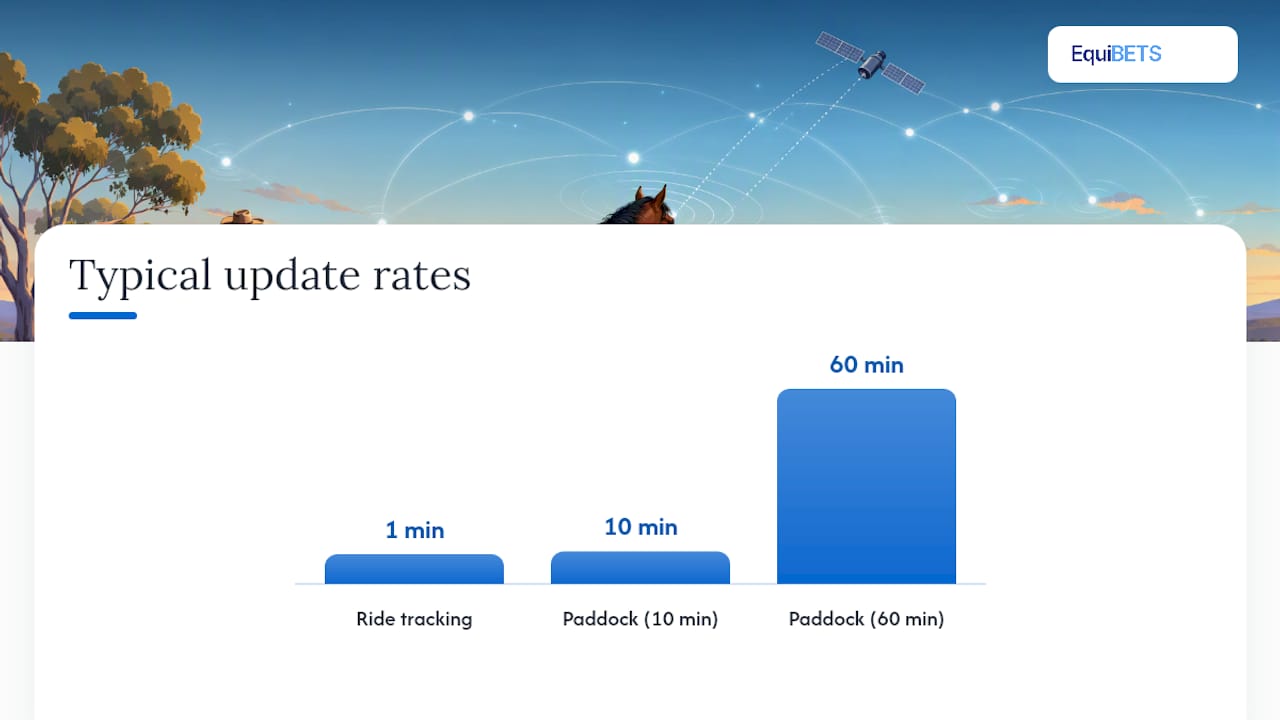
- Update rate / latency: How often does the device report position? Every 1 minute is useful for ride tracking. Every 10–60 minutes is acceptable for paddock monitoring. "Real-time" in marketing copy often means 1-minute intervals, not continuous streaming.
- Battery life: Compact ride trackers trade battery for size. The UBEE CLIP's 450 mAh battery gives roughly 3–4 days standby. Livestock collars with larger batteries or solar panels can run weeks to months between charges.
- Waterproof rating: Look for IP67 or IP68 as a minimum for a horse environment. Horses sweat, roll and wade. A device rated IPX4 (splash-resistant) will not survive a creek crossing.
- Weight and form factor: Anything over 100 g on a halter or collar becomes a snag and welfare risk. Compact tags like the UBEE CLIP at 23 g are appropriate for tack attachment. Heavier livestock collars are designed for that purpose and sit differently on the animal.
- Attachment options: Tags clip to halters or bridles. Collars sit around the neck. Leg-mounted wearables (like Hoofstep) attach below the knee. Each has different snag and loss risks.
- App features: Geofencing alerts, location history, firmware updates over the air, and data export are the four features that separate useful apps from basic ones. Most GPS systems pair with a smartphone app, as demonstrated by tracker apps on both Google Play and the App Store.
- Integration and APIs: If you run a yard management platform, check whether the tracker's data can be exported or integrated. Equibets ingests GPS ride data and connects it to stable records, owner portals and emergency plans.
Warranty and Australian support:
Check whether the device ships from Australian stock or arrives from overseas. Warranty claims on overseas-only stock can take weeks. Ask the vendor directly: Is there Australian stock? Who handles warranty replacements? What is the SIM situation if I travel between states?
Pro Tip: For horses that are rugged or wear neck covers, a collar-mounted tracker can be hidden under the rug and lost without notice. A halter-clip or mane-mounted tag is easier to check visually at each daily inspection.
How do you choose the right tracker for your horse?
Work through these decisions in order. Skipping to price first is how buyers end up with a tracker that does not work on their property.
- Define your primary use-case. Remote paddock monitoring, ride safety, theft recovery and yard management each need different technology. A tracker that excels at one often compromises on another.
- Check your coverage. Open a coverage map for Telstra and Optus (the two networks with the widest rural reach in Australia). If your property sits in a black spot, satellite is your only real option.
- Set your update-rate requirement. Paddock monitoring can tolerate 10–60 minute intervals. Ride tracking benefits from 1-minute or faster updates. Real-time biometric streaming (Steed) requires a stable mobile connection.
- Calculate total cost of ownership. Device price is only the start. Add the monthly data or subscription fee, multiply by 24 months, and compare across options. A cheap device with an expensive plan often costs more than a mid-range device with a modest plan.
- Confirm attachment compatibility. Match the device form factor to your horse's tack and management routine. A collar tracker on a horse that is never haltered is a welfare and loss risk.
- Verify Australian availability and support. Ask the vendor: Do you hold Australian stock? What is the warranty period and process? Does the SIM roam automatically across Telstra and Optus?
Questions to ask any vendor before buying:
- What network does the SIM use, and does it automatically select the strongest carrier in my area?
- What is the warranty period and replacement process for Australian customers?
- Can I export my location data, and in what format?
- Is there a local dealer or support contact in Australia?
Red flags on product pages:
- Accuracy claims below 3 metres without independent verification (consumer GPS hardware does not achieve this)
- No IP waterproof rating listed
- No mention of SIM or network compatibility for Australia
- No warranty period stated
- "Real-time" tracking with no definition of update interval
Where does each tracker type actually work in Australia?
Australia's geography makes network coverage the single most important variable in this decision.
Telstra's 4G network covers the largest rural footprint of any Australian carrier, but large parts of outback Queensland, Western Australia, South Australia and the Northern Territory sit outside it. Optus covers a smaller rural area. Vodafone (now merged with TPG) is largely metropolitan. For properties in regional or remote areas, check Telstra's coverage map against your specific paddock locations before buying any GSM device.
Satellite trackers, including CERES GEN6 and RANCHER tags available through 4Tags, operate independently of mobile towers. They are the only technology that works reliably on remote stations. The cost premium is real: satellite data plans typically charge per message or per day of connectivity, and hardware costs more than GSM equivalents.
SIM and roaming considerations:
- Some trackers ship with a built-in global SIM that automatically selects the strongest available network. This is the best option for properties near carrier boundaries.
- BYO SIM devices let you choose your own plan, which can reduce ongoing costs if you are already on a Telstra business account.
- Confirm whether the device supports Australian 4G bands (B28 at 700 MHz is the critical rural band in Australia). A device that only supports B3 or B7 will struggle in regional areas.
Before you buy any GSM tracker: take your phone to the paddock where the horse will spend most of its time and check signal strength. If you have two bars or fewer on Telstra, test the tracker in that location before committing to a subscription. Most vendors will not refund a subscription once activated.
Geofencing works wherever the tracker has connectivity. On a satellite device, a geofence alert may arrive minutes after the horse crosses the boundary due to the longer update interval. On a GSM device in good coverage, the alert can arrive within seconds. Neither is a substitute for good physical fencing: a geofence is an alert tool, not a containment method.
Fitting trackers and keeping them working on horses
Getting the device on the horse correctly matters as much as choosing the right one.
Attachment by device type:
- Collar trackers (GrazerTrack, CERES RANCHER): Fit with two fingers of clearance. Check weekly for rubbing, especially on horses with fine skin or thin coats. Collars on horses that roll frequently need more regular inspection than those on horses in stable management.
- Halter-clip tags (UBEE CLIP, Tracki Pro, TrackiPet): Clip to the side ring of a well-fitting halter. Avoid the noseband, where the device can be knocked off during grazing. Check the clip mechanism at every catch.
- Tack-mounted tags (Jiobit, TrackiPet): Attach to a breastplate D-ring or saddle D-ring for ridden work. Remove before turnout unless the device is rated for unsupervised use.
- Leg/wearable devices (Hoofstep): Follow manufacturer fitting guides precisely. An incorrectly fitted leg device can cause pressure injuries within hours.
Routine maintenance:
- Daily: Visual check that the device is present, undamaged and correctly positioned. Check the app for last-known location and battery level.
- Weekly: Confirm firmware is up to date, check strap or clip wear, wipe the device clean and inspect waterproof seals.
- Monthly: Full battery or solar health check. For solar-assisted devices, clean the panel. Test the geofence alert by walking the device across the boundary yourself.
A tracker that has not been checked in a week may have a flat battery, a failed clip or a firmware issue. None of those failures announce themselves until you need the device most.
Equibets: GPS ride tracking inside a full yard platform
Equibets is not a GPS hardware manufacturer. It is the management layer that makes GPS data useful across a whole yard operation.
For a single horse and a single rider, a standalone tracker and a basic app is often enough. For professional yards, syndicates and multi-horse operations, the data problem is different: GPS ride history needs to connect to training records, owner updates, emergency plans and health notes. Equibets does that in one place.
What Equibets adds to GPS data:
- GPS ride history is stored and linked to individual horse records, so a trainer can review a horse's workload alongside feeding, health and competition data.
- Owner portals give syndicate members and horse owners live updates without the yard manager fielding phone calls.
- Emergency plans attach GPS location data to vet and responder contacts, so critical information is accessible offline when it matters most.
- AI movement analysis sits alongside GPS data to flag changes in gait or activity that may indicate health issues before they become emergencies.
The stable manager module handles team coordination, task management and horse records. GPS ride data feeds into that workflow rather than sitting in a separate app that nobody checks.
Which yards benefit most:
- Professional training yards with multiple horses and multiple owners to update
- Syndicates where GPS ride data is part of the reporting obligation
- Yards that already use digital records and want GPS to connect to them, not sit alongside them
Pro Tip: Before committing to a combined hardware and software purchase, test your GPS hardware in the paddock and confirm it exports data in a format Equibets can ingest. Most standard GPX or CSV formats work, but verify with the Equibets team during your trial.
What does GPS horse tracking actually cost in Australia?
The device price is rarely the biggest number over two years. Subscription and data fees are.
| Category | Typical device cost (AUD) | Typical ongoing cost | Example products |
|---|---|---|---|
| Entry-level consumer trackers | $30–$80 | $5–$15/month | Tracki Pro, TrackiPet, Jiobit |
| Mid-range GSM equine/livestock | $100–$200 | $10–$30/month | GrazerTrack, UBEE CLIP, Whistle, Hoofstep |
| Satellite tags | $200+ | $30–$80+/month (data plan) | CERES GEN6 / RANCHER via 4Tags |
| Integrated platforms (software) | Hardware separate | Single subscription (all modules) | Equibets |
A few practical notes on cost:
- Satellite plans often charge per message or per day of connectivity. A horse that triggers frequent alerts on a satellite plan can run up costs quickly. Set update intervals conservatively and review after the first month.
- Some GSM trackers bundle a SIM and 12 months of data in the purchase price. Read the fine print: "12 months included" sometimes means a low-data tier that throttles after a few weeks of active use.
- Equibets operates on a single subscription plan that covers all modules, unlimited horses and unlimited team members. There is no per-horse fee and no module add-on cost.
- For true cost-of-ownership comparison, add device replacement cost (what happens if the tracker is lost or damaged?) and battery replacement or solar maintenance over a two-year period.
Pro tip on multi-year cost: A $50 tracker with a $15/month plan costs $410 over two years. A $200 tracker with a $10/month plan costs $440. The difference is small, but the $200 device is usually more durable and better supported. Factor in one replacement device for the cheap option and the maths shifts significantly.
Which tracker should you choose for your situation?
Match your scenario to the right tool and you will avoid the most common buying mistakes.
Remote grazing (no reliable mobile coverage): Satellite is the only technology that works. CERES GEN6 or RANCHER tags via 4Tags are the Australian-available option in this category. Budget for higher hardware and data costs.
Paddock and ride tracking (mobile coverage available): A GSM/4G collar or tag covers most needs. GrazerTrack collar kits suit large grazing blocks. For ride-specific tracking, the UBEE CLIP at 23 g and 3–4 days battery is a practical option. Tracki Pro and TrackiPet work for theft recovery and ride safety at low entry cost.
High-value competition horses: Steed pairs biometric monitoring with GPS, streaming vitals and location to the app simultaneously. If knowing your horse's heart rate and location in real time matters, Steed is the only product in this list that delivers both.
Training and performance analysis: Hoofstep adds movement analytics to location tracking, which suits trainers who want to connect GPS data to gait and workload analysis.
Professional yards and syndicates: Equibets is the right starting point. GPS ride data connects to owner portals, stable records, emergency plans and AI movement analysis under one subscription. Start with the free trial and test your GPS hardware compatibility before committing.
One-line next step: Check Telstra coverage at your paddock location, then match the technology to that coverage before comparing device prices.
Red flags to watch for: Any device claiming sub-3-metre accuracy without independent verification, no IP waterproof rating, no stated warranty period, or no clarity on Australian SIM compatibility. If a vendor cannot answer those four questions clearly, look elsewhere.
A candid view on GPS tracking and what actually matters
The tracker market is full of products that work well in a demo and disappoint in a paddock. The gap between a product page and a real paddock is wider than most buyers expect.
The honest truth is that most GSM trackers perform similarly in good coverage. The meaningful differences show up in three places: how the device attaches to the horse, how the app handles alerts when you are not watching, and what happens when something goes wrong and you need support. A tracker that falls off at the first roll, sends alerts you cannot act on, or has no Australian support contact is not a useful tool regardless of its spec sheet.
The argument for a platform-first approach is not that GPS hardware is unimportant. It is that GPS data sitting in a standalone app is only marginally more useful than no GPS data at all, for a yard managing multiple horses and multiple owners. The value of knowing where a horse is doubles when that information connects to who owns it, what its emergency plan says and who the vet is. That is what a platform like Equibets adds, and it is the reason professional yards tend to move toward integrated solutions once they have tried standalone trackers for a season.
Single-purpose trackers still make sense. A trail rider who wants to share their location with a safety contact does not need a yard management platform. A horse on a remote station needs satellite hardware, full stop. The mistake is assuming one solution fits every scenario.
Equibets brings GPS ride data into your whole yard workflow
GPS hardware tells you where a horse is. Equibets tells you what to do with that information.

The Equibets platform connects GPS ride history to individual horse records, owner portals, emergency plans and AI movement analysis in one offline-capable mobile app. For professional yards, syndicates and multi-horse operations, that connection is what turns location data into something a trainer, owner or vet can actually act on. There is no per-horse fee and no module add-on: one subscription covers the full platform, unlimited horses and your whole team.
Check the pricing page for plan details, or start a free trial and test GPS ride data import with your existing hardware before committing. If you manage a professional yard and want to see how the stable manager and owner portals work alongside GPS data, the stable manager overview is the right place to start.
Sources
Before purchasing, confirm Australian stock availability directly with the vendor or reseller. Overseas-only stock means longer warranty turnaround and potential SIM compatibility issues.