
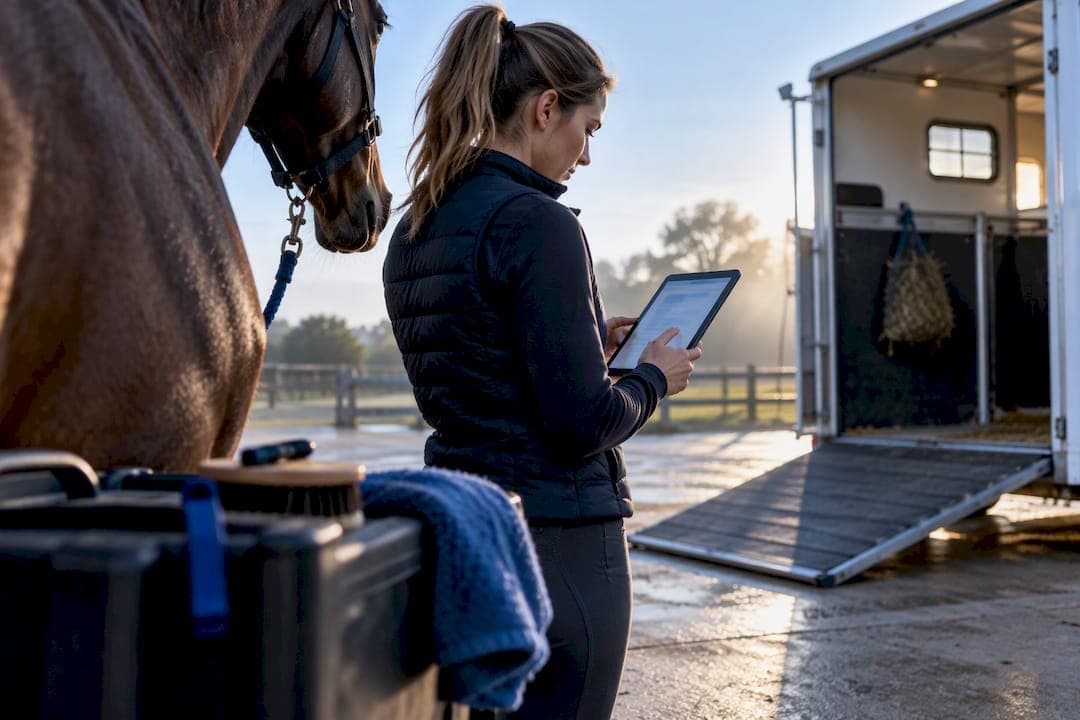
Yes, you can capture and use horse data offline. Photos, clinical notes, treatments and ride logs can be recorded without signal and synchronised securely once you're back in range. Purpose-built offline-first apps handle this reliably, unlike browser-based tools that need a connection to save anything. This guide covers what to record offline, how the underlying sync technology works, a pre-departure checklist, and the security questions worth asking before you trust a device paddock-side.
TL;DR:
- Offline horse data capture can store identification, clinical notes, photos, ride logs, medication records, and treatments, but not large videos or online-required signatures.
- Offline-first apps keep a full local copy of data and sync automatically once reconnected, but may drain device battery and cause conflicts if multiple users edit simultaneously.
- Pre-departure steps, including syncing, device charging, Bluetooth pairing, and storage checks, ensure reliable data capture before losing signal.
- When reconnecting, apps reconcile conflicts by timestamps or prompts, emphasizing the need for backup options and audit logs to verify successful uploads.
- Data security depends on device encryption and role-based server access, with policies for lost devices and privacy policies essential for trustworthy offline storage.
Table of Contents
- What can you actually capture offline for horses?
- How does offline data capture actually work?
- Pre-departure checklist: what to do before you lose signal
- What happens when your device reconnects?
- Is offline horse data actually secure?
- How EquiBETS handles offline field work
- Field notes: what actually goes wrong
- Run your yard on offline-first data, not hope
- Where to check further details
- Sources
- FAQ
What can you actually capture offline for horses?
Offline horse data capture covers most of what a working day in the field demands. The gap is anything that depends on someone else's system responding in real time.
- Identity and registration details — microchip numbers, brand marks, passport data for quick identification.
- Photos and short video clips — wound progression, conformation checks, lameness assessments.
- Ride and training logs — distance, duration, heart rate, GPS tracks recorded during the session.
- SOAP notes and clinical records — subjective, objective, assessment and plan entries written barn-side.
- Vaccination and medication records — batch numbers, doses, withdrawal periods.
- Treatments and procedures — anything a vet or farrier performs on site.
- Invoices and emergency plans — billing line items and critical contact information.
Each of these matters because it's the record someone reaches for under pressure. A missing vaccination date delays a competition entry. A vague treatment note costs the next vet ten minutes of guesswork. Where offline capture hits limits is large video files that need real bandwidth to upload, third-party verification steps like registry lookups, and any document that legally requires an online signature or portal confirmation.
How does offline data capture actually work?
Two architectures dominate this space, and the difference matters more than most buyers realise.
- Offline-first (local-first) apps store a full working copy of your data on the device itself, in a local database, then queue every change you make while disconnected.
- Cached or PWA-style tools rely on browser caching and a service worker; they need an initial online connection to install, and their offline depth varies depending on what's been cached in IndexedDB.
- Hybrid partial-offline modes let you view some data offline but block editing or new entries until you reconnect.
Ambulatory equine systems built offline-first let clinicians write SOAP notes, log procedures and generate invoices with zero signal, then push everything to the server once coverage returns, according to StableTrack's product documentation. GlobalVetLink's HorseSync takes the second approach: it captures photos and horse profile data in the field, but needs that initial web connection to install before it works offline at all.
The trade-off is storage and battery. A true offline-first app holds more data locally, which uses more device memory and drains battery faster during a long day. It also means two people editing the same horse's record on separate devices won't see each other's changes until both sync.
Pre-departure checklist: what to do before you lose signal
The best offline capture happens before you leave the yard, not after something goes wrong in the paddock.
Before you go:
- Open the app and force a manual sync while you still have signal.
- Download today's roster, medication schedules and any reference lists you'll need.
- Charge every device fully, including backup phones or tablets.
- Pair any Bluetooth readers (microchip scanners, heart rate monitors) while connected.
- Check local storage has enough free space for photos and video.
On site:
- Capture photos and key identifiers first, before anything else, in case the visit gets cut short.
- Use voice-to-text for SOAP note drafts rather than typing one-handed near a horse.
- Timestamp every entry as you make it, not from memory later.
- Attach batch numbers to every medication entry immediately.
- Avoid two people editing the same horse record simultaneously on different devices.
Post-day:
- Connect to reliable Wi-Fi as soon as you're back.
- Check the sync log to confirm every entry uploaded.
- Verify invoices and critical clinical entries specifically, since these carry the most downstream consequences if lost.
Pro Tip: Run your sync check before you leave the vehicle, not after you've unpacked. A failed sync you catch at the gate costs two minutes; one you catch tomorrow costs a full re-entry session.
For a longer version of this process built specifically around multi-horse rounds, EquiBETS runs through a seven-step pre-sync checklist worth bookmarking.
What happens when your device reconnects?
Sync isn't instant, and it isn't magic. Once your device finds signal, every queued write uploads in order, and the server reconciles incoming changes against what's already stored, using timestamps to decide which edit came first.
Conflicts happen when two people edit the same record before either syncs. Most apps handle this one of three ways: last-write-wins (the most recent timestamp overwrites the earlier one, silently), a manual merge prompt (the app flags the conflict and asks you to choose), or an audit log that records both versions without forcing a decision. Last-write-wins is the riskiest pattern for clinical data, because a farrier's note and a vet's note about the same visit could quietly overwrite each other. Ask any offline app directly how it surfaces conflicts before you trust it with medication records.
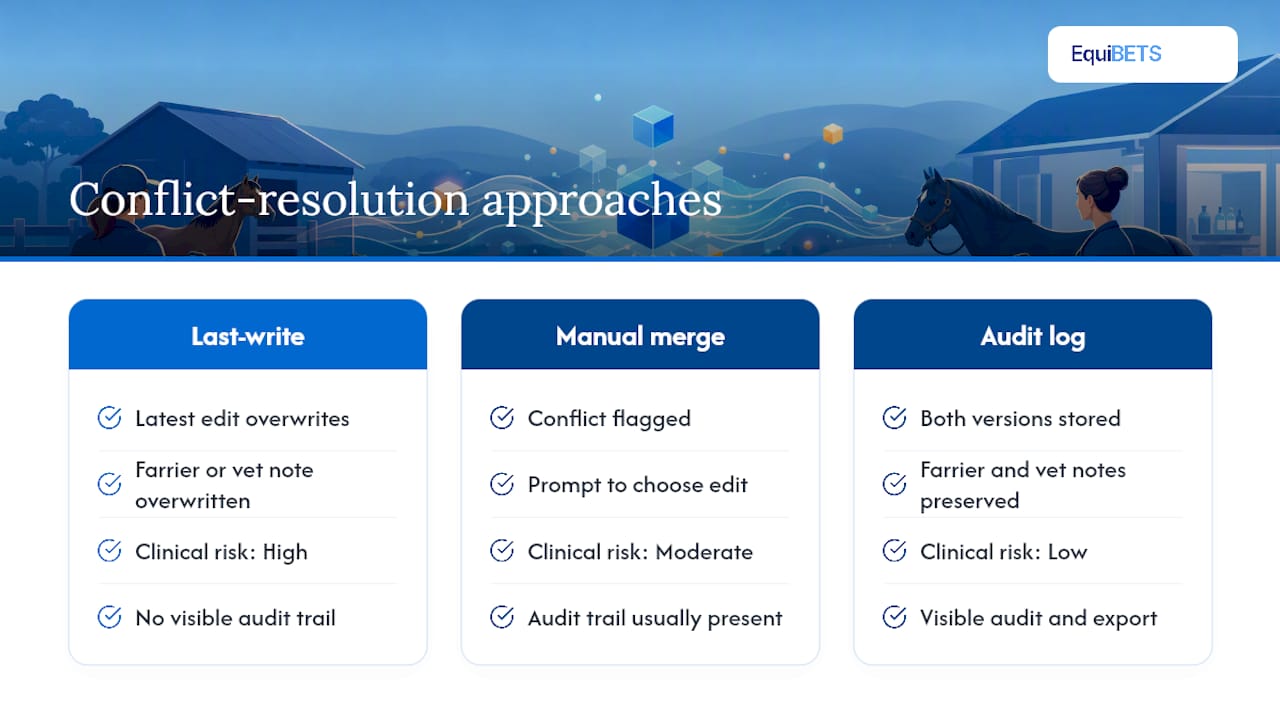
Recovery matters just as much as sync itself. Look for export or backup options, a visible audit trail showing who changed what and when, and a straightforward way to confirm an upload actually completed rather than just assuming it did.
Is offline horse data actually secure?
Offline storage introduces a different risk profile than cloud-only tools: the data sits physically on a device that can be lost, stolen or borrowed.
Device-level protections matter first. Encryption at rest, an enforced PIN or biometric lock, and a separate app-level passcode all reduce what someone can access if a phone goes missing at the yard. On the server side, look for TLS encryption in transit and role-based access control, so a groom's login can't pull up billing data and a bookkeeper can't see clinical notes.
- Confirm the app encrypts local data at rest, not just data in transit.
- Set a lost-device procedure before you need one, including remote wipe if the app supports it.
- Write a shared-device policy for yards where multiple staff use the same tablet.
- Keep emergency access to critical records simple for vets who need fast routes in a crisis.
Review any vendor's privacy policy directly, the same way you'd check Google's app privacy standards before trusting a store listing.
How EquiBETS handles offline field work
EquiBETS was built around the assumption that yards lose signal constantly, not occasionally. The app works fully offline on mobile, so a vet round, a foaling watch or a lesson at a remote paddock never stalls waiting for bars.
- Offline mobile access across horse records, treatment logs and ride data, with sync queued automatically.
- Vet-fast routes to pull up a horse's full history in seconds during an emergency call-out.
- FEI-ready trot traces generated from movement data, so competition documentation is ready without extra admin.
- Owner portals that update automatically once a session syncs, keeping owners informed without a phone call.
The platform's own seven-step pre-sync checklist walks through exactly what to check before a device leaves the office, covering storage, Bluetooth pairing and roster downloads in the order that actually prevents lost data.
Field notes: what actually goes wrong
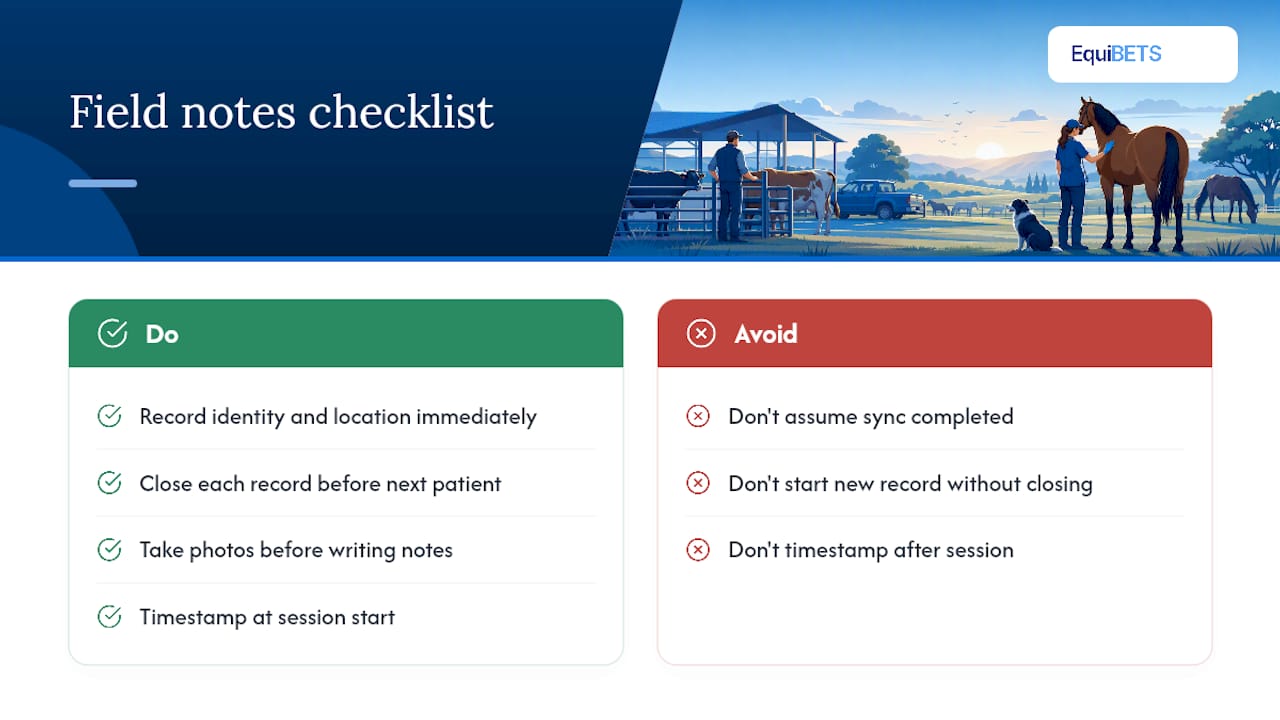
Record identity and location details the second you arrive, before anything else. Everything else, including a polished write-up of a SOAP note, can wait until you're back at the truck. The most common sync mistake isn't a technical failure; it's someone assuming a sync finished because the app didn't complain.
A vet doing six horses in one barn visit needs each record closed before starting the next, or entries blur together. A foaling box entry at 2am needs the photo taken first, notes second. Trainers logging rides should timestamp at the start of the session, not after, since memory of exact splits fades fast. For deeper step-by-step procedures, the equine medical records guide covers documentation standards worth adopting yard-wide.
— isaac
Run your yard on offline-first data, not hope
Most yards patch together a phone camera, a paper diary and a spreadsheet that only updates back at the office, which means half the day's detail never makes it into a permanent record. EquiBETS Complete replaces that gap with one offline-first workspace: mobile access that keeps working with zero signal, vet-fast routes to pull a horse's full history during an emergency, FEI-ready trot traces generated straight from movement data, and owner portals that update the moment a session syncs.

There's a free trial before you commit to anything, and the plan itself is EquiBETS Complete at $9.99 AUD per month, covering every module rather than charging separately per feature. If you manage a professional yard, run a syndicate, or handle ambulatory vet work across multiple properties, start the trial and load your current roster in before your next round. You'll know within a week whether it holds up against a dead zone.
Where to check further details
For regulatory context, HISA's own announcement covers how its MedEnt app handles offline treatment entry for licensed vets. GlobalVetLink's HorseSync documentation is a useful product-level comparison for photo and profile capture. For privacy expectations any app should meet, Google's app privacy policy is a fair baseline to check vendors against.
Sources
- HISA Launches MedEnt App to Streamline Equine Treatment Report Entry
- HorseSync app documentation — GlobalVetLink
- Equine ambulatory practice software — StableTrack
FAQ
Can I put a tracker on my horse?
Yes, GPS trackers designed for equine use are widely available and legal to fit to your own horse for training and location monitoring. Many horse management apps, including EquiBETS, also log GPS data automatically during rides without needing a separate standalone tracker device.
What is the 1/2/3 rule for horses?
The 1/2/3 rule is a general feeding and management guideline some horse owners use, though definitions vary between sources and disciplines. Rather than rely on an informal rule, log actual feed, exercise and rest data for each horse so decisions are based on that individual animal's pattern, not a generic ratio.
What does milkshaking a horse mean?
Milkshaking refers to administering a sodium bicarbonate solution via nasogastric tube before a race, intended to buffer lactic acid buildup and delay fatigue. It's banned under racing rules in most jurisdictions because it's considered a performance-enhancing practice, and detecting it is one reason clinical treatment logs matter so much for compliance.
What do you call a girl who loves horses?
There's no single official term, though "equestrienne" is sometimes used for a female rider or horsewoman in a more formal sense. Most riders and owners simply go by "rider," "horsewoman," or their specific role, like trainer or groom.
What happens if my device loses signal mid entry?
A well-built offline-first app keeps writing to local storage regardless of connectivity, so an entry started offline doesn't get lost. It queues automatically and uploads once signal returns, which is the core difference between offline-first tools and browser-based apps that require a live connection to save anything at all.