
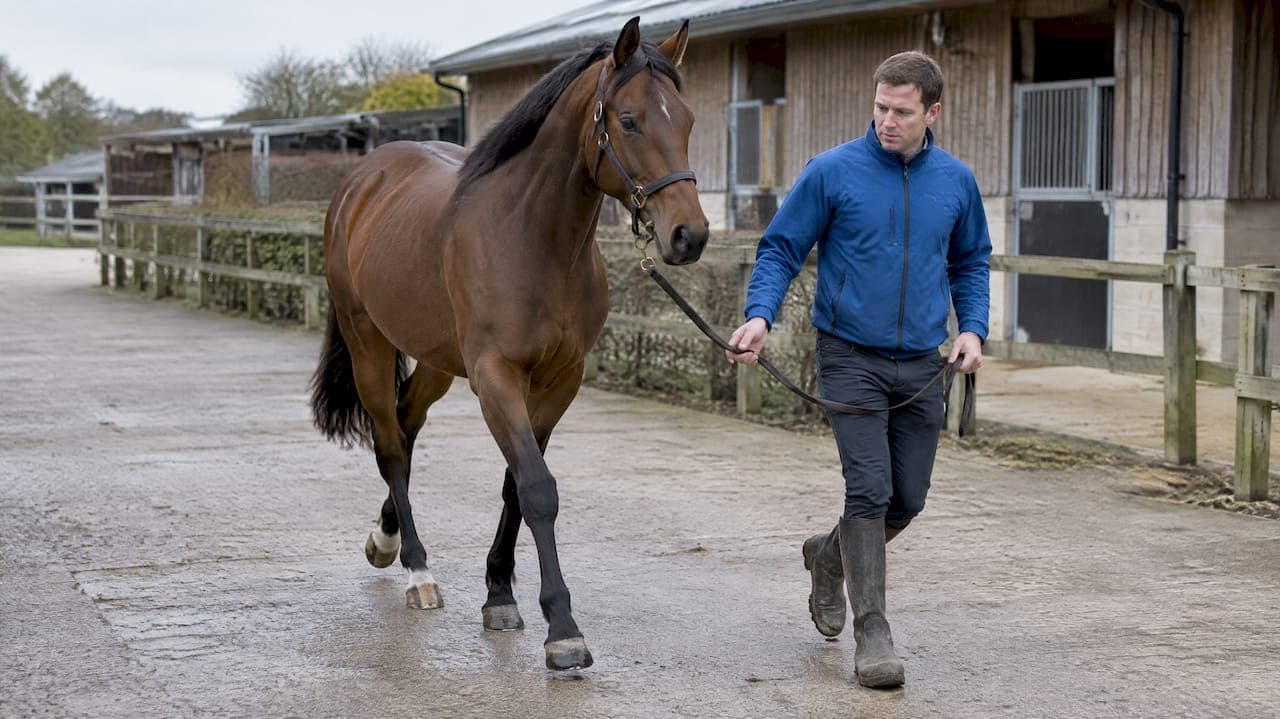
Baseline soundness tracking means recording how each horse moves when it is going well, under the same conditions every time, so that any change shows up as a deviation from that horse's own normal. It is not a pass/fail trot-up. It is a repeatable set of measurements, kept in one place, that you and your vet can compare month after month.
This guide is for yard managers, trainers and vets who want a method they can run in a working yard. It covers what a baseline should contain, which conditions to test, how often to recheck, and how to store the results so they are useful when something changes.
TL;DR
- A baseline is individual. The aim is a stable record of what is normal for this horse, not perfect symmetry.
- Record more than one condition: straight-line trot and lungeing at minimum, because horses show different strategies on a line and a circle.
- Objective sensor data reduces disagreement between observers, but it supports a vet's judgement and does not replace it.
- Recheck on a fixed schedule. Six-month intervals are used in longitudinal dressage research, and your vet may advise a different interval for your horses.
- Data only helps if it is findable. Keep measurements, notes, video and vet access in one record.
Table of Contents
- What "baseline soundness" actually means
- Why the eye alone is not enough
- Building the baseline: what to record
- A simple baseline protocol for a working yard
- Reading the data: drift, not perfection
- Our perspective: a baseline is only as good as its record
- Keeping the routine going across a team
- Running this in EquiBETS
- FAQ
- Sources
What "baseline soundness" actually means
Soundness is not a single number, and it is not the same as having no orthopaedic findings. Veterinary guidance on this point is consistent: many successful performance horses live with chronic, low-grade changes. What matters is whether the horse is stable against its own pattern. A AAEP resource on the topic frames the goal as spotting deviations, not chasing symmetry.
That changes how you set up tracking. You are not asking "is this horse sound?" once. You are asking "is this horse moving the way it moved when we last checked, under the same conditions?" every time.
Two practical consequences follow:
- Soundness is task-dependent. A horse can look level on a straight line and show a relevant asymmetry on the lunge. A baseline taken in one context only will miss this.
- Soundness is dynamic. Shoeing, surface, fitness, rider and season all shift the picture. A baseline is a reference you revisit, not a certificate you file.
Why the eye alone is not enough
Most yards still rely on a visual trot-up. It is quick and it is a useful screen, but it has limits that matter for tracking over time.
In a study of visual lameness assessment against quantitative gait data, researchers examined agreement between and within veterinarians and related subjective grades to measured data. The findings support the use of inertial sensor data to reduce disagreement between observers. The same work reports that a one-degree difference in clinical lameness grade corresponded to roughly 13.2 mm of measured asymmetry in forelimb-related parameters. That gives you a bridge between the grade your vet says out loud and a number you can chart.
There is also the problem of how common small asymmetries are. A 2025 study of racehorses at a pre-race inspection used a markerless AI gait system and found that 79% of horses exceeded typical asymmetry thresholds during lungeing, even though these were animals considered sound. If subclinical asymmetry is that common, a single snapshot cannot tell you whether a given asymmetry is new or just this horse's normal. Only a baseline can.

Building the baseline: what to record
1. Identify the conditions
Pick a small set of conditions and keep them identical on every recheck.
- Straight-line trot on a firm, level, consistent surface
- Lungeing on both reins, on a consistent circle size and surface
- Optionally, ridden work if you are tracking a specific performance concern
Research on variation in gait parameters in sound horses looked at differences between paths, trials and days in horses perceived as sound. The practical lesson is that variation exists even when nothing is wrong. Write down surface, handler, time of day and tack, so you can tell "the protocol changed" from "the horse changed".
2. Capture objective movement data
Body-mounted inertial sensors are the common tool for longitudinal monitoring. A retrospective study of 235 horses in Brazil shows how head and pelvic movement are used to characterise lameness patterns. Two cautions from that literature are worth taking seriously:
- Sensors are a measurement layer, not a diagnosis. Your vet interprets them alongside the clinical exam.
- They need careful calibration and a consistent protocol. Without that, you get point-in-time numbers that cannot be compared across months.
The core metrics are head and pelvic vertical displacement asymmetry. We have written separately about clinician limits for head and pelvic asymmetry, and about turning trot data into records that a clinician can actually use.
3. Add video and photos
Numbers need context. A short, well-framed clip from a fixed position lets a vet see what the sensor saw. If you are setting up video, frame rate is only the start: camera position, background and consistent distance matter just as much. Photos of limbs, heat or swelling are most useful when they are linked to the relevant rehab plan or record rather than left in someone's phone.

4. Add context notes
A baseline without notes is hard to interpret. At each session record:
- Farrier date and any shoe or trim change
- Workload in the preceding week
- Surface and weather
- Recent vet treatment or medication
- Anything the rider or groom noticed
5. Consider load data as it matures
Researchers are moving toward combining kinematic (movement) and kinetic (load) data. Work on an instrumented hoof boot reported by EquiManagement describes using pressure data alongside body-mounted sensors, including monitoring change during diagnostic anaesthesia. This is largely a clinical and research tool today, but it signals where baselines are heading: a richer "signature" per horse than movement alone.
A simple baseline protocol for a working yard
Here is a workable routine. Adjust it with your vet.
| Step | What you do | Why |
|---|---|---|
| 1. Choose the horses | Start with horses in work, then widen to the whole yard | Quick wins, then coverage |
| 2. Fix the protocol | Same surface, same handler, same conditions, written down | Comparable data |
| 3. Record the baseline | Straight-line trot and lunge on both reins, sensor data plus video | Captures task dependence |
| 4. Vet review | Vet confirms the baseline is representative, notes known findings | A baseline is not "zero findings" |
| 5. Set the recheck interval | Agree a schedule, then stick to it | Drift needs a time axis |
| 6. Set action triggers | Agree in advance what change prompts a call to the vet | Avoids debating it in the moment |
On the interval: a retrospective study of 70 dressage horses followed animals that had at least five comprehensive orthopaedic examinations at six-month intervals. Horses presenting for routine evaluation with no prior lameness concerns had a good outcome in 71% of cases, against 60% for those with a history of lameness or poor performance. That is an association in one population, not a promise, but it supports regular structured rechecks rather than waiting for a problem.
Reading the data: drift, not perfection
Once you have two or three points, you can start looking for drift. Ask:
- Has the asymmetry moved in size or direction compared with the baseline?
- Is the change on one rein only?
- Does it coincide with a farrier visit, a workload jump or a surface change?
- Is the change within the horse's normal day-to-day variation, or beyond it?
The last question is why repeat measurements in the same horse matter. If a horse's day-to-day spread is small, a modest shift stands out. If it is wide, you need a bigger change before you act.
When a deviation is real, tracking becomes rehab tracking. We describe how yards and vets can follow small changes through a rehab plan, which is where the baseline earns its keep: you can see improvement against the horse's own normal, not against a textbook.
A note on caution. Any new or worsening lameness, swelling, heat or reluctance to work should go to your veterinarian, not be managed by a chart. Tracking tells you when to call; it does not tell you what is wrong.
Our perspective: a baseline is only as good as its record
We build equine management software for professional yards, and the pattern we see in the research and in yard workflows is the same. The measurement is rarely the hard part. The hard part is that last quarter's data lives in a vet's file, a groom's phone and a trainer's memory, and nobody can lay them side by side when a horse comes up short.
So we think about baselines as a records problem first. A good baseline needs the same fields every time, one place to find them, and a way for the vet to see them without a scramble. That is why our approach joins movement analysis, horse records, photos, team notes and secure vet access in one workspace, and why we care about clean equine medical records.
We are also cautious about what AI can claim. Movement analysis is a measurement layer that supports a clinician. We favour evidence-led features, a consistent protocol, and clear limits on what a number can tell you. A tidy chart does not make a horse sound, but a tidy chart makes a developing problem visible sooner.
— isaac
Keeping the routine going across a team
A protocol that depends on one person tends to lapse. A few habits help:
- Name an owner for each horse's baseline. Usually the head groom or yard manager.
- Standardise the setup. Mark the trot-up lane and lunge spot, so everyone uses the same one.
- Use the same filters when comparing. Comparing a session on a hard surface with one on a soft arena muddies the result. A weekly benchmarking workflow and the ability to compare training sessions by condition help here.
- Tell owners what you are doing. Owners are more comfortable with a change in workload when they can see the reasoning and the data behind it.
Running this in EquiBETS
If you want one place to hold baselines, recheck schedules, movement data, photos and vet access, EquiBETS Complete is a single plan at 9.99 AUD per month, with all features and modules included and a free trial before you pay. You can see the details on the EquiBETS pricing page, or start from the EquiBETS homepage. The platform works offline on mobile, which matters in paddocks and arenas with patchy reception.
FAQ
How do I track soundness in a horse over time?
Record the same conditions, on the same surface, in the same way, at regular intervals. Include straight-line trot and lungeing, add objective sensor data and video if you can, and keep notes on shoeing and workload. Compare each new session with the horse's own earlier results, and call your vet when you see a change beyond that horse's normal spread.
How often should I recheck a baseline?
There is no universal interval. Research on elite dressage horses used six-month rechecks, which is a sensible starting point. Horses in heavy work, returning from injury or with known findings may need more frequent checks, so agree a schedule with your vet.
Does a baseline mean the horse has to be perfectly symmetrical?
No. Small asymmetries are common even in horses considered sound, and many performance horses manage low-grade chronic changes. The aim is a stable individual baseline, so that a real change stands out.
Can sensors replace a vet's lameness exam?
No. Inertial sensors provide objective measurements that reduce disagreement between observers, but they are not a standalone diagnostic. Your veterinarian interprets the data with the clinical picture.
Sources
- Variation in gait parameters used for objective lameness assessment in sound horses at the trot on the straight line and the lunge
- Objective Evaluation of Gait Asymmetries in Traditional Racehorses During Pre-Race Inspection
- Visual lameness assessment in comparison to quantitative gait analysis data in horses
- A Retrospective Study of the Evolution of Orthopaedic Injuries in 70 Dressage Horses
- Objective lameness assessment of 235 horses undergoing lameness examination in Brazil
- Validating an Innovative Instrumented Hoof Boot for Gait Analysis, EquiManagement
- AAEP resource on transitioning racehorses