
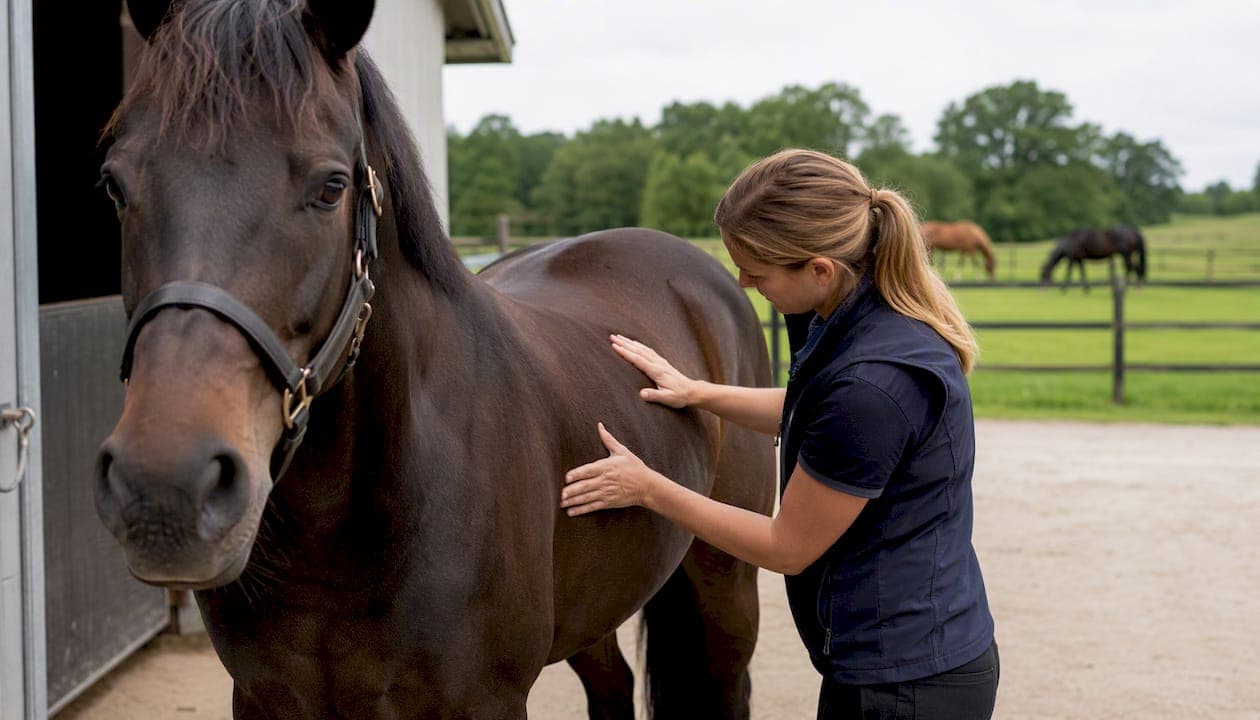
Body condition scoring (BCS) is the standard hands-on method for measuring a horse's fat reserves across six anatomical areas. For most Australian horses, a Henneke score of 4–6 is the healthy target. The system runs from 1 (emaciated) to 9 (extremely obese), and a single session of looking and palpating gives you a number you can act on immediately.
Key takeaways
The Henneke 1–9 scale, applied consistently with firm palpation across all six anatomical areas, is the most reliable low-cost tool for protecting horse health and guiding nutrition decisions.
| Point | Details |
|---|---|
| Target range for most horses | A Henneke score of 4–6 is healthy for most horses; outside this range warrants management review. |
| Palpate, don't just look | Firm, massage-like pressure at all six areas is more accurate than visual assessment alone, especially in winter. |
| Record every session | Log date, scorer name, individual area scores, photos and feed notes to build a meaningful trend. |
| Act on thresholds | Scores below 4 or above 6 require dietary or workload changes; rapid loss needs immediate vet attention. |
| Equibets for trend tracking | Equibets records BCS entries, generates trend graphs and connects scores to nutrition analysis in one platform. |
Table of Contents
- What is the Henneke 1–9 body condition scoring system?
- How to assess the six anatomical points using palpation
- Worked examples: what each reference score looks and feels like
- How often to score and what to record
- What to do when scores fall outside the target range
- Common scoring mistakes and how to avoid them
- Quick reference: Henneke BCS 1–9 at a glance
- Making body condition scoring a genuine yard habit
- Equibets makes BCS tracking part of your yard workflow
- Sources
What is the Henneke 1–9 body condition scoring system?
The Henneke system was developed as a standardised scientific method to evaluate fat deposition consistently across breeds, ages and body types. Because it focuses on fat distribution rather than conformation or muscle pattern, it works equally well on a stocky Quarter Horse and a lean Thoroughbred. Veterinarians, welfare inspectors and nutritionists across Australia and internationally use it as a common language.
Why does standardisation matter? Because without a shared scale, "she's looking a bit thin" means something different to every person on the yard. A numerical score tied to defined anatomical landmarks removes that ambiguity.
Key reasons the Henneke scale holds up in practice:
- Breed-neutral: fat deposits at the six scoring points behave consistently regardless of conformation.
- Welfare-relevant: scores below 4 or above 6 are recognised thresholds for welfare concern and metabolic risk.
- Reproducible: trained scorers using the same method produce comparable results, making trend data meaningful.
- Applicable across disciplines: optimal ranges differ by use — a horse in race training may sit at 4, while a broodmare approaching foaling is better managed at 5–6.
The scale was originally validated on mares but has since been applied to all horses. The six scoring areas are averaged to produce the final rating, which means a horse with uneven fat distribution gets a more accurate overall picture than a single-area assessment could provide.
How to assess the six anatomical points using palpation
The Henneke method uses both visual appraisal and palpation at six body points; scores from each area are averaged into a final 1–9 rating. Work front to back so you never skip an area.
The six areas:
- Crest of neck: feel for fat along the top of the neck; a hard, cresty ridge suggests over-condition.
- Behind the shoulder: slide your hand behind the shoulder blade; fat here feels like a soft pad.
- Wither: run your fingers over the wither; prominent, sharp withers indicate low condition.
- Back: feel along the spine; a visible or sharply palpable spine suggests a score below 4.
- Over the ribs: press firmly along the ribcage; at score 5, ribs are not visible but are easily felt.
- Point of hip, tailhead and point of buttock: assess fat cover around the pelvis; at low scores, the hip and tailhead bones protrude sharply.
Front-to-back palpation routine:
- Stand back and take a visual assessment from both sides and the rear.
- Begin at the crest of the neck, pressing firmly along the top line.
- Move to behind the shoulder, then across the wither.
- Walk along the back, pressing either side of the spine.
- Press firmly over the ribs with your fingertips, not your palm.
- Finish at the tailhead, point of hip and point of buttock.
Score each area on the 1–9 scale, then average the six scores. Scoring is subjective, so half-point increments improve precision — a horse that sits between a 4 and a 5 is recorded as 4.5, which matters when you are tracking change over weeks.
Pro Tip: Apply firm, massage-like pressure when palpating. Light touching risks confusing a thick winter coat or muscle bulk for fat, producing a score that is too high. If you are unsure, press harder and feel for the tissue that compresses, not the tissue that resists.
Keeping the same scorer across sessions reduces variation more than almost any other single practice.
Worked examples: what each reference score looks and feels like
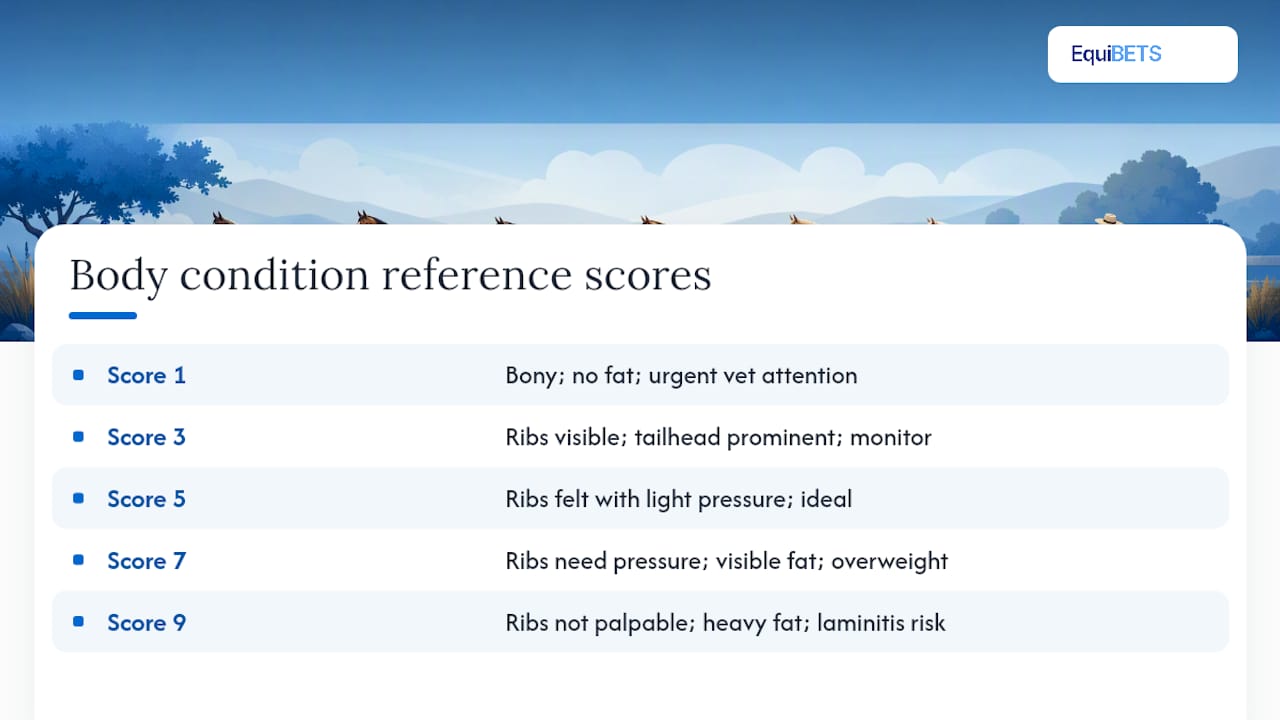
Calibrating your eye and hands against reference scores is the fastest way to become consistent.
Score 1 (emaciated): All bony structures are visible from a distance. The spine, ribs, tailhead and hip bones protrude sharply. No palpable fat anywhere. This horse needs urgent veterinary attention.
Score 3 (thin): Ribs are easily visible. Slight fat cover over the spine but individual vertebrae are still distinguishable. Tailhead is prominent. Manageable with nutrition intervention but warrants close monitoring.
Score 5 (moderate, ideal for many horses): Ribs cannot be seen but are easily felt with light pressure. Back is level. Fat around the tailhead feels spongy. Wither is rounded. This is the middle of the healthy range.
Score 7 (fleshy): Ribs can be felt but require noticeable pressure. Fat deposits are visible behind the shoulder and along the neck. Tailhead feels soft. The horse is above the target range and dietary review is warranted.
Score 9 (extremely obese): Ribs cannot be felt even with firm pressure. Obvious fat bulging along the neck, behind the shoulder and around the tailhead. Patchy fat deposits visible. Laminitis risk is significant.
Using half-points: A score of 4.5 sits between "thin" and "moderate." The ribs are visible in some light but not all; the tailhead has slight fat cover but the hip bones are still prominent. Half-points are most useful when you are tracking a horse recovering from illness or a broodmare building condition before breeding.
For photo calibration, take images from the near side, off side and rear at the same time of day and in consistent lighting. Save a folder on your phone or pin printed reference images to the feed room noticeboard.
How often to score and what to record
Scoring frequency depends on the horse's life stage and workload:
- Performance horses in work: every 4 weeks, or after any significant change in training load or feed.
- Broodmares: monthly through pregnancy, increasing to fortnightly in the last trimester and post-foaling.
- Stallions: monthly through the breeding season, quarterly otherwise.
- Retired or older horses: monthly, or more often through winter when energy demands rise and feed quality drops.
What to record every session:
- Date and horse name
- Score for each of the six areas and the averaged final score
- Scorer's name
- Photo (near side, off side, rear)
- Current feed and forage ration
- Recent workload changes
- Body weight or girth measurement if available
- Any clinical observations (coat condition, hoof health, behaviour)
Consistent recordkeeping lets yards spot small trends before they become welfare issues. A horse dropping from 5 to 4.5 over two months is easy to miss without a log; with one, it is obvious. Digital tools that generate trend graphs and send scoring reminders add real value here, particularly on yards managing more than a handful of horses. Equibets' equine nutrition analysis integrates directly with score records, making it straightforward to connect a dropping score with a feed-plan review.
Winter coat deserves a specific note: thick coats can make a horse look heavier than it is. Palpation matters more than visual assessment in the cooler months, and scoring frequency should increase rather than decrease through winter.
What to do when scores fall outside the target range
Score below 4 (thin): Increase caloric intake gradually — sudden large ration changes risk digestive upset. Add quality forage first, then consider a hard feed or oil supplementation. Recheck in two weeks. If the horse is not responding or is losing weight rapidly, call your vet.
Score 4–6 (target range): Maintain current management. Continue regular scoring to confirm stability. Adjust seasonally as needed.
Score above 6 (over-condition): Reduce non-structural carbohydrates and increase movement. Assess the cresty neck score alongside BCS; a hard, cresty neck at a score of 7 or above is a recognised risk factor for insulin dysregulation and laminitis. Dietary changes should be gradual.
BCS is a low-cost management tool that links nutritional status with reproductive performance and other production outcomes. For broodmares, targeting a score of 5–6 at conception and maintaining it through pregnancy supports foal development and post-foaling recovery.
Call your vet immediately if you observe:
- Rapid weight loss (more than half a score in under four weeks)
- Laminitis signs: heat in the hooves, reluctance to move, a "rocking back" stance
- Colic behaviours alongside condition change
- Poor coat quality, lethargy or abnormal sweating alongside a low score
Common scoring mistakes and how to avoid them
Scoring errors cluster around a few predictable problems:
- Confusing muscle with fat: a well-muscled horse can look well-covered but have minimal subcutaneous fat. Palpate firmly; muscle resists pressure, fat compresses.
- Being misled by winter coat: thick coats add apparent bulk. Always palpate; never score by eye alone in winter.
- Pregnancy and gut fill: a heavily pregnant mare or a horse with a hay belly will look heavier than its fat reserves justify. Focus palpation on the neck, wither and ribs rather than the abdomen.
- Scorer inconsistency: different people applying different pressure or starting at different points produces incomparable scores. Assign one primary scorer per horse where possible.
- Poor palpation pressure: light touching is the single most common technical error. Use firm, deliberate pressure.
- Single-area focus: horses store fat unevenly. Scoring only the ribs and ignoring the neck or tailhead will misrepresent total reserves.
Run a short calibration session every few months: score the same horse independently with a colleague or vet, then compare results. A one-point discrepancy is worth investigating; half a point is normal variation.
Quick reference: Henneke BCS 1–9 at a glance
| Score | Hallmark | Immediate action |
|---|---|---|
| 1 | Emaciated; all bones visible, no palpable fat | Urgent vet assessment |
| 2 | Very thin; slight fat over spine, ribs prominent | Vet review; increase forage immediately |
| 3 | Thin; ribs visible, tailhead prominent | Increase calories; recheck in 2 weeks |
| 4 | Moderately thin; ribs faintly visible, slight fat cover | Increase forage; monitor weekly |
| 5 | Moderate; ribs not visible but easily felt | Maintain current management |
| 6 | Moderately fleshy; ribs felt with pressure | Review ration; monitor monthly |
| 7 | Fleshy; ribs hard to feel, fat deposits visible | Reduce non-structural carbohydrates; increase work |
| — | Fat; ribs very difficult to feel, cresty neck | Dietary restriction; vet or nutritionist review |
| 9 | Extremely obese; ribs not palpable, patchy fat | Urgent vet and nutritionist review; laminitis risk |
Exceptions to note: performance horses in hard training may sit comfortably at 4–4.5; broodmares approaching foaling are better at 5–6. Record the scorer's name and date alongside every entry so the table remains a useful trend document rather than a snapshot.
Making body condition scoring a genuine yard habit
The yards that get the most from BCS are not the ones with the most sophisticated tools. They are the ones that score consistently, record everything and act on what they find.
A practical workflow that holds up in real conditions: schedule weekly BCS checks for the competition string on the same day as farrier or physio visits, when the horse is already being handled. Monthly checks for retirees can sit alongside worming or dental reminders. For broodmares, tie scoring to the reproductive calendar: at joining, at 90 days, at 180 days, and fortnightly from 300 days onward.
Calibration sessions do not need to be formal. Pull up three reference photos on a tablet, score each horse independently with a yard hand or working student, then compare. A 15-minute exercise once a quarter is enough to keep the team aligned and catch scoring drift before it distorts your trend data.
Communicating scores to owners is where many yards miss an opportunity. A monthly score update alongside a photo is far more persuasive than a verbal "she's looking well." Owners who can see a score moving from 4.5 to 5 over six weeks understand the feed plan is working. That transparency builds trust and reduces the number of unsolicited feed changes owners make between visits.
Equibets makes BCS tracking part of your yard workflow
Scoring a horse takes five minutes. The value comes from what you do with that number over the following months, and that is where most yards lose the thread.

Equibets is built for exactly this: a professional yard platform where BCS entries, photos, scorer names and dates sit alongside feed records, vet notes and workload logs in one place. Score entry takes seconds on the mobile app, which works offline in the paddock. Trend graphs surface automatically, so a horse quietly dropping half a point over winter shows up before it becomes a welfare issue. The equine nutrition analysis module connects score trends directly to feed-plan recommendations, removing the manual step of cross-referencing a spreadsheet with a ration calculator. Owner portals mean the monthly score update goes out without a separate email.
Start a free trial at Equibets and see how much easier consistent scoring becomes when the recordkeeping looks after itself.
Sources
Authoritative resources for deeper study and vet or nutritionist conversations:
- Body Condition Score | Tarleton Equine
- Evaluating Body Composition of Horses | Ohioline
- Horse body condition scoring (Purdue Extension) | as_552_w.pdf
- Guide to body condition scoring beef cows and bulls (KSRE)
For region-specific welfare thresholds and metabolic conditions common in Australia (equine metabolic syndrome, laminitis risk in pasture-fed horses), consult your local equine vet or an accredited equine nutritionist. The Henneke method applies consistently, but management responses need to account for local pasture conditions, seasonal feed quality and breed-specific metabolic tendencies.
This article is general information, not a substitute for advice from a qualified doctor. Consult a qualified healthcare professional about your own circumstances before acting on anything here.