
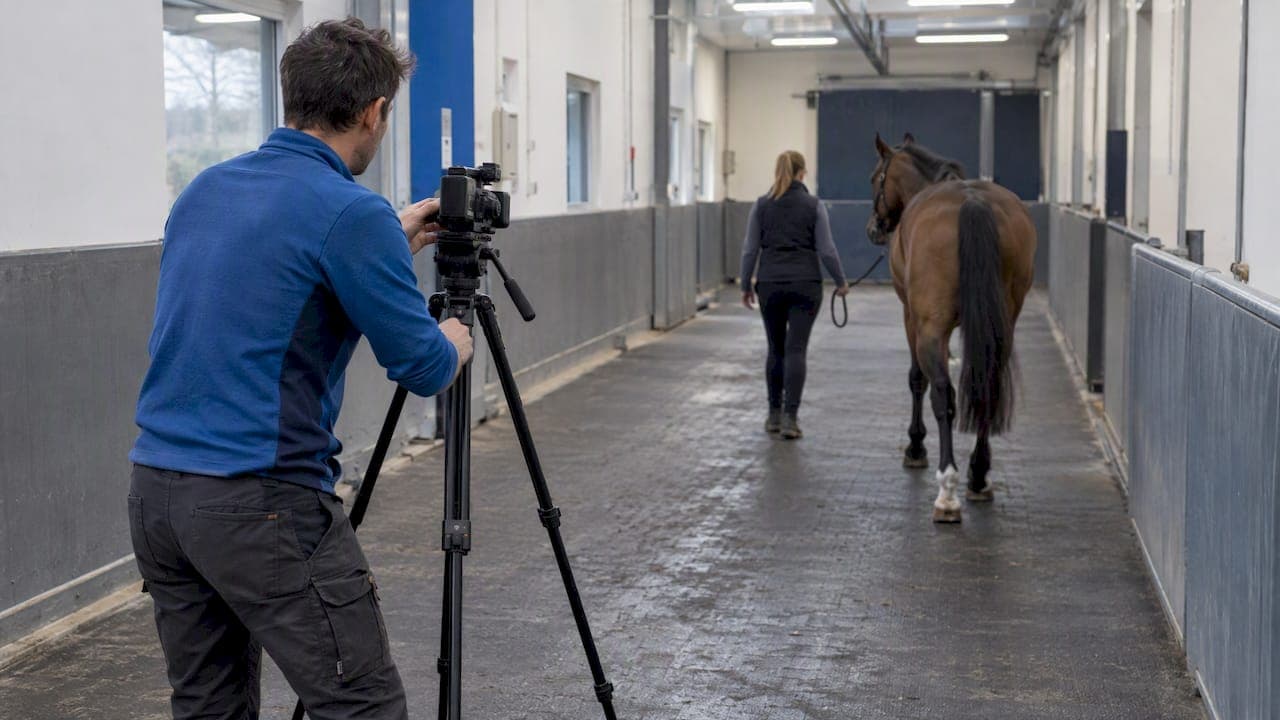
For clinic-grade gait video, record from a sagittal view at a minimum of 50 Hz for standard walking and 100 Hz for fast walking, at no less than 720×1280 pixels. The single biggest improvement you can make is standardising camera height, angle, distance and settings, then documenting that configuration so every session is repeatable rather than guessed at.
TL;DR:
- Repeat calibration after lens changes and whenever the mount moves; clinics should calibrate daily, while one validated system repeated checks every eight subjects.
- An 18 meter walkway helps patients reach steady speed; leave two to three strides of approach and exit space at each end.
- Temporal measures such as cadence and step time tolerate angle changes, but spatial measures favor sagittal views and camera distances of 3 to 6 meters.
- Record multiple valid trials per condition after practice passes, because a single walk may not represent a patient's typical gait pattern.
Table of Contents
- Camera settings and recording specs for clinical gait video
- Room layout and walkway dimensions that produce valid strides
- Calibration, synchronisation and daily checks you must run
- Recording protocol: pre-session checks and trial counts
- Data quality checks and which gait parameters video reliably provides
- Capture methods for clinics: stationary, dolly and phone-based setups
- Why repeatability beats precision when resources are tight
- Keeping gait videos, settings and reports organised with EquiBETS
- FAQ
- Sources
Camera settings and recording specs for clinical gait video
Frame rate and resolution determine whether your data holds up to scrutiny. The GAMMA association's 2024 recommendations set a floor of 50 Hz for standard walking and 100 Hz for fast walking or jogging, with spatial resolution of at least 720×1280 pixels. Where equipment allows, 1080p or a 2.2 megapixel sensor gives pose estimation algorithms more to work with, particularly around the ankle and foot.
A camera running below 50 Hz cannot reliably resolve standard clinical gait, which puts step-time accuracy at risk before you have even started the session.
A few settings matter beyond the headline numbers:
- Keep shutter speed fast (around 1/500s or quicker) to limit motion blur during swing phase.
- Fix exposure and white balance manually rather than letting the camera hunt mid-trial.
- Choose a lens and sensor combination with minimal distortion at the edges of the frame, since wide-angle lenses can skew spatial measurements.
Where hardware cannot reach these frame rates, video frame interpolation is a workable fallback for temporal parameters, though it does not substitute for genuine spatial accuracy. For a deeper look at frame-rate trade-offs and sensor choice, our guide to frame rates for movement capture covers the technical detail.
Room layout and walkway dimensions that produce valid strides
Space constraints quietly undermine more gait studies than bad cameras do. GAMMA guidance favours longer tracks, around 18 metres where the room allows, so the subject reaches a steady walking speed before entering the measurement zone and the camera is not capturing acceleration or deceleration strides.
- Allow clear approach and exit zones of at least two to three strides at each end of the walkway.
- Position the sagittal camera perpendicular to the direction of travel, roughly level with the midpoint of the walkway.
- Add a frontal camera only as a secondary view: it has known spatial limitations but still has value for detecting coronal-plane deviations such as circumduction or limb crossing.
- Place floor markers or a checkerboard grid at known intervals along the walkway to support homography-based scaling later.
Where floor space is limited, a stationary camera's field of view becomes the binding constraint rather than frame rate or resolution, which is where a moving dolly setup earns its keep.
Calibration, synchronisation and daily checks you must run
Calibration is the step clinics skip under time pressure and regret later. Intrinsic calibration, using a checkerboard and the Zhang method, corrects lens distortion, while extrinsic calibration fixes the camera's position relative to the walkway to build an accurate projection matrix.
- Run intrinsic calibration when the lens or camera body changes, not just at system installation.
- Confirm extrinsic placement each time the tripod or mount is moved, using floor reference points for a planar homography.
- For systems paired with force plates, run a daily synchronisation check such as the pole test, and log the result against that day's sessions, consistent with CMAS standards.
- Repeat calibration after a set number of subjects in busy clinics rather than relying on a single morning check.
A validated low-cost system repeated calibration after every eight subjects and recommended at least one full calibration per clinical day to maintain measurement reliability.
Pro Tip: Keep a calibration log next to the recording station and tick it off before the first patient, not after the first error shows up in your data.
Recording protocol: pre-session checks and trial counts
A repeatable protocol turns a one-off video into usable clinical data. Before the patient arrives, confirm frame rate and resolution settings on the camera, check battery and storage headroom, and set a file naming convention that captures date, patient ID and trial number.
- Warm up the patient with a few practice passes along the walkway before recording begins.
- Brief the patient on starting position, walking speed and where to stop, so each trial starts the same way.
- Record a minimum number of valid strides per condition rather than a single pass, since one trial rarely represents typical gait.
Staffing matters too:
- One person manages patient interaction, instructions and safety.
- A second person handles camera operation, calibration checks and file logging.
- Metadata (frame rate, resolution, camera distance, lighting conditions) gets recorded with the video file, not left to memory.
A validated low-cost system reported reasonable reliability across repeated trials when this kind of structured protocol was followed, reinforcing that multiple trials per condition beat a single capture every time. For clinics building out fuller workflows, our guide to clinic-ready gait analysis walks through interpretation alongside capture.
Data quality checks and which gait parameters video reliably provides
Not every gait parameter survives a single camera equally well. Temporal parameters such as cadence and step time stay fairly robust regardless of viewing angle, but spatial parameters like step length and speed are far more sensitive to camera geometry.

Sagittal views produce the strongest agreement with motion-capture references for spatial parameters, with diagonal and frontal views performing progressively worse, and camera distances of roughly 3 to 6 metres often preferred for single-camera setups.
Common pitfalls and fixes:
- Motion blur from slow shutter speeds: increase shutter speed and improve lighting rather than relying on post-processing.
- Inconsistent camera tilt between sessions: mark and lock tripod height and angle.
- Variable camera-to-subject distance: use floor markers to keep every patient at the same distance.
When spatial precision needs to exceed what a single camera can offer, that is the point to escalate to multi-camera or instrumented systems.
Capture methods for clinics: stationary, dolly and phone-based setups
Each capture method suits a different clinical reality. A stationary tripod is cheap and stable but limited by field of view, which can clip longer strides or faster gait. A moving camera on a dolly or rail captures longer stride sequences without sacrificing spatial resolution, a pragmatic middle ground where room length is tight.
- Stationary tripod: lowest cost, easiest to calibrate, best for short walkways.
- Dolly or rail system: captures more strides per pass, useful where the room cannot stretch to 18 metres.
- Phone-based capture: viable for temporal metrics when frame rate, resolution and distance are deliberately set and logged, with frame interpolation applied cautiously if needed.
Pro Tip: Whichever method you choose, store the camera settings, calibration date and distance alongside the video file itself, not in a separate notebook that never makes it back to the session record.
A platform that keeps session metadata, frame rates and calibration records attached to each video reduces the change of a setting drifting unnoticed between visits, which matters more for longitudinal tracking than any single camera upgrade. Our piece on turning movement data into clinical records looks at this workflow in more detail.
Why repeatability beats precision when resources are tight
The temptation in gait labs is to chase the highest frame rate and resolution available. A more defensible rule is to pick the lowest configuration that reliably answers your specific clinical question, then hold it fixed. Document every setting with every session: camera height, angle, distance and frame rate. A clinic that records the same imperfect setup consistently will out-measure one that upgrades gear every year but never logs what changed.
— isaac
Keeping gait videos, settings and reports organised with EquiBETS
Clinics that get calibration and camera settings right still lose value if the footage and metadata scatter across phones, laptops and paper logs. We built EquiBETS around one workspace that keeps session metadata, movement analysis and horse records together, so a frame rate noted at capture time stays attached to that video and that patient permanently.

- We store camera settings, calibration dates and session notes alongside each gait video, not in a separate file.
- Our AI-powered movement analysis works from the footage you already capture, so standardising your setup pays off across every future session.
- Owner portals give vets and owners access to the same records without chasing files by email.
- Our offline mobile app means capture and logging work even where connectivity in the yard or clinic is unreliable.
For yards tracking rehabilitation over time, pairing a standardised video setup with centralised records is what makes small changes visible; our notes on rehab progress metrics cover that workflow. EquiBETS Complete is available from $9.99 AUD per month, with a free trial before you commit to a plan.
FAQ
What is gait exercise therapy?
Gait exercise therapy refers to structured exercises and training aimed at improving walking patterns, strength and coordination in patients or animals with movement impairments. It is typically guided by findings from a gait assessment, including video-based analysis, to target specific deviations identified during the session.
How do I take a good walking video for gait analysis?
Record from a sagittal view at a minimum of 50 Hz for standard walking, using a fixed camera height and distance so every session matches. Keep the subject in frame for the full walkway, use a fast shutter speed to limit blur, and log the camera settings with the footage.
What are the 8 phases of gait?
The gait cycle is commonly broken into eight phases spanning stance (initial contact, loading response, mid stance, terminal stance and pre-swing) and swing (initial swing, mid swing and terminal swing). Video recorded at an adequate frame rate and from a sagittal view makes these phases easier to identify and time accurately.
What causes poor gait?
Poor gait can stem from musculoskeletal injury, neurological conditions, pain, muscle weakness or structural abnormalities, among other causes. A properly set up gait video, recorded at sufficient frame rate and resolution from a consistent camera position, helps clinicians distinguish between these contributing factors over repeated sessions.
Sources
- Recommendations of the GAMMA association for the standardization of clinical movement analysis laboratories (2024)
- Effects of viewing geometry on the validity of markerless video-based estimation of spatiotemporal gait parameters (Fujiyama et al.)
- Concurrent validity and reliability of a low-cost gait analysis system for assessment of spatiotemporal gait parameters (J Rehabil Med)
- Application of video frame interpolation to markerless, single-camera gait analysis (2023)