
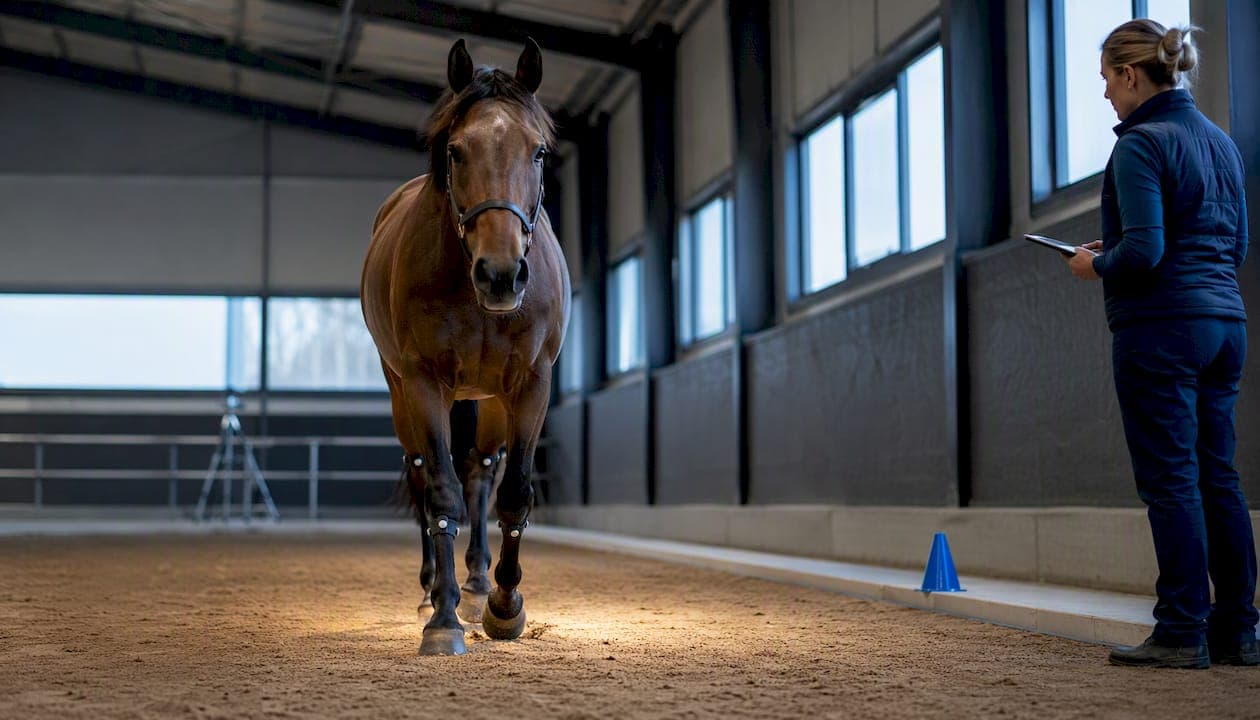
The metrics worth tracking are impact and push-off asymmetry, stride length and frequency, joint range of motion, vertical load proxies, pain and behaviour scores, and functional capacity under workload. Use them together: establish a baseline, chart the trend across serial visits, and set trigger rules for when a change demands further diagnostics. None of these numbers replace a clinical exam; they sharpen it.
TL;DR:
- Consistent measurement protocols, including matching surfaces and speeds, are essential for reliable serial tracking of asymmetry, stride, and range of motion.
- Small, temporary changes in gait metrics often fall within measurement error; a sustained trend over multiple visits signals meaningful progress.
- Objective metrics are valuable for supporting clinical judgment but cannot replace palpation, diagnostic anesthesia, or imaging in unclear cases.
- Reassessing key metrics at baseline, 7–14 days, and 4–6 weeks ensures accurate monitoring of recovery progress rather than relying on single assessments.
- Integrating AI-based movement analysis and session comparison tools into a unified workflow improves early detection of issues and owner communication.
Table of Contents
- 1. What each core metric actually measures
- 2. Choosing devices and running a reliable protocol
- 3. Reading the numbers without chasing noise
- 4. Building a workflow your team can actually run
- 5. Where evidence-led technology fits into the workflow
- 6. What years of watching these numbers taught me
- Try a platform built for metric-driven rehab
- Sources
- FAQ
1. What each core metric actually measures
Every metric on this list earns its place because it answers a specific clinical question, not because a sensor happened to record it.
Impact and push-off asymmetry (often expressed as HDmin/HDmax for the head and PDmin/PDmax for the pelvis, plus a vector sum) capture how evenly a horse loads and unloads each limb. A shrinking gap between minimum and maximum values over successive visits usually signals genuine improvement, while a widening gap or a switch in the affected limb warrants a second look. Objective systems agree on which limb carries the greatest asymmetry in 87.1% of horses compared in a 2025 study of 31 horses, which is high but not unanimous agreement, so a single reading should never carry a diagnosis alone.
Stride length and stride frequency shift together as a horse compensates for discomfort: shorter strides at a higher frequency often flag pain, while a lengthening stride at a stable frequency tends to track fitness returning. Joint and sagittal or coronal range of motion, alongside muscular symmetry scoring, matters most when a specific joint or muscle group is under rehabilitation, and these are best measured at matched gaits and speeds each time.
Vertical impulse and stance time serve as practical load-distribution proxies when a force plate is not on hand. Pain and behaviour measures, covering pain at rest, pain during exercise and behaviour during exercise, sit among the ten core domains an international consensus identified for equine rehabilitation outcome measures, alongside lameness, palpation, balance and proprioception.
Functional capacity, measured through timed trotting, workload tolerance and session-based exercise tests, is what ultimately answers the return-to-sport question.
- Asymmetry metrics show whether loading is becoming more even limb to limb.
- Stride and ROM metrics show whether movement quality is normalising.
- Pain, behaviour and functional capacity metrics show whether the horse is ready for real work.
2. Choosing devices and running a reliable protocol
Getting comparable numbers across visits depends more on protocol discipline than on which sensor you buy.
- Assess on a consistent, level surface with the same handler, a standard warm-up, and the horse moving at a matched, controlled speed.
- Run enough trials to smooth out noise, typically several passes per gait rather than a single trot-up.
- Choose your measurement method to match the case: inertial measurement units (IMUs) suit field repeatability and are what most yards will use day to day; markerless AI video systems suit busy clinics needing quick setup with no wearables; lab-based optical or force-plate systems remain the reference standard for research or genuinely ambiguous cases.
- Time the baseline capture relative to any recent treatment, and repeat it at defined intervals rather than opportunistically.
- Keep filter settings, stride frequency targets and surface conditions matched between sessions so a change in the number reflects the horse, not the method.
Pro Tip: Record a baseline before any treatment or shoeing change, not after, so later comparisons reflect the horse's own trajectory rather than an artefact of timing.
Objective numbers work best paired with palpation and, where asymmetry persists or the picture is unclear, diagnostic analgesia to confirm the true source of movement change. Our guide to clinic-ready gait analysis walks through capture protocols in more depth for teams setting this up for the first time.

3. Reading the numbers without chasing noise
A number moving between visits is not automatically meaningful. Validated IMU systems report sagittal symmetry agreement within a millimetre or two between trials, with coronal plane angles carrying wider limits of agreement, so a shift smaller than the system's own repeatability error tells you nothing.
- Treat single-visit swings with caution: one assessment is a data point, not a trend.
- Look for sustained directional change across at least two or three consecutive assessments before acting.
- Rule out surface, speed, tack and rider changes before attributing a shift to the horse's condition.
- Watch for compensatory patterns masking the primary lesion, particularly after a limb switch.
Some asymmetry is simply how a horse is built. A 2019 trial found that a four-day course of meloxicam did not change movement asymmetry at group level across 66 horses in training, suggesting a portion of measured asymmetry reflects biological variation rather than active pain. This is exactly why serial tracking, and where needed diagnostic analgesia or imaging, matters more than any single reading. Compensatory movement can also disguise the primary problem, and separating the two often needs diagnostic analgesia alongside repeated measurement.
4. Building a workflow your team can actually run
A metric is only useful if it feeds a repeatable process, not a one-off report.
- Run a baseline visit before treatment begins, then a short-term recheck at 7 to 14 days.
- Follow with a medium-term review at 4 to 6 weeks and a dedicated pre-return-to-work check.
- Set trigger rules in advance: a sustained asymmetry change beyond a defined threshold across two consecutive tests prompts further diagnostics, while negligible improvement after several weeks prompts a plan pivot.
Composite scoring across multiple domains is still an evolving area. Reviews of equine rehabilitation outcome measures note that no single validated composite score exists yet, so most clinics combine objective markers with clinical judgement rather than relying on one number.
- Each report should carry a one-line summary, a key metrics table, a trend snapshot and a clinician's interpretation with next steps.
- Assign clear roles: who captures the data, who reviews it clinically, and who signs off on return-to-work.
- Keep raw traces, short video, clinician notes and an owner-facing summary attached to the horse's record, not scattered across separate files.
Our guide to offline field data capture covers how yards keep this consistent when connectivity in the field is unreliable.
5. Where evidence-led technology fits into the workflow
EquiBETS builds these workflows into a single yard workspace rather than a spreadsheet stitched to a sensor app. AI-based movement analysis, offline mobile access, owner portals and session comparison tools sit alongside finance tracking and emergency plans, so a rehab record does not live apart from the rest of the horse's file.
- AI movement analysis turns trot passes into structured metrics without a lab setup.
- Session comparison tools let a yard line up baseline and recheck data side by side.
- Owner portals push plain-language updates to owners without a phone call.
In practice, our rehab tracking case study describes catching a 2% asymmetry change 8 days earlier than a traditional recheck cadence would have flagged it, illustrating why serial capture beats occasional spot checks. For teams building this into daily routine, the movement analysis explainer is a practical starting point.
6. What years of watching these numbers taught me
Early in one case, a barely perceptible asymmetry showed up two visits running before anything visible changed under saddle. Flagging it early meant a small adjustment to the plan rather than a setback three weeks later. If there is one habit worth building, it is prioritising repeatable measurement over impressive-looking single readings, and telling owners plainly what a number does and does not mean.
— isaac
Try a platform built for metric-driven rehab
Baselines, serial rechecks and owner updates all live in one place with EquiBETS Complete, priced at $9.99 AUD per month. If your yard is ready to run the workflow above without juggling separate tools, view the platform and see how it fits your rehab caseload.

Sources
- Agreement between objective gait analysis systems (2025 comparison)
- Consensus on core domains for equine musculoskeletal rehabilitation (TEMROS)
- Effect of meloxicam on movement asymmetry in riding horses (2019)
FAQ
What are the most important rehab progress metrics to track?
Prioritise impact and push-off asymmetry, stride length and frequency, joint range of motion, load distribution proxies, pain and behaviour scores, and functional capacity under workload. Used together across a baseline and serial rechecks, these give a fuller picture than any single measure, and objective systems agree on the limb of greatest asymmetry in 87.1% of horses compared in one study.
How often should rehab metrics be reassessed?
A common pattern is a baseline visit, a short-term recheck at 7 to 14 days, a medium-term review at 4 to 6 weeks, and a final check before return to work. Serial, longitudinal assessment is considered standard practice because recovery rarely follows a straight line.
Can a small change in asymmetry be ignored?
Not automatically, but a tiny shift can fall within a system's own measurement error rather than reflect real change. Validated IMU systems report sagittal symmetry agreement within a couple of millimetres between trials, so look for a sustained trend across multiple visits before treating a change as meaningful.
Do objective gait tools replace a vet's clinical exam?
No. Objective metrics support and sharpen clinical judgement but do not substitute for palpation, diagnostic analgesia or imaging when the picture is unclear. Some asymmetry reflects biological variation rather than pain, as shown when a four-day meloxicam course did not shift group-level asymmetry in a 2019 trial.
What tools can help yards track rehab metrics day to day?
Options range from IMU-based wearables to markerless AI video analysis, each suited to different budgets and case complexity. Platforms such as EquiBETS combine AI-based movement analysis with offline access and owner reporting so serial tracking fits into a yard's existing routine rather than sitting apart from it.