
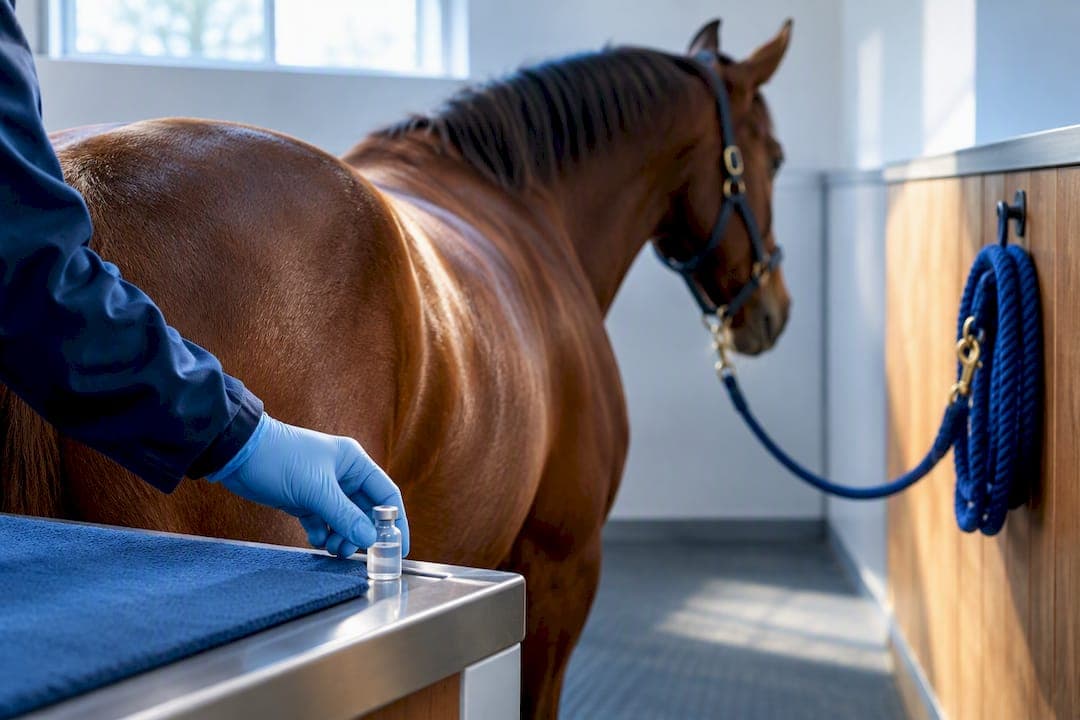
A horse record audit trail is an append-only, timestamped log showing who did what, when, and why. It underpins every credible medicine record, ownership transfer, and inventory count in a yard. Where regulation applies, medicine records typically need retaining for five years, and the biggest compliance action you can take today is making every entry contemporaneous and exportable.
TL;DR:
- Records must be append-only with timestamps and user IDs; silent edits are unacceptable for legal credibility.
- Mandatory fields for medicine records include date, dose, batch number, administrator, and withdrawal period, all retained for at least five years in the UK.
- Stock reconciliation for medicines should be performed annually, with strict tracking from receipt to disposal, especially for prescription-only products.
- Entries should be made within roughly 24 hours of activity, as delayed records are considered less credible and can weaken legal defense.
- Digital systems that offer vet-ready exports and offline synchronization greatly improve compliance efficiency and reduce the risk of audit failures.
Table of Contents
- What must a horse record audit trail actually contain?
- Retention rules and audit obligations you can't ignore
- Why contemporaneous records carry more legal weight
- Building the checklist: from roles to offline sync
- How digital platforms deliver vet-ready evidence in practice
- Why yards can't afford to treat this as optional anymore
- Get your yard audit-ready without the paperwork chase
- Sources
- FAQ
What must a horse record audit trail actually contain?
An audit trail is only as strong as its structure. It needs an append-only history, meaning nothing gets deleted or silently overwritten, and every entry carries a timestamp and a user ID showing exactly who logged it and when.
Corrections happen, but they should never erase the original entry. Instead, an addendum gets added with a sign-off, leaving a visible record of what changed and who changed it. For medicine and treatment records specifically, the mandatory fields are non-negotiable: date and time of administration, dose given, batch number, the identity of the administrator, and the withdrawal period before the horse can compete or be slaughtered for consumption.
Inventory needs the same rigour across its full lifecycle, tracking every receipt, issuance, disposal, and instance of waste.
Pro Tip: Export formats matter more than most yards realise. If your vet can't pull a clean PDF or CSV mid-visit, your record system is failing at the one moment it's supposed to help.
- Append-only entries with timestamps and user attribution
- Signed addenda instead of silent edits
- Full medicine field set: date, dose, batch, administrator, withdrawal period
- Inventory reconciliation covering receipts through to disposal
- Vet-ready exports, including FEI-format trot traces, in PDF or CSV
Retention rules and audit obligations you can't ignore
Retention periods aren't uniform, and assuming your jurisdiction matches another is a common, costly mistake. In the UK, owners and keepers must keep veterinary medicines records for at least five years, covering the date of administration, the amount given, who administered it, and the withdrawal period. Passport copies often need retaining alongside these records, particularly where ownership or medical history intersects.
Responsibility doesn't sit with one party. Owners, keepers, treating vets, and medicine suppliers can all carry distinct record-keeping duties, and extra rules often kick in for prescription-only categories.
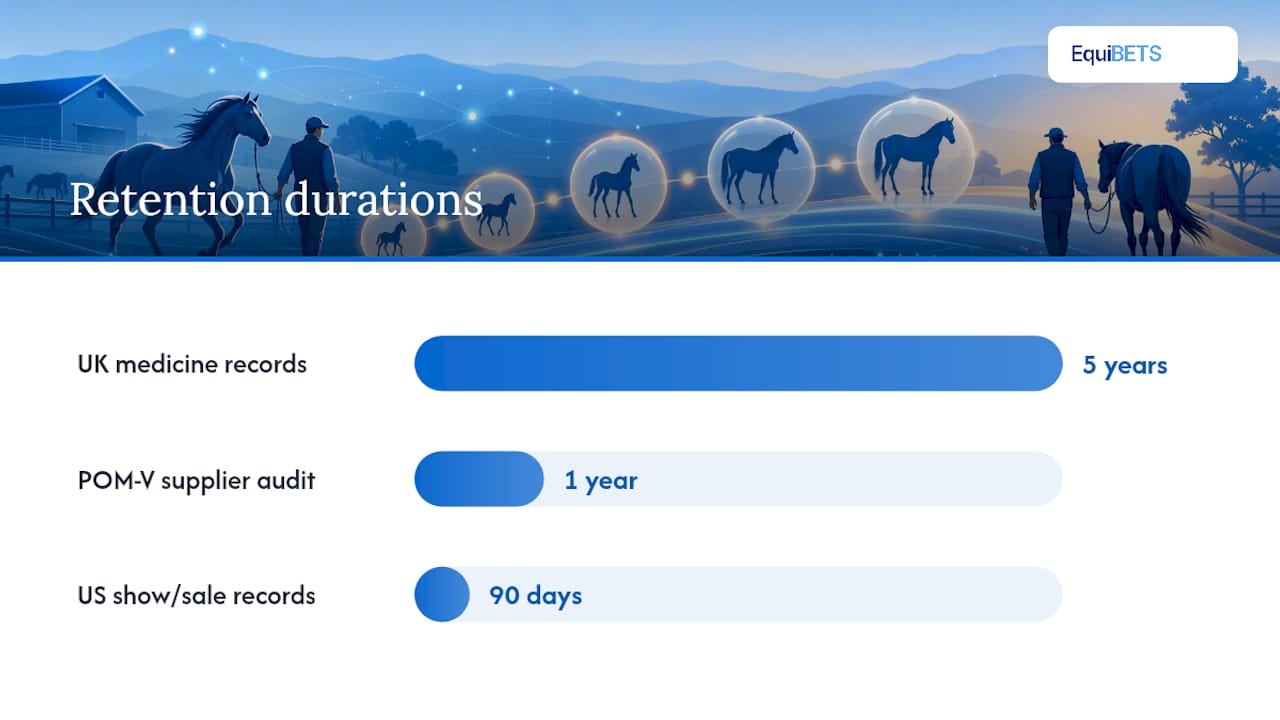
Suppliers handling POM-V and POM-VPS products face a stricter bar: guidance expects an annual audit reconciling incoming and outgoing stock, following a defined multi-step process including identifying opening stock, logging what came in, logging what went out, and reconciling the totals.
Retention isn't limited to medicine, either. Show and sale organisers in the US, for example, face a separate rule under 9 CFR 11.22 requiring event records to be kept for a specified minimum period mandated in the relevant jurisdiction and made available to inspectors, a much shorter window than medicine retention.
- UK medicine records: minimum five years, with defined mandatory fields
- Annual audits expected for POM-V and POM-VPS suppliers
- US show/sale event records: minimum 90 days under CFR rules
- Never assume one jurisdiction's standard applies elsewhere; check local guidance directly
The takeaway is straightforward but easy to skip: don't build your record system around a single remembered rule. Check what applies to your role, your location, and the category of product or event in question.
Why contemporaneous records carry more legal weight
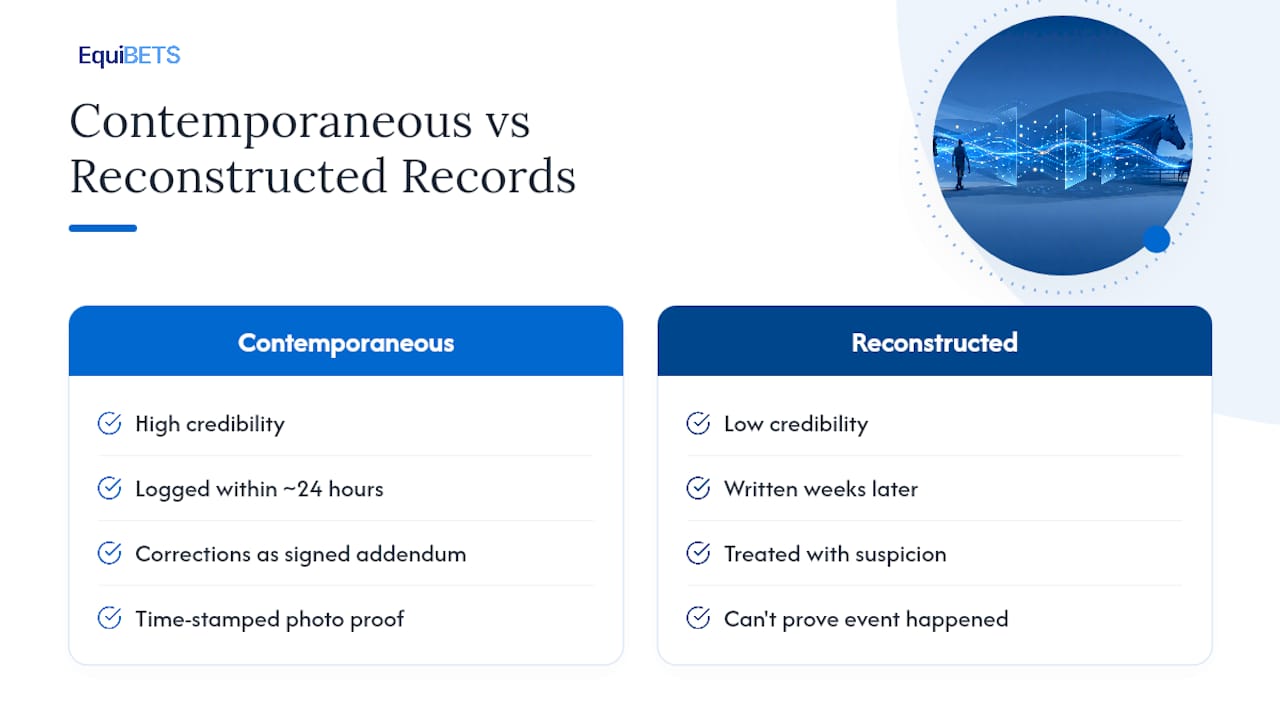
Timing is everything in an audit. Records completed close to the event carry far more credibility than anything reconstructed weeks later from memory, and regulators know the difference. Experts recommend logging entries within roughly 24 hours, with any later correction added as a signed, dated addendum rather than a quiet edit.
Reconstructed records get treated with suspicion, and for good reason. A note written from memory three weeks after a treatment can't prove what actually happened, and inspectors, vets conducting competition checks, and legal teams handling recalls or disputes tend to discount them heavily. If a horse changes hands and a dispute arises later over its treatment history, the absence of a timely record is often read as evidence that nothing was done, not simply as a paperwork gap.
Pro Tip: Capture proof in the moment. A time-stamped photo of a medicine label next to the horse, or a form filled out in the field before you've even left the stable, does more for your defence than a tidy summary written that evening.
Recalls are where this bites hardest. If a batch of medicine is pulled and you can't show which horses received it and when, you're exposed regardless of how carefully you actually treated the animal.
Building the checklist: from roles to offline sync
A working audit trail comes down to five decisions, made once and enforced consistently.
- Assign roles clearly. Decide who logs entries, who signs off on corrections, and who resolves discrepancies when the numbers don't match.
- Standardise your templates. Medication, movement, and procedure records should follow the same format every time, not whatever the person on duty feels like writing.
- Reconcile inventory on a schedule. Start with opening stock, log every item in and out, compare against the physical count, and resolve any gap immediately rather than at year-end.
- Plan your exports and retention. Know how you'll produce five years of medicine records on request, and keep passport copies where they're needed.
- Make offline work reliable. Field forms need to sync without overwriting contemporaneous entries, and sync conflict rules should always preserve the original timestamp rather than the last save.
| Checklist item | Why it matters |
|---|---|
| Defined roles and sign-off | Stops disputed entries and unclear accountability |
| Standard templates | Makes records comparable and audit-ready |
| Scheduled reconciliation | Catches stock discrepancies before they become findings |
| Five-year export plan | Meets statutory retention without a scramble |
| Offline-first sync | Preserves timestamps when connectivity drops in the field |
Most yards fail audits not because they lack diligence, but because they lack a system that enforces these steps by default.
How digital platforms deliver vet-ready evidence in practice
Paper diaries can technically satisfy an audit trail, but they make reconciliation slow and export impossible without manual retyping. Digital systems built for yards close that gap by logging append-only entries automatically, tagging every change with a user ID, and generating vet-ready exports on demand.
One concrete example: FEI-format trot traces can be generated in under a minute inside a properly built yard platform, turning what used to be a slow paperwork chase into an instant handover document.
Good records are the foundation of a good defence. In an inspection or a dispute, the absence of a record is often treated as evidence that nothing happened at all.
The operational upside compounds. Faster audits mean less disruption to yard routine, owners get clearer reporting without chasing staff for updates, and clinical handover between vets happens in minutes rather than through a stack of loose notes.
Why yards can't afford to treat this as optional anymore
Regulatory scrutiny in equine welfare and racing is tightening, and the yards that get caught out aren't usually the ones with poor horse care. They're the ones with poor documentation of good care. Audit-ready records protect welfare outcomes, support the commercial value of a horse at sale, and give owners genuine confidence in how their animals are managed.
The rules themselves vary by country and by category, so check what applies to your operation rather than assuming. What doesn't vary is the need for a system that produces clean, exportable evidence the moment someone asks for it.
— isaac
Get your yard audit-ready without the paperwork chase
There are platforms that serve as alternatives to juggling paper diaries and spreadsheet reconciliations for yards that need evidence-grade records without hiring extra admin hours. The platform's append-only logs, GPS ride traces, offline mobile forms, and vet-ready exports map directly onto everything covered above, so the checklist becomes a workflow rather than a to-do list nobody finishes.

Every entry carries a timestamp and user ID by default, medication fields follow the structure vets and regulators expect, and reports export straight to PDF or CSV when an inspector or buyer asks for proof. The Stable Manager module handles the day-to-day logging, while owner portals keep everyone informed without extra phone calls.
If your current system can't produce five years of clean medicine records on request, it's worth testing one that can. EquiBETS Complete is $9.99 AUD per month, with a free trial available before you commit.
Sources
- Gov
- Record-keeping requirements for veterinary medicinal products (VMGN 14)
- The importance of medical recordkeeping in equine practice - EquiManagement
FAQ
Can you give me an example of an audit trail?
A simple example is a medicine log entry showing the horse's ID, the drug and dose given, the date and time, who administered it, and the withdrawal period, with any later correction added as a signed addendum rather than an edit to the original entry.
What does an audit trail check for?
It checks that every change to a record is attributable to a specific person at a specific time, and that nothing has been deleted or silently altered. For medicines specifically, it also verifies that required fields like dose, batch number, and withdrawal period are present and complete.
What are the fastest times ever recorded in horse racing?
Fastest-time records vary significantly by distance, track, and surface, and no single global record applies across the sport. Official times are held by individual racing authorities and track record boards rather than one central body, so check the specific jurisdiction's own records for an accurate figure.
What are the different types of audit trails?
The main types cover medicine and treatment logs, inventory reconciliation records, ownership and transfer histories, and operational logs like ride tracking or training records. Some platforms consolidate several of these into one system so entries stay consistent across all of them.