
FEI horse records are the stable-side files kept on every horse in your care: medical history, training logs, movement data, feeding plans, and ownership or administrative paperwork. The first practical step is auditing one horse's profile in your yard management software right now. If core fields are missing, fix that horse before touching the other twenty.
TL;DR:
- Only include core fields like horse ID, date, author, location, and relevant event links in every record for proper traceability and sharing.
- Medical, training, movement, feeding, and administrative records must be kept separately and linked to avoid critical data gaps across different sources.
- Use consistent file naming with dates and version numbers for attachments to streamline vet access and reduce search time during emergencies.
- Implement offline-capable mobile data entry and role-specific permissions to ensure accurate record-keeping regardless of connectivity or staff responsibilities.
- Automate recurring tasks like feed checks and vaccination reminders to prevent missed treatments that can impact horse health more than training setbacks.
Table of Contents
- What stable-side records actually need to cover
- The data fields every record needs to earn its keep
- Structuring records so they're actually usable, not just stored
- Templates and daily workflows that actually get used
- Why this needs a platform built for it, not a workaround
- Put this into practice with Equibets
- Sources
What stable-side records actually need to cover
Every professional yard is really running five separate record systems under one roof, whether staff realise it or not. Each type serves a different decision, and mixing them into one messy notebook is how critical details get lost.
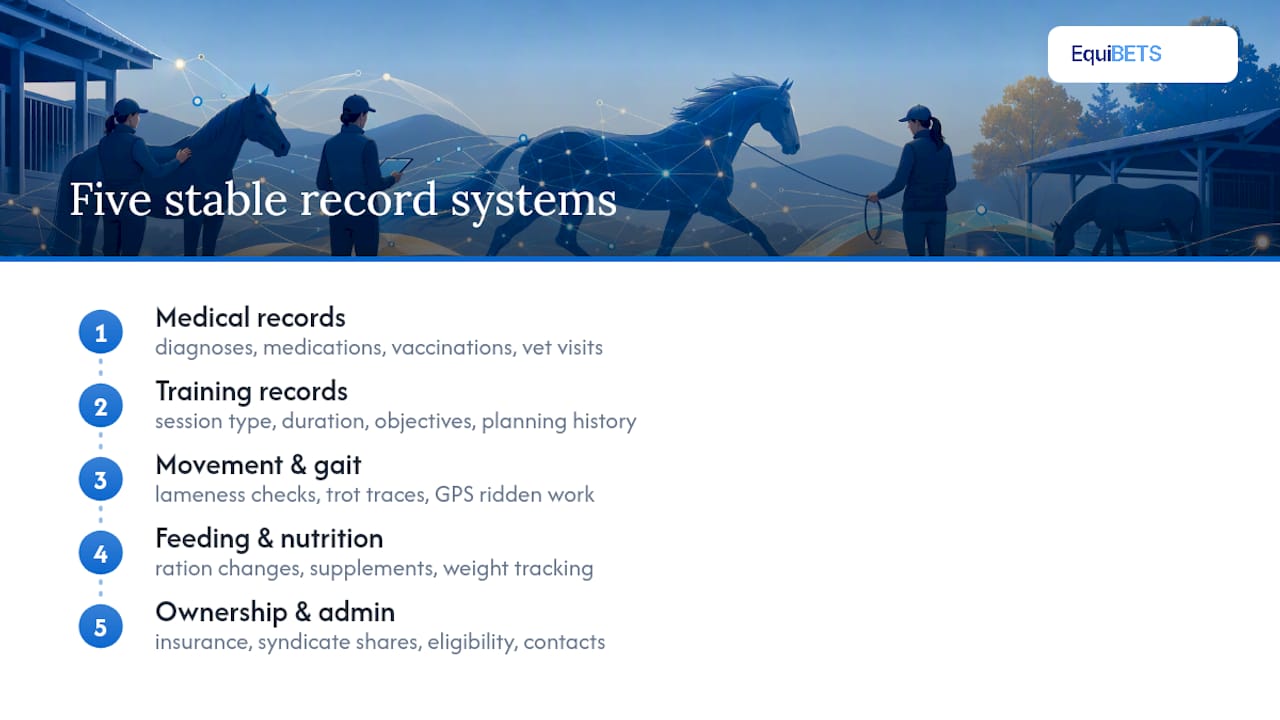
Medical records track diagnoses, medications, vaccination dates, and vet visits. These are what a locum vet needs at 2am when the regular practitioner is unreachable, and they're what an insurer asks for when a claim gets contested.
Training records log session type, duration, and objectives, giving a trainer the history to plan the next four weeks rather than guessing where a horse left off. Movement and gait records capture lameness assessments, trot traces, and GPS data from ridden work, which matters enormously when a subtle asymmetry needs comparing against three months of history rather than one bad Tuesday.
Feeding and nutrition records document ration changes, supplement additions, and weight tracking. Finally, ownership and administrative records cover insurance, syndicate shares, competition eligibility paperwork, and contact details for every party with a stake in the horse.
The failure mode Equibets sees most often isn't missing records. It's records that exist but sit in three different places: a vet's paper file, a trainer's phone notes, and a whiteboard that gets wiped weekly. That gap is exactly what modern stable management software was built to close, consolidating health records, scheduling, and owner communication so nothing depends on one person's memory.
The data fields every record needs to earn its keep
A record without the right fields is just a note. It's not auditable, not shareable, and not much use to the next person who opens it. Here's what separates a genuinely useful entry from a placeholder:
- Universal fields on every entry: horse ID, date and time, author name, role (vet, trainer, groom), location, and a link to the relevant event or booking.
- Medical entries: diagnosis or presenting complaint, medication name and dosage, administering vet's contact details, and a clear next review date.
- Training entries: session type (flatwork, jumping, hacking), duration, trainer name, stated objective, and any attached video or photo.
- Movement entries: device or sensor ID, sampling date, summary metrics (stride length, symmetry score), and the attached trot trace or clip itself.
- Attachments: named consistently, version stamped, and time stamped so a vet comparing this month's scan to last month's isn't guessing which file is current.
Pro Tip: File names like "Bella_trot_2026-03-12_v2" beat "IMG4521.mp4" every time. A vet scrolling through a shared folder during an emergency shouldn't have to open five files to find the right one.
Clinical gait data on its own is close to useless without context. A trot trace paired with a short written summary noting the observed asymmetry and the recommended next step turns raw data into something a vet can act on in under a minute, rather than a graph they have to interpret cold.
Structuring records so they're actually usable, not just stored
Treat the horse profile as the single source of truth, and link every medical note, training log, and movement file back to it. When records live scattered across apps, spreadsheets, and paper folders instead of one profile, staff waste time hunting for the version that's actually current.
Tags and custom fields earn their place fast once a yard passes 15 or 20 horses. Filtering by "rehab", "novice level", or "restricted diet" turns a five-minute search into a five-second one, which matters when a locum vet needs to see every horse on a particular medication protocol.
Permissions matter just as much as the data itself:
- Owners get read access to their own horse's updates, not the full yard ledger.
- Staff vets and trainers get write access scoped to their role.
- Visiting clinicians get a time-limited export, not standing access to the whole system.
Templates and recurring entries handle the repetitive stuff, daily feed checks, weekly weight logs, so staff aren't retyping the same fields every morning. Rural yards need offline capture built in from day one; connectivity drops mid-paddock, and a form that only saves when there's signal is a form that gets abandoned. Offline-first mobile access isn't a nice extra for stable software, it's the baseline expectation now.
Export formats matter too. A PDF vet packet for a referral, a CSV medication history for an insurance query, both should be a couple of taps away, not a manual copy-paste job the night before a deadline.
Templates and daily workflows that actually get used
The best record system fails if it takes longer than the job it's replacing. Here's what tends to stick:
- Daily care log: feed given, turnout duration, medications administered, staff member responsible, and a free-text field for anything unusual.
- Pre-competition checklist: vaccination status confirmed, passport and paperwork checked, farrier work up to date, and a printed vet handover packet ready to travel with the horse.
- Weekly training summary: total sessions, cumulative load, and a brief note on how the horse responded, which builds the history a trainer needs for genuine periodisation rather than guesswork.
- Recurring reminders: worming schedules, vaccination boosters, and farrier visits set once and left to fire automatically.
Yards running more than 10 to 15 horses hit a point where paper calendars and whiteboards simply can't keep pace, and that's usually when missed tasks start costing real money. A missed medication dose or a forgotten vaccination booster is rarely a training failure. It's a record-keeping gap that a recurring task would have caught.
Why this needs a platform built for it, not a workaround
Spreadsheets and shared folders get a yard through the first ten horses. Past that, the cracks show fast: a vet exports get emailed as attachments, permissions live in someone's memory, and movement data sits in a phone's camera roll rather than linked to the horse it belongs to.
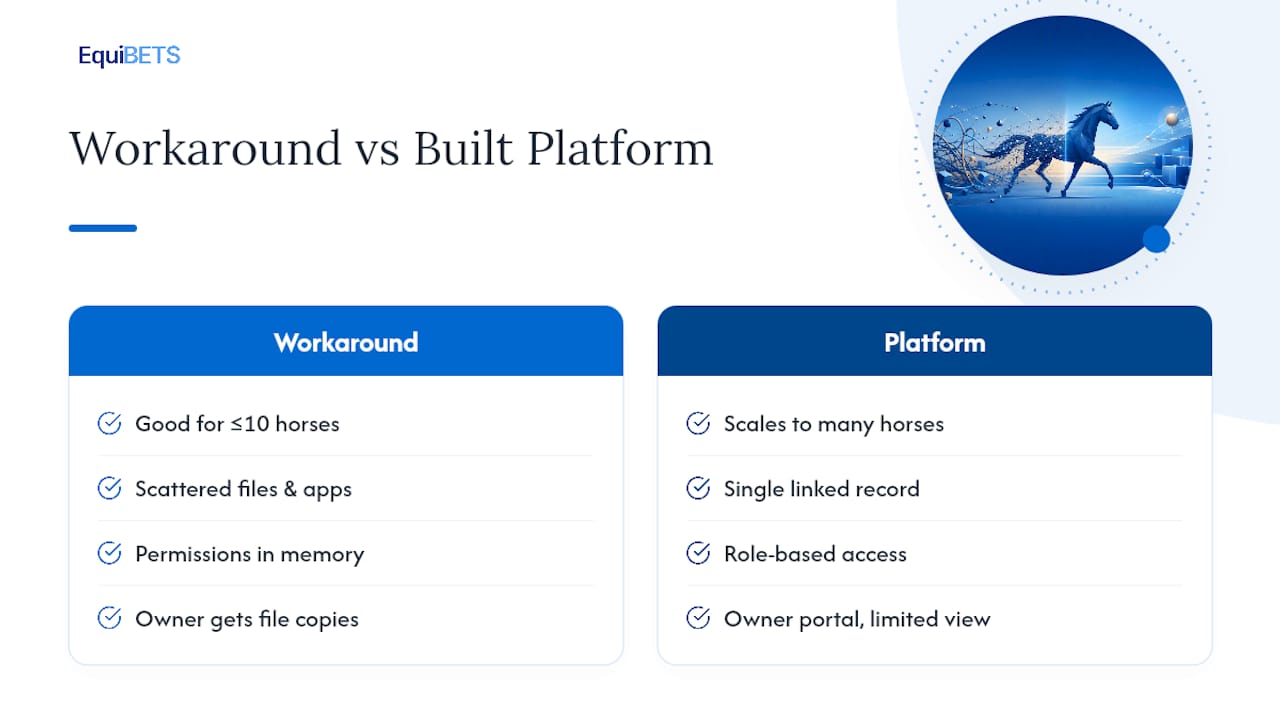
Some stable management platforms are built around exactly this gap. Horse profiles carry the checklist fields described above natively, medical notes, training sessions, movement summaries, all linked to one record instead of scattered across apps. Owner portals give owners live visibility without exposing the full yard's operational data, and offline mobile capture means a groom in a paddock with no signal still logs the entry the moment it happens rather than trying to remember it that evening.
Where this gets genuinely useful is EquiBETS Intelligence (EBI), which turns raw movement and competition data into analytics a trainer or syndicate can actually act on, rather than a spreadsheet nobody has time to interpret. A trot trace becomes a concise clinical summary a vet can review in a minute, not a graph requiring a follow-up phone call to explain. That's the real test of any record system: does it save the vet time during the handover that matters, or just add another file to search through?
— isaac
Put this into practice with Equibets
Some platforms provide one consolidated place for every record type covered here: medical history, training logs, movement data, and ownership paperwork, all linked to a single horse profile instead of scattered across notebooks and phone folders. Owner portals keep owners informed without extra emails, offline mobile capture means paddock entries never get lost to a dead signal, and AI-powered movement analysis can turn trot traces into actionable summaries.

The lowest-effort way to see whether this fits your yard is to pick one horse, ideally one with a recent vet visit or a rehab plan in progress, and rebuild its profile properly: core fields, attachments named and dated, permissions set for the right people. Equibets offers a free trial for exactly this kind of test run. Explore the Stable Manager module for the full feature set, or head to the main EquiBETS platform to start your trial today.
Sources
For deeper detail on the topics covered here, the medical records management guide walks through structuring vet-facing files properly, and the movement analysis guide covers converting gait data into clinical summaries. On offline capture specifically, see the field-ready forms guide for rural yards.
- Horse stable operations and the digital shift in horse stable operations (Coruzant)