

The safest default for equine records is field-level merging, with manual review locked in for anything medical or emergency-related. Turn on conflict surfacing in your app today and name one on-duty reviewer who resolves flagged records before the next shift starts. The checklist and verification steps below explain exactly how to build that habit into daily yard operations.
TL;DR:
- Critical fields such as medication doses and emergency contacts should be resolved manually or prioritized by role-based rules rather than relying on last-write-wins.
- Field-level merging is recommended to keep non-overlapping edits like notes and paddock reassignments, preventing one update from erasing another.
- Establishing clear responsibilities for conflict resolution and configuring per-field merge rules are essential for maintaining data integrity during offline edits.
- Regular conflict auditing, simulating failure scenarios, and monitoring conflict metrics ensure the sync system remains reliable in patchy rural environments.
- Organizational training and role alignment are key, as technical safeguards alone cannot prevent sync failures caused by unclear procedures among yard staff and owners.
Table of Contents
- Why do sync conflicts happen in equine management systems?
- Which conflict-resolution strategy actually protects horse records?
- What should a yard's sync conflict checklist look like?
- How do you verify your sync system is actually safe?
- Why sync is a governance problem, not just a code problem
- EquiBETS: built for yards that can't afford a lost medication update
- Sources
- FAQ
Why do sync conflicts happen in equine management systems?
Sync conflicts aren't bugs. They're the expected outcome of running a yard where several people edit the same horse's data from different devices, often without a signal. A trainer logs a lameness note on a tablet in the arena. Ten minutes later, an owner updates insurance details from home. Neither device has coverage at the exact moment the other syncs, so both edits queue locally and fire off when connectivity returns. That's normal offline-first behaviour, and any app built for rural yards has to expect it rather than treat it as failure.
The real risk is which fields collide. Consider these common multi-stakeholder scenarios:
- A vet enters a new medication dosage on-site while a stable hand logs the same horse's feed change from the office.
- An owner edits emergency contact details through the portal while a manager reassigns the horse's paddock in the same window.
- Two riders log GPS ride data for the same horse after a shared lesson, each capturing a slightly different track.
Critical fields, health status, medication amounts, emergency contacts, deserve far stricter handling than low-risk fields like tags or a last-seen timestamp. A tag conflict is cosmetic. A medication conflict can hurt a horse.
Clock skew adds another layer of trouble. If two devices disagree on the time by even a few minutes, a naive system might apply edits in the wrong order. Webhooks and "echo writes," where a device receives back its own change and mistakes it for a new one, can also trigger phantom conflicts that clutter your review queue without representing real disputes.
Which conflict-resolution strategy actually protects horse records?
Not every field needs the same rule. The Couchbase Lite documentation describes the default many sync engines fall back on: last-write-wins (LWW), where whichever edit lands last simply overwrites the other. It's fast and requires no configuration, but for horse health data, LWW is a silent liability. If a vet's dosage update loses to an outdated cached edit purely because of timing, nobody gets notified. The record just looks correct.
Hybrid logical clocks and vector clocks solve part of this by ordering edits based on causality rather than wall-clock time. ObjectBox's sync documentation describes exactly this approach, pairing a sync clock with a precedence value so business-critical writes can be prioritised over routine ones, even when device clocks drift.
The strongest approach for most yard data is field-level merging. Instead of one edit replacing the whole record, the system merges non-overlapping fields independently, so a training note and an insurance update land side by side rather than one erasing the other.
- Low-risk fields (tags, notes, last-seen timestamps): auto-merge or LWW is fine.
- Concurrent, non-overlapping edits (feed change plus paddock reassignment): field-level merge.
- Critical fields (medication, emergency contacts, health status): manual resolution or strict role-based precedence.
- Collaborative lists (shared training logs, annotation threads): consider CRDTs or operation-based sync, which handle concurrent additions well but carry real engineering overhead.
Pro Tip: Don't try to apply one universal rule across your whole record schema. Set merge behaviour per field type, so medication dosage and turnout notes are governed by completely different logic.
What should a yard's sync conflict checklist look like?
Configuration is only half the job. The other half is deciding, in advance, who wins when two people touch the same field.
Configuration settings to lock in:
- Per-field merge rules, so medical fields never silently overwrite
- Tombstones (soft-delete markers) instead of hard deletes, so a removed record can be recovered and audited
- Idempotency keys on every write operation, so a retried sync never applies the same change twice
Operational roles to assign:
- One named conflict reviewer per shift, not "whoever's free"
- Role-based precedence, where a vet's medication entry outranks a stable hand's routine note
- A checkpoint/approve step specifically for emergency plan changes, given how much rides on that data being right
Offline app behaviours to expect from your platform:
- A durable mutation queue that holds edits locally until reconnection, described well in DerkOnline's guide to offline-first mobile sync
- Delta sync (sending only what changed, not the whole record) to cut bandwidth on patchy rural connections
- A visible sync-state indicator, so a rider knows whether their entry has actually reached the server or is still sitting in a local queue
When a conflict does surface, the incident flow is simple: quarantine the conflicting record so nobody acts on either version, compare both side-by-side, resolve, then log the decision in the audit trail with who chose what and why.
Pro Tip: Treat every resolved conflict as a small training moment. If the same two roles keep colliding on the same field, that's a workflow gap, not a technology gap.
Yards managing offline paddocks and patchy connectivity should also look at how rural stable connectivity strategies handle these queues before problems compound, and how pre-sync checklists reduce the number of conflicts that reach a human reviewer at all.
How do you verify your sync system is actually safe?
Trust in a sync system comes from testing it under the conditions that break it, not from assuming the vendor got it right.
- Instrument every conflict with metadata: who made each edit, when, which fields changed, and which resolution rule fired. Without this, you can't audit a disputed medication record after the fact.
- Run a divergence reconciler on a schedule. This process compares every device's state against the canonical store and repairs drift automatically, a pattern detailed in LetsBuild's guide to bidirectional sync engines. Track sync generation or log sequence numbers so the reconciler can tell an echo write from a genuine new edit.
- Simulate failure in staging before it happens in production. Force two devices offline, make concurrent edits to the same horse record, then reconnect both and confirm the merge behaves as designed. Sachith Dassanayake's crash course on offline sync patterns walks through exactly this kind of network-partition testing.
- Watch three metrics ongoing: conflict rate (how often collisions occur), unresolved queue length (how many are sitting unreviewed), and average time-to-resolve. A rising queue length usually means understaffed review, not a technical fault.
Why sync is a governance problem, not just a code problem
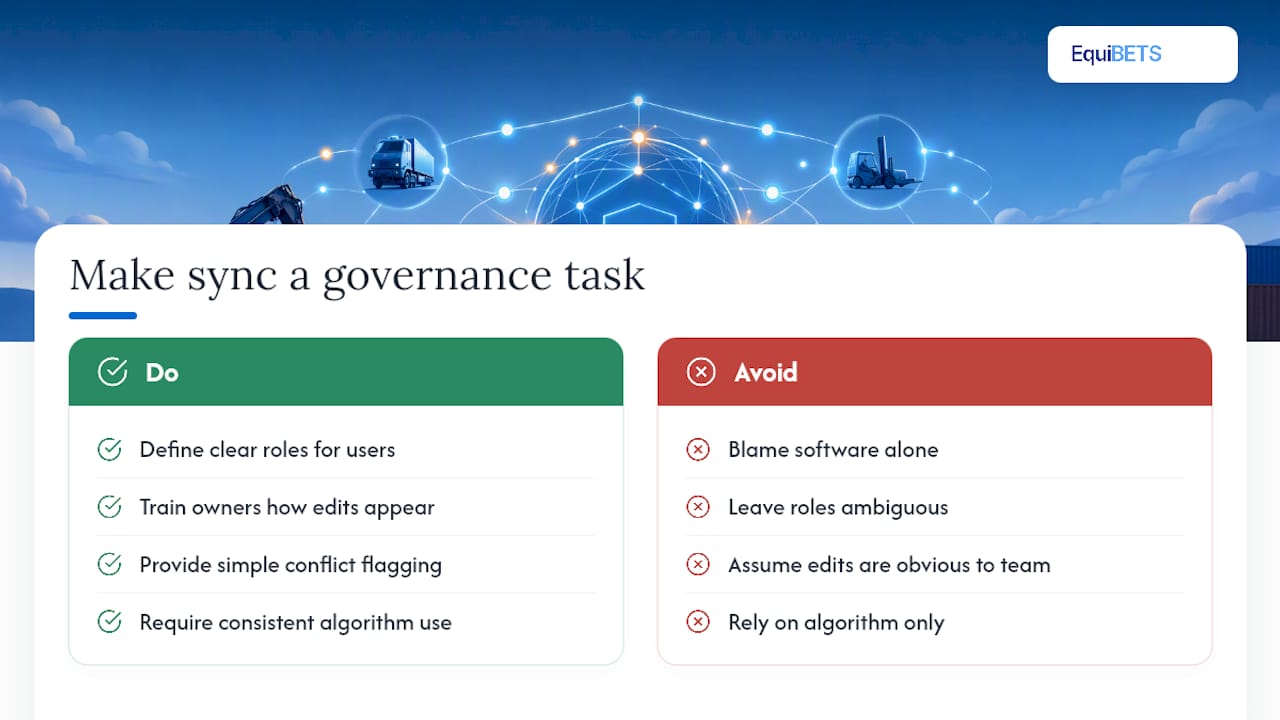
Most sync failures trace back to unclear roles, not broken software. A socio-technical analysis of equine health data makes the case directly: harmonised records only work when technical interoperability is paired with organisational alignment among vets, owners, and yard staff. Train owners on how their edits appear to the team, and give every user a simple way to flag a conflict they've spotted. The algorithm matters less than whether people actually use it consistently.
— isaac
EquiBETS: built for yards that can't afford a lost medication update
This platform is designed to keep horse data trustworthy when multiple people update it from different devices, often with patchy signal. The offline mobile app queues edits durably and syncs them once connectivity returns, so a trainer working in a paddock with no coverage never loses a note.

Every change carries an audit trail, so when multiple users update different fields in the same window, it is possible to see exactly what happened and when, rather than guessing which version won. Owner portals give owners real-time visibility into horse records without needing edit access to critical fields, which can cut down collisions before they start. The Stable Manager module centralises health, training, and emergency data with configurable workflows built for the field-level merge approach this guide recommends, and yards running competition analytics can extend that same reliability into FEI eventing data. Potential users are encouraged to start a free trial and configure their own sync and review rules.
Sources
For deeper technical grounding, read LetsBuild's sync engine design guide on architecture, Couchbase Lite's docs on default conflict behaviour, and the socio-technical matrix paper on governance. Vet practices coordinating with yards can also review Animal Booking's vet-practice resources.
- Using a socio-technical matrix to analyse the digital representation of equine health data (MDPI, 2023)
- Designing a bidirectional data sync engine: conflict resolution, change detection and multi-system consistency at scale (LetsBuild Solutions)
- Design offline-first mobile sync that survives bad networks (DerkOnline)
- Couchbase Lite conflict resolution docs
FAQ
What is sync conflict resolution in horse management software?
It's the process of deciding which edit wins when two users update the same horse record from different devices before syncing, using rules like field-level merging or manual review rather than a blanket overwrite.
Why is last-write-wins risky for horse health records?
LWW silently discards whichever edit arrives second, so a vet's medication update can be overwritten by an unrelated change with no warning, a risk the Couchbase Lite documentation flags directly for critical data.
How does field-level merging differ from record-level resolution?
Record-level resolution picks one whole version and discards the other; field-level merging keeps both concurrent, non-overlapping edits, so a feed note and a paddock change both survive instead of one erasing the other.
Who should resolve a flagged sync conflict at a yard?
A single named on-duty reviewer, backed by role-based precedence that lets a vet's medical entry outrank a routine note, keeps resolution consistent instead of falling to whoever notices first.
Does the platform support offline editing and conflict logging?
Yes. The platform runs an offline-first mobile app with a durable mutation queue and an audit trail for every change, letting yards review who edited what and when a conflict occurs.