
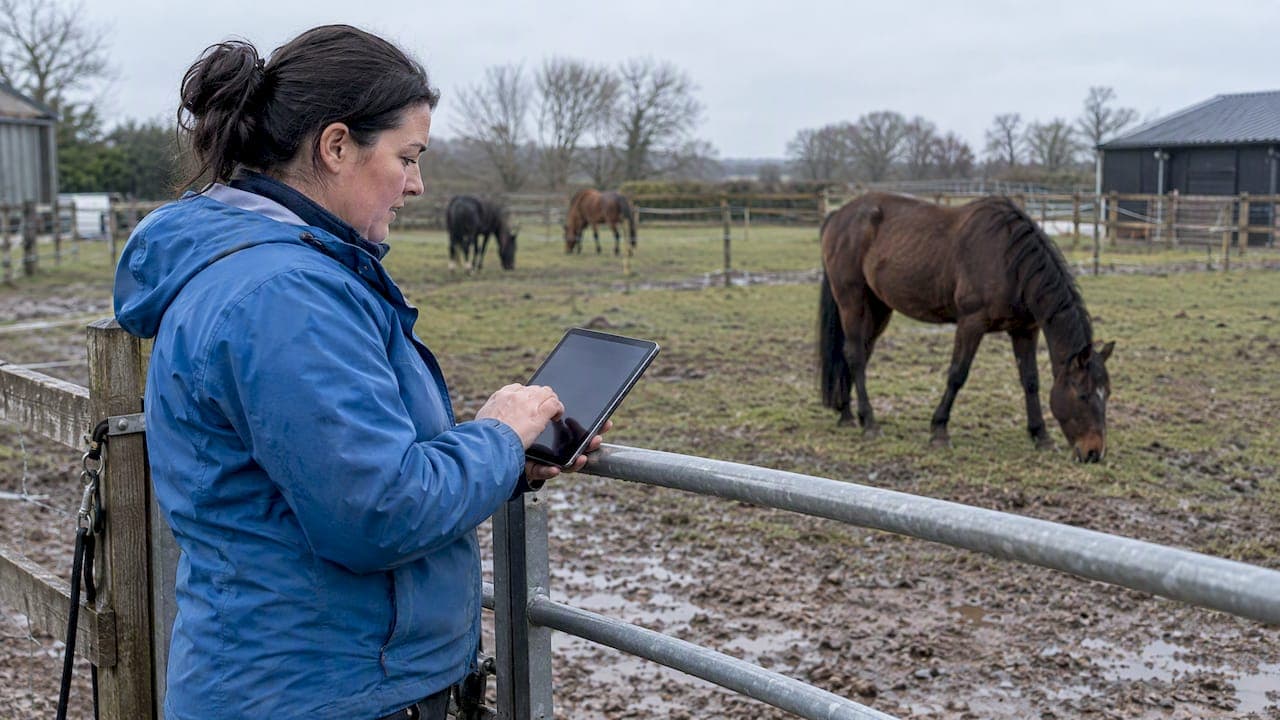
Yard benchmarking horses turns routine care into repeatable KPIs and action plans that identify risks early and show measurable improvement. It means tracking yard-level outcomes, body condition trends, turnout hours, training load, not auditing fences or stable layouts. The fastest way to start is a short, one-week baseline: pick a single KPI, or run a quick HEY-style welfare scan across the yard, and build from there.
TL;DR:
- Keep the scorecard to six to ten repeatable KPIs, combining animal outcomes such as lameness with management measures such as turnout and feed compliance.
- Record turnout and feed compliance daily, body condition and training load weekly, and behavior and rehabilitation milestones monthly; review trends with the team each month.
- Treat acute lameness or sudden weight loss as same day issues; fix recurring operational gaps within a week, and investigate trends lasting two cycles.
- Use HEY for periodic welfare scans; choose an integrated platform if you need daily turnout, feed, training, movement, and owner reporting in one system.
Table of Contents
- What yard benchmarking covers and why it matters for professional yards
- Core KPIs and indicators to include in a yard benchmarking scorecard
- Practical data collection methods and low-friction tools for pro yards
- Step-by-step workflow to implement benchmarking that fits a busy professional yard
- How to interpret benchmarking results and turn them into short- and long-term action plans
- Author credentials, practical proofs and how evidence-led tools support benchmarking
- Comparison of benchmarking platforms and their features
- Data privacy and security considerations in managing horse and yard data
- Making yard benchmarking sustainable: a manager's perspective
- How EquiBETS helps you run benchmarking without the extra admin
- FAQ
- Sources
What yard benchmarking covers and why it matters for professional yards
Yard benchmarking measures how a yard's horses are actually faring and how management decisions shape that outcome, nothing to do with physical infrastructure surveys. The evidence base behind this comes from frameworks like the Horses' Experiences on Yards (HEY) tool, built on the Five Domains Model, which scores 15 essential equine needs in a two-stage process and prompts teams toward concrete action.
Reliable benchmarking mixes two measure types, because each catches different problems:
- Animal-based indicators (body condition, lameness, behaviour) that show real welfare outcomes
- Resource-based indicators (turnout schedules, feed availability, staffing) that explain why those outcomes occur
Framing scoring sessions as team reflection rather than inspection matters just as much as the metrics themselves. A yard that treats benchmarking as a shared improvement exercise gets more honest data and faster buy-in than one that treats it as a compliance check.
Core KPIs and indicators to include in a yard benchmarking scorecard
A workable scorecard stays small enough to repeat every week without becoming its own job. Most professional yards do well with a moderate number of KPIs split across relevant categories.
- Body condition score trends across the herd, tracked against the Henneke scoring system
- Lameness detection rate and time-to-flag for new cases
- Behavioural indicators (stereotypic behaviour, social interaction, response to handling)
- Rehabilitation progress against planned milestones
- Turnout hours per horse per week against the yard's own target
- Feeding plan compliance, including hay analysis results versus ration targets
- Staffing ratio and stocking density at peak and off-peak times
- Training load variance week to week, measured through session comparisons
- Injury recurrence rate for horses returning from rehab
- Owner response and update turnaround time
The mix of animal-based and resource-based measures matters here too: animal-based signals tend to be more informative but take longer to collect, while resource checks are quicker and catch upstream causes before they show up in the horse itself, a trade-off noted in comparative welfare white paper reviews.
Pro Tip: Pick KPIs you can collect the same way every time; a metric that changes definition between staff members is worse than no metric at all.
Practical data collection methods and low-friction tools for pro yards
Good benchmarking data comes from short, standardised forms rather than long free-text notes. A daily turnout log, a weekly BCS check and a monthly behaviour scan, each using the same scoring rubric every time, beat an exhaustive form nobody fills in consistently.
- Use offline-capable forms for yards with patchy signal, so data entry happens at the stable door, not from memory later
- Add sensor-derived data such as GPS ride tracking and movement analysis where it reduces manual labour rather than adding to it
- Feed into decision-support thinking borrowed from livestock analytics: simple predictive flags built on consistent, labelled data can highlight outliers before they become clinical problems, an approach demonstrated in data-driven feed formulation research
- Run short inter-observer checks occasionally, two staff scoring the same horse independently, to catch drift in how a rubric is applied
Sample frequency should match how fast a metric changes: daily for turnout and feed compliance, weekly for BCS and training load, monthly for behaviour and rehab milestones.
Step-by-step workflow to implement benchmarking that fits a busy professional yard
A benchmarking system only survives if it fits inside the yard's existing rhythm rather than adding a parallel admin layer.
- Assign roles. Name a yard manager as owner, a senior groom for daily capture, a vet or RVN contact for clinical flags, and an owner liaison for communication.
- Set a collection cadence. Daily entries for turnout and feed, weekly for BCS and training load, using the weekly benchmarking workflow as a template for who records what.
- Review monthly. Bring the team together, assign an owner to each flagged issue, and set a deadline for the next check.
Keep the paperwork minimal and automate wherever a tool can capture data without extra typing, GPS traces and movement scoring instead of manual stopwatch notes, for instance.
Pro Tip: Give every KPI a one-line decision rule, such as "if more than 3% of the herd falls outside target BCS for two consecutive weeks, review the ration and call the vet within seven days", so review meetings stay short and action-focused.
How to interpret benchmarking results and turn them into short- and long-term action plans
A single off week rarely means much; a KPI drifting in the same direction for two or three consecutive cycles does. Set rule-of-thumb thresholds in advance so the team isn't debating definitions during a review.
- Treat anything with immediate clinical risk, acute lameness, sudden weight loss, as same-day action
- Treat recurring operational issues, turnout shortfalls, feeding gaps, as near-term fixes within the week
- Treat capacity or staffing gaps as longer-term investment cases to raise with ownership
Comparative welfare-assessment research shows that protocols using more animal-based measures detect more welfare issues than quicker, resource-only checks, though they take longer per assessment. That trade-off is exactly why a mixed scorecard, fast resource checks paired with periodic animal-based deep dives, works better than either approach alone.
Benchmarking outputs double as evidence for owner reports: a trend line showing turnout hours recovering after a staffing change is a stronger message than a verbal reassurance.
Author credentials, practical proofs and how evidence-led tools support benchmarking
Isaac has spent years working alongside professional yard teams on practical welfare and performance measurement, translating frameworks like HEY and the Five Domains Model into routines yards can actually sustain.
Evidence-led tools make each workflow step easier to run without adding to the day: automated scoring reduces manual tallying, movement analysis replaces subjective lameness notes with repeatable traces, and owner portals turn a monthly review into a report that goes out with one tap rather than a round of phone calls.
Comparison of benchmarking platforms and their features
Yards generally choose between three approaches: paper-based scorecards, standalone welfare-assessment tools like HEY, and integrated management platforms.
Paper scorecards cost nothing to start but rely entirely on staff discipline, and comparing trends across months means manually re-entering old data every time. Standalone welfare tools such as HEY give a structured, evidence-based scoring method for a point-in-time yard scan, strong for an annual or quarterly deep dive, but they aren't built to track daily turnout, feed compliance or training load between scans.
Integrated platforms combine both jobs: structured scoring plus continuous KPI tracking, movement data and owner communication in one place. The trade-off is a subscription cost against the hours saved on re-entry and reporting.

Outside equine management specifically, decision-support systems built for other livestock sectors show the same pattern. Silk Data's agricultural AI case studies illustrate how predictive analytics and automated flagging work across farm operations more broadly, a useful reference point for yards weighing how much automation to add to their own scorecards.
Whichever route a yard takes, the feature that matters most isn't the dashboard, it's whether the data entered on a Tuesday morning turnout round actually becomes a trend line someone reviews a month later.
Data privacy and security considerations in managing horse and yard data
Yard data covers more than hoofcare notes: it includes owner contact details, financial records, veterinary history and sometimes GPS location of horses and riders. That combination makes privacy a genuine operational concern, not a box to tick.
Before adopting any digital system, check who can access owner and horse records, whether data stays on-device when connectivity drops, and how long records are retained after a horse leaves the yard. Practical privacy guidance for yard data covers the questions worth asking before rollout: access permissions by role, backup practices and what happens to records if a yard changes management software.
A sensible baseline: restrict financial and emergency contact data to named roles, keep veterinary records accessible to the vet contact and yard manager only, and give owners view-only access to their own horse's updates rather than the full yard dataset.
Making yard benchmarking sustainable: a manager's perspective
Running a yard already means early mornings, constant triage and decisions made on too little sleep. Adding a benchmarking system that feels like extra homework will fail within a month.
Start with one KPI, prove it catches something useful, then add the next. Scoring sessions work best as a team conversation, not a manager handing down a verdict, because the groom who handles a horse daily often spots the pattern first.
— isaac
How EquiBETS helps you run benchmarking without the extra admin
We built our platform around the workflow this guide describes, including offline-capable forms for daily logs, movement analysis for lameness and training-load tracking, GPS ride data, owner portals for easy reporting, finance tracking, and emergency plans designed to support timely vet access.

None of that replaces the team conversation that makes benchmarking stick, it just removes the re-entry and chasing that eats into it. You can start a baseline benchmark on EquiBETS Complete for $9.99 AUD per month after your free trial.
FAQ
What is yard benchmarking in horse management?
Yard benchmarking is the repeated measurement of yard-level horse outcomes and management practices, such as body condition, turnout hours and training load, used to spot risks early and track improvement over time. It is distinct from physical facility surveys and focuses on care and operational performance.
What is the HEY tool and how does it relate to the Five Domains Model?
The Horses' Experiences on Yards (HEY) tool is a free, yard-level welfare assessment built on the Five Domains Model, scoring 15 essential equine needs in a two-stage process. It is designed to prompt teams toward specific, achievable action plans rather than produce a pass or fail audit.
How many KPIs should a yard track for benchmarking?
Most professional yards manage best with six to ten KPIs that are repeatable and genuinely actionable, mixing animal-based measures like body condition and lameness with management measures like turnout hours and feeding compliance. Tracking more than that tends to reduce consistency rather than improve insight.
How often should a yard review benchmarking results?
Daily or weekly capture works for fast-changing metrics like turnout and feed compliance, while a monthly team review suits body condition trends, training load and rehab progress. Immediate clinical risks, such as acute lameness, should trigger same-day action rather than waiting for the scheduled review.
What does EquiBETS cost for a professional yard?
EquiBETS Complete is $9.99 AUD per month after a free trial, covering offline forms, movement analysis, owner portals, finance tracking and emergency plans in one subscription, as listed on the EquiBETS pricing page.