
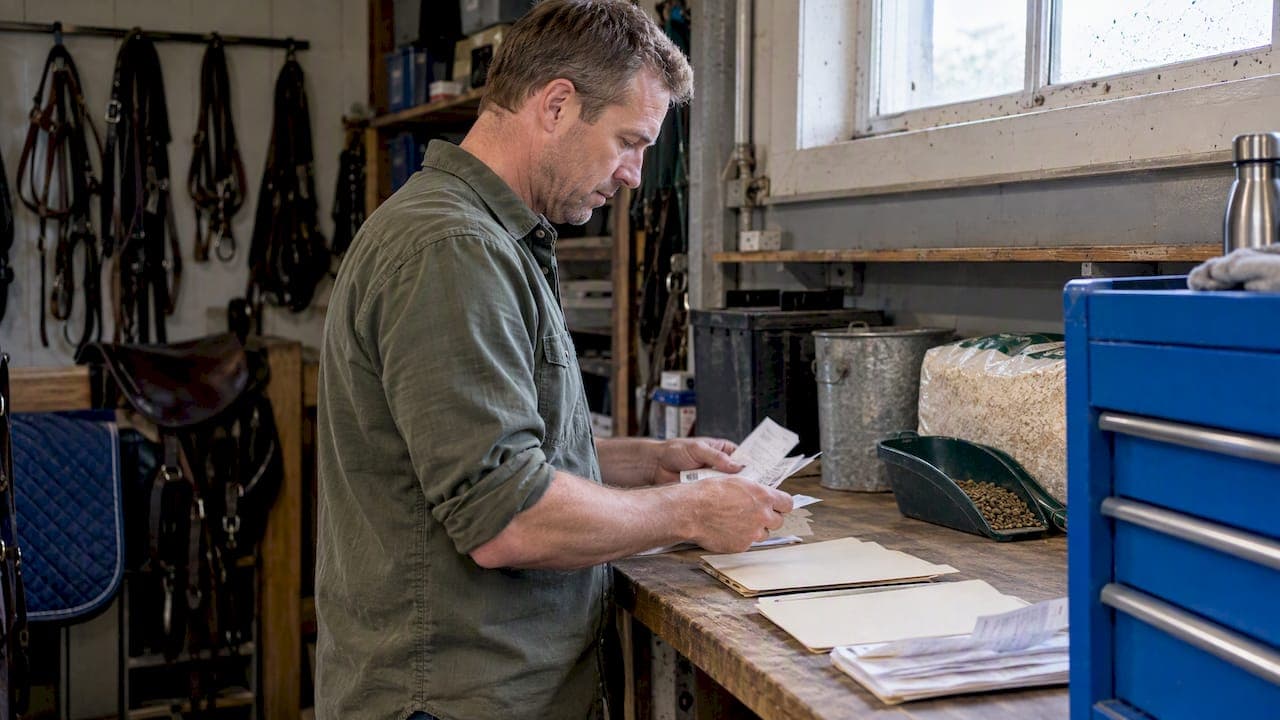
A stable cost centre is a defined bucket of spending, such as feed, farrier, staff or arena upkeep. Each bucket gets its own budget and its own running total. For a professional yard, the useful set is usually two layers: cost centres for the parts of the business that spend money, and a per-horse view that shows what each horse costs once those buckets are shared out. This guide shows you how to build both, with a worked example, a short look at what building a stable costs, and the mistakes that cause surprise bills.
TL;DR
- Group spending into 6 to 10 cost centres that match how your yard actually runs, not how an accountant's template looks.
- Tag every expense once, at the moment it happens, to a cost centre and, where possible, to a horse.
- Direct costs (a horse's own farrier visit) go straight to that horse. Shared costs (arena, staff wages) are spread by a simple, stated rule.
- Review cost centres monthly against budget, and per-horse margins against what you charge.
- Capital costs of building or fitting out stables belong in their own centre so they do not distort running costs.
Table of Contents
- What a cost centre means on a yard
- A practical set of cost centres for a professional yard
- Direct and shared costs: how to allocate fairly
- Setting cost centres up step by step
- Capital costs: what a stable build or fitout adds
- Running checks and compliance as part of cost control
- Our perspective
- Keeping it all in one place
- Common mistakes with stable cost centres
- FAQ
- Sources
What a cost centre means on a yard
In accounting, a cost centre is a part of a business that incurs cost but is not itself judged on revenue. In a stable, that is almost everything: the feed room, the paddocks, the vet account, the wash bay. Your income sits elsewhere, in board, training fees, lessons, sales commissions and syndicate management fees.
The point of splitting costs this way is simple. A single line called "yard expenses" tells you the yard lost money. Ten cost centres tell you the feed bill climbed 18% because hay prices moved, while the farrier line stayed flat. You can only fix what you can see.
There are two questions a good cost centre structure answers:
- Where is the money going? (by activity: feed, labour, vet, facilities)
- Who is it going on? (by horse, owner, or syndicate)
Most yards answer the first with a bank statement and the second with a guess. The aim is to answer both from the same set of records.
A practical set of cost centres for a professional yard
There is no official list. What matters is that each centre has an owner, a budget and clear rules about what belongs in it. A workable starting structure looks like this:
| Cost centre | Typical contents | Usually allocated |
|---|---|---|
| Feed and forage | Hay, chaff, hard feed, supplements, bedding | Per horse (direct) |
| Farrier and hoof care | Trims, shoes, remedial work | Per horse (direct) |
| Veterinary and health | Vet visits, dental, physio, vaccinations, wormers | Per horse (direct) |
| Labour | Wages, super, workers compensation, casual cover | Shared |
| Facilities and grounds | Arena maintenance, fencing, paddock care, rubbish removal | Shared |
| Equipment and tack | Rugs, saddlery repairs, grooming kits, float costs | Mixed |
| Transport and competition | Fuel, entries, float servicing, travel | Per horse or per event |
| Utilities and insurance | Power, water, public liability, property cover | Shared |
| Admin and software | Accounting, subscriptions, phone | Shared |
| Capital works | New stables, fitout, major repairs | Separate, depreciated |
Our stable budget playbook on expense categories walks through ten categories in detail and the surprise bills each one tends to hide. Use it to sanity check the table above against your own yard.
Keep the number small
The temptation is to create a centre for every cost. Resist it. Past about ten, people stop tagging expenses properly, and the data becomes worse, not better. If you need more detail, use sub-categories inside a centre (for example, "supplements" inside feed) rather than new centres.
Give each centre an owner
Even in a small team, name one person responsible for each centre. The head groom owns feed and bedding. The stable manager owns labour and facilities. The vet and farrier lines might belong to the manager but be reviewed with the head rider. When nobody owns a line, nobody notices when it drifts.
Direct and shared costs: how to allocate fairly
This is where most yards go wrong. Some costs belong to one horse. Others are shared by every horse on the property. Treat them differently.
Direct costs are traceable. A set of shoes, a vet call for a particular horse, a bag of a specific supplement. Tag these to the horse the moment they happen.
Shared costs cannot be traced, so you need an allocation rule. The common options are:
- Equal split per horse. Simple, and fine when horses use the facilities about the same.
- Split by horse-days. Better when horses come and go, as with spelling or short-stay horses.
- Split by service level. A full-training horse uses more labour than a paddock-kept spelling horse, so weight it accordingly.
Pick one rule per shared centre, write it down and apply it consistently. A rule that is slightly imperfect but stable beats a clever one that changes every quarter.
A worked example
The figures below are illustrative, not benchmarks. Imagine a yard with 20 horses and the following monthly shared costs: labour $12,000, facilities and grounds $2,400, utilities and insurance $1,600, admin and software $400. That is $16,400 a month, or $820 per horse if split equally.
Now add direct costs for one horse: feed and bedding $520, farrier $140, vet and health $210. That horse costs $820 + $870 = $1,690 a month to keep. If you charge $1,500 in board and training, the horse loses you $190 a month, even though the yard as a whole might look profitable because other horses are priced higher.

That per-horse view is what lets you reprice, change service levels or decide which clients to keep. We explain the method in more depth in our guide to per-horse P&L and stable expense tracking, and how a break-even figure falls out of it in per-horse cost tracking.
Setting cost centres up step by step
- Pull twelve months of spending. Bank feeds, supplier statements and receipts. You are looking for patterns, not perfection.
- Sort it into your draft centres. Anything you cannot place in under a minute suggests a centre is missing or badly defined.
- Mark each centre direct, shared or mixed. This decides how it will be allocated.
- Set a monthly budget per centre. Base it on last year's actuals, adjusted for known changes such as a wage rise or a new feed contract.
- Choose the allocation rule for each shared centre. Write it in one sentence.
- Decide who tags expenses and when. The best answer is the person who spends the money, at the time of spending.
- Review monthly. Compare actual to budget by centre, then per-horse margin against fees.
Tagging at the source
The reason cost tracking fails is rarely the design. It is the lag. A receipt gets stuffed in a ute console, and three weeks later nobody remembers which horse the bute was for. Tagging in the moment, from a phone, even when there is no signal in the feed shed or at a remote property, closes that gap. Offline capture matters more than it sounds: at many yards the places where money is spent are the places with the worst coverage. Our piece on offline horse management software explains how that plays out for yards that have stopped fielding owner calls for basic updates.
Capital costs: what a stable build or fitout adds
Searchers for this topic often arrive wanting build prices, so it is worth being clear about where those costs sit. Building or fitting out stables is a capital expense. Keep it out of your running cost centres, or one new barn will make a profitable year look like a disaster. Record it in a capital works centre and spread it over its useful life, following advice from your accountant.
For scale, published figures are mostly from overseas, so treat them as ballparks for what drives cost rather than Australian quotes. In the UK, Horse & Hound reported prices of about £2,000 to £5,000 for a single standalone stable excluding groundwork, £7,000 to £15,000 for a block of two or three boxes, and £25,000 to over £100,000 for a full yard with groundwork and infrastructure. A Checkatrade cost guide puts the average for a basic one-bay stable at £1,250 and a two-bay at £2,300. These are not directly comparable, because they cover different scopes and sources, which is itself the lesson: always ask what a quote includes.
The factors that move the number are consistent. According to the Checkatrade guide, they include the number of bays, materials, groundworks, whether you choose a kit or bespoke build, extras such as insulation and lighting, and site access. If you convert overseas figures to Australian dollars, remember that exchange rates alone can mislead. BCIS has noted that ordinary exchange rates can distort international construction comparisons, so get local quotes before you budget.

What to budget beyond the building
A stable budget that stops at the structure will blow out. The usual extras are excavation and grading, a concrete foundation, water lines, stall fittings and mats, lighting and power outlets, as listed in Equus magazine's planning guide. Put each as a line inside the capital works centre so you can compare quotes like for like.
Size and safety affect cost and welfare
Cheaper is not always better. The Scottish Government's welfare code, which reproduces British Horse Society recommendations, suggests minimum stable sizes of 3.65m x 3.65m for a horse and 3.65m x 4.25m for a large horse. Cutting size or ventilation to save money can cost more in vet bills later. Planning rules also differ by state and council in Australia, so check with your local council before committing to any build.
Running checks and compliance as part of cost control
Unplanned costs often start as missed maintenance: a failed fire extinguisher check, an ignored electrical fault in the feed room, an out-of-date first-aid kit. A routine that records recurring safety checks, with reminders and stored certificates, reduces the chance of an expensive surprise. A digital logbook for recurring site checks can handle schedules and records for items like these, so your facilities centre carries fewer emergency repairs.
Our perspective
We build software for professional yards, and the same pattern shows up again and again. The yards that struggle with money do not usually have a cost problem. They have a visibility problem. Spend is recorded late, in three places, by four people, and nobody can say what a particular horse cost last month.
Our view is that cost centres should be the boring backbone, not a project. Pick a handful of centres, tag at the point of spend, allocate shared costs with one stated rule, and look at the numbers monthly. The AI and analytics layers are only useful once the basic records are trustworthy.
We also think owners deserve to see where their money goes. When a client can see feed, farrier and vet lines against their horse, the conversation about fees shifts from suspicion to planning. That openness matters even more for syndicates, where administrators answer to many people at once.
— isaac
Keeping it all in one place
A spreadsheet can hold cost centres, but it struggles with offline entry, owner visibility and linking costs to horse records. EquiBETS Complete is a single plan at 9.99 AUD per month that includes every module, with finance tracking, per-horse records, owner portals and an offline mobile app, and there is a free trial before you pay. You can see the details on the EquiBETS Complete pricing page. If you are moving off spreadsheets, our guide to replacing horse spreadsheets covers which columns to carry across.
Common mistakes with stable cost centres
- Too many centres. Tagging fatigue ruins the data.
- Mixing capital and running costs. One big purchase hides the real trend.
- Ignoring cash timing. Profit on paper does not pay the farrier. See our cash flow guide for stables.
- No owner for each centre. Nobody reviews, so nothing changes.
- Supplements and extras untracked. Small items add up fast, and vets need the history too. Our supplement tracking guide shows a six-step approach.
- Unclear owner billing. When several owners share a horse, costs need clear rules. See how to fix multi-owner management.
FAQ
How many cost centres does a stable need?
Most professional yards do well with six to ten. Fewer than that hides problems, and more than that makes tagging a chore. Use sub-categories for detail inside each centre.
What is the difference between a cost centre and a profit centre in a stable?
A cost centre only incurs spending, like feed or facilities. A profit centre earns revenue as well, such as a training program, a breeding operation or a lesson business. Many yards treat each income stream as a profit centre and each activity that supports it as a cost centre.
Should stable building costs be part of my cost centres?
Track them, but separately. Put them in a capital works centre and spread them over the life of the asset, so one build does not distort monthly running costs. Ask your accountant how to treat depreciation for your structure.
How do I allocate shared costs like labour to each horse?
Choose one rule and apply it consistently. Equal split works when horses use the yard similarly, horse-days suits changing numbers, and service-level weighting suits mixed training and spelling horses. Write the rule down so owners can see it.
Sources
- How much does it cost to build stables? | Horse & Hound
- How much does it cost to build horse stables in 2026? | Checkatrade
- European construction costs compared | BCIS
- A Guide to Planning Your First Horse Barn | My New Horse
- The need for a suitable environment | Welfare of equidae, gov.scot