
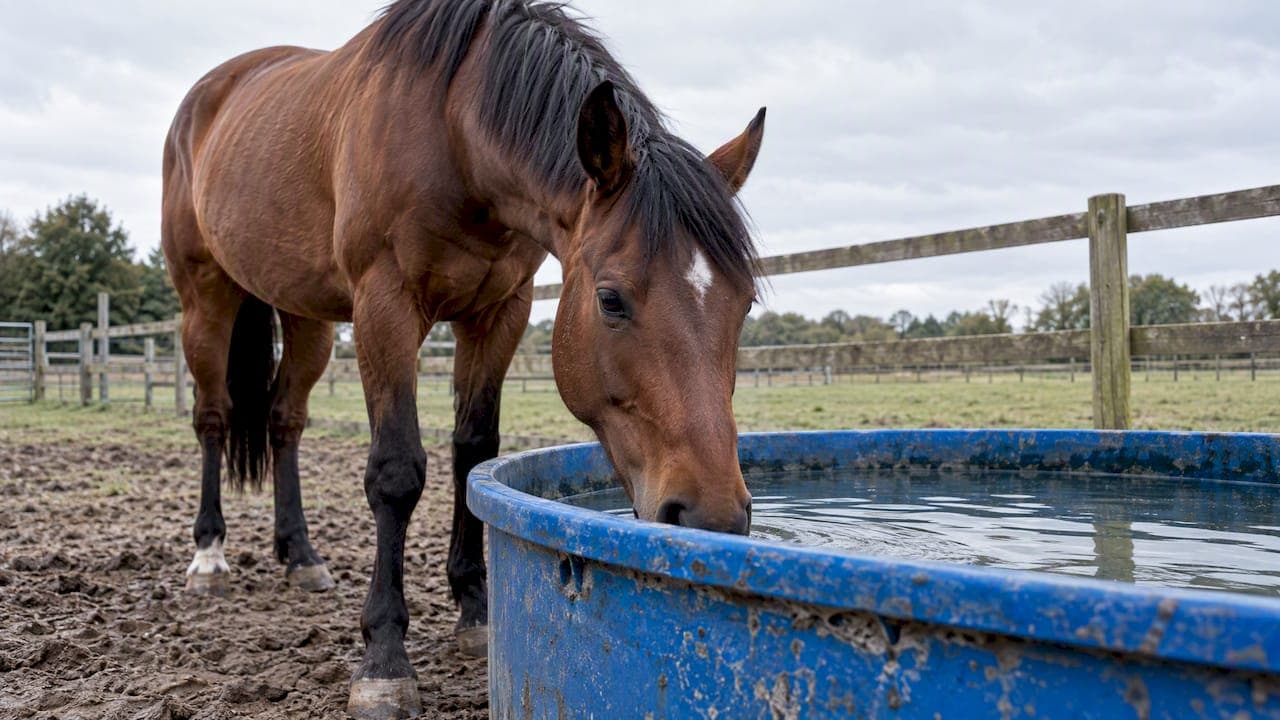
Good hydration monitoring for horses combines three things: knowing how much each horse normally drinks, checking a short set of clinical signs when something looks off, and writing it all down so the next person on shift sees the same picture. The pinch test alone won't do it. By the time skin tenting shows up, a horse is already well down on fluids.
This guide is written for yard managers, trainers and vets who look after many horses at once, in Australian conditions where heat, travel and hard work stack up quickly.
TL;DR
- Measure what you can every day: water intake, manure, appetite and attitude. A change from the horse's own baseline is your earliest signal.
- Use a fixed check for suspect horses: gum colour and moisture, capillary refill time, heart rate and skin tent. Capillary refill beyond 3 seconds warrants veterinary attention.
- Offer clean, palatable water first. A horse that drinks eagerly probably had an unmet need, whatever the clinical signs said.
- Provide plain water alongside any electrolyte-treated water, so a fussy horse never cuts its intake.
- Record every check in one shared place, so trends and handovers don't depend on memory.
Table of Contents
- Why hydration deserves its own routine
- What to monitor every day
- The hands-on check: what to look at and what the numbers mean
- Electrolytes: helpful, but easy to get wrong
- Building a yard-wide hydration routine
- Where technology fits
- Our perspective: hydration is a records problem as much as a care problem
- Turning notes into patterns
- Trying it on your yard
- FAQ
- Sources
Why hydration deserves its own routine
Horses lose water mainly through sweat, and the loss can be large. Dehydration is defined functionally as losing body water faster than it is replaced, and clinical concern begins when a horse sweats for more than an hour. A loss of 3% of body mass or more has traditionally counted as clinical dehydration, which is about 15 L for a 500 kg horse.

The consequences go beyond thirst. The Brooke's veterinary manual calls dehydration a serious welfare concern and a contributing factor to exhaustion, heat stroke and reduced work capacity. The Merck Veterinary Manual notes that dehydration before exercise leads to higher core temperatures during work. A horse that starts a session short of fluid is already behind.
On a professional yard the problem is rarely one horse on one day. It is twenty or sixty horses, several grooms, changing weather, transport days and competition schedules. That is why monitoring has to be a routine, not a reaction.
What to monitor every day
The most reliable hydration monitoring is boring: making sure every horse has access to clean, palatable water at all times. Veterinary guidance stresses that hydration management should be preventative, not reactive, and your daily observations are what make that possible.
Water intake
At rest, an adult horse in a cool climate drinks about 6 to 10 US gallons a day, roughly 23 to 38 litres, depending on feed, and much more when working or when it is hot. Treat that as a range, not a target. What matters is each horse's own normal.
Ways to track intake on a yard:
- Metered or marked buckets. Fill to a known line, check the level at the same times each day, and note the difference.
- Troughs and paddocks. Individual measurement is hard. Watch for horses that hang back from the trough, and note any that are slow to approach it.
- Water temperature and cleanliness. The University of Minnesota Extension recommends clean, cool water between 45 and 64°F, which is about 7 to 18°C. In an Australian summer, troughs in full sun will sit well above that, so shade and frequent refreshing matter.
- Equipment hygiene. Scrub buckets and troughs weekly at minimum, and more often in warm weather when algae and feed residue build up.
Manure, appetite and demeanour
Drier, smaller or harder manure is an early flag, and reduced faecal moisture or volume is listed among the clinical indicators of dehydration. Combine that with leftover feed, a dull coat or a horse that seems flat in the stable. None of these proves dehydration, but together they tell you which horse to check first.

Seasonal shifts
Demand changes through the year. In hot weather sweating raises the requirement. In cold weather, horses on dry hay take in less moisture from feed and often drink less. Both are worth a note in the yard calendar so your checks tighten before the problem appears.
The hands-on check: what to look at and what the numbers mean
When a horse looks off, or after hard work in heat, run the same short check each time. Consistency matters more than which signs you pick.
| Check | Normal | Concerning |
|---|---|---|
| Capillary refill time (press gum, count the blanch) | 1 to 2 seconds | More than 2 to 3 seconds; over 3 seconds warrants veterinary attention |
| Mucous membranes | Moist, pink | Dry or tacky |
| Heart rate at rest | 30 to 44 beats per minute | Typically above 50 |
| Skin tent (pinch on the neck) | Snaps back quickly | Stays up for several seconds |
| Manure | Normal moisture and volume | Reduced moisture or volume |
The ranges come from the Merck Veterinary Manual's table of parameters used to estimate dehydration in adult horses.
Why the pinch test is not enough
The skin tent is the first thing most guides mention, and it is easy to do. But practitioners note that skin tent and dry gums often don't appear until a horse is 3 to 5% dehydrated. Skin elasticity also varies with age, body condition and breed. A thin older horse can tent with perfectly adequate fluids, and a fit horse can pass the test while still a litre or two light.
Use the pinch as one input, not the verdict.
Offer water as a test
The Brooke's guidance makes a useful practical point: offering water is itself diagnostic. If a horse drinks eagerly when offered palatable water, it likely had an unmet need, even when the clinical signs were ambiguous. If it refuses, look at external causes first: water quality, an unfamiliar bucket, a stressful environment, a taste it dislikes. Only then assume a clinical problem.
When to call the vet
Call your vet, and don't wait for the next check, if a horse:
- has a capillary refill time over 3 seconds,
- has a resting heart rate persistently above 50 beats per minute,
- has dry or tacky gums and won't drink,
- shows signs of colic, weakness, or stops eating after heavy sweating.
These are signs that a horse may need fluid therapy or more, and that is a veterinary decision. Don't tube or drench a horse yourself unless your vet has told you to.
Electrolytes: helpful, but easy to get wrong
Sweat carries electrolytes as well as water, so replacing one without the other doesn't fully restore balance. A 2022 review of oral electrolyte and water supplementation in horses covers this in detail.
The common yard mistake is putting electrolytes in the only water source. Horses can reject the taste and drink less overall, which makes the problem worse. The University of Minnesota Extension's hot-weather guidance supports offering plain water alongside any electrolyte-supplemented water. Practically:
- Always keep a plain water bucket in the stable.
- Add a second bucket with electrolytes only if the horse accepts it, and record whether it did.
- Track which horses are on which supplement and dose, so the vet can see the full picture.
A note on "milkshaking": this refers to giving sodium bicarbonate by stomach tube before a race to alter blood chemistry. The Merck Veterinary Manual states that it is banned in many jurisdictions and that its performance benefit is unclear. It is not hydration management. For racing yards, check your own racing authority's rules before using any alkalinising or oral supplement around race day, and put your energy into legitimate water and electrolyte replacement instead.
Building a yard-wide hydration routine
A routine only works if everyone does it the same way. This is a simple structure that scales from a small training yard to a large operation.
Morning and evening
- Check every water source is full, clean and cool.
- Note any horse that has left water untouched or drunk far more than usual.
- Look at manure and appetite during feeding rounds.
Around work
- Before: confirm the horse has been drinking, especially after travel or a hot night.
- During: shorten or ease sessions in extreme heat and humidity, and give water breaks.
- After: offer water straight away, note sweat level and recovery, and check heart rate and gums on any horse that looks flat.
Travel and competition days
Horses often drink less away from home. Take water from home if your horses are fussy, and record how much they take at the venue. Note which horses refuse unfamiliar water, so next time you can plan around it.
Weekly
- Scrub troughs and buckets.
- Review the week's notes for horses with repeated low intake or dry manure.
- Check the forecast and adjust the next week's work and electrolyte plans.
Where technology fits
Research is moving toward wearable sensors and smart textiles that track heart rate, respiratory rate and even sweat composition continuously. A recent review of these systems argues they could fill the gap left by manual monitoring, particularly for high-value horses working in heat. They are promising, but most yards today still rely on observation, a stethoscope and good notes. The honest position is that the best hydration data is the data your team actually collects and can read later.
That is where a digital system earns its keep. Paper charts on a stable door get lost, and a message in a group chat disappears in a scroll. What you need is a place where a groom's observation, a vet's recommendation and a trainer's work plan all attach to the same horse.
Our perspective: hydration is a records problem as much as a care problem
When we talk to yards, the horses rarely fail to get water because nobody cares. They fail because information gets lost between shifts. The night groom noticed a horse had left her bucket full, the morning rider never heard, and the trainer worked her hard in the heat.
We built EquiBETS around the idea that one connected workspace beats five separate tools. For hydration, that means a few practical habits:
- Put observations on the horse's record, not in someone's head. Dry manure, low intake or a refused electrolyte bucket should sit beside the horse's other notes, where the team and the vet can find them.
- Link the checks to the work. Ride and training data, including GPS ride tracking, show how long and how hard a horse worked, which is the context you need to judge how much it should have sweated and drunk.
- Track what goes into the horse. Feed plans and supplement records make it clear which horses are on electrolytes, at what dose, and whether they accepted them.
- Make vet handover easy. When a horse does need a vet, the history should be ready, and secure vet access to horse data is something we've written about separately.
- Plan for the bad day. Emergency plans that give vets and responders critical information quickly are part of the same thinking, because heat events don't wait for the office to open.
We don't claim a tool can replace a stethoscope, a trained eye or your vet. It can make sure what those people find is recorded, visible and acted on. Our focus is on evidence-led features and a clear, task-focused design, so a busy groom can log a note in seconds, including offline in a paddock with no signal.
— isaac
Turning notes into patterns
Once you record hydration observations consistently, they become useful beyond the day.
- Baselines. After a few weeks you will know which horses drink heavily, which are fussy, and which are slow to recover after work.
- Early warning. A horse whose intake drops for three days running stands out on a trend, even if no single day looked alarming.
- Workload context. Pairing hydration notes with training load shows whether sudden jumps in work line up with dry manure or poor recovery.
- Rehab and recovery. Horses returning from injury often have changed routines and reduced turnout. Keeping hydration alongside rehab tracking helps spot problems that might otherwise be blamed on the injury.
- Owner communication. Owners want to know their horse is looked after. A short, factual update is more reassuring than a vague one.
Trying it on your yard
EquiBETS Complete is a single plan at 9.99 AUD per month, with all features and modules included and a free trial before you pay. It covers horse records, team coordination, owner portals, feed planning, nutrition analysis, GPS ride tracking and emergency plans. You can see the details on the EquiBETS pricing page, or look at the EquiBETS platform overall to judge whether it fits how your yard works.
FAQ
How do you check if a horse is dehydrated?
Look at the gums (they should be moist), press a gum and count the capillary refill time (normal is 1 to 2 seconds), take the resting heart rate (normal is 30 to 44 beats per minute), and then do the skin pinch on the neck. A refill time over 3 seconds warrants veterinary attention, so call your vet rather than waiting.
What are the signs of dehydration in horses?
The main signs are dry or tacky gums, slow capillary refill, a raised heart rate, a skin tent that stays up for several seconds, and drier or smaller manure. Many of these only appear once a horse has lost 3 to 5% of its body mass in fluid, so a dull horse that is drinking less deserves attention before the classic signs show.
How much water does a horse need each day?
At rest in a cool climate, an adult horse drinks around 23 to 38 litres a day according to University of Minnesota Extension, and considerably more when working or in heat. Because needs vary with feed, weather and work, learn each horse's own normal and watch for change.
What is milkshaking in horses?
It is the practice of giving sodium bicarbonate or similar agents by stomach tube before a race to change blood chemistry and delay fatigue. It is banned in many jurisdictions, and its benefit at permitted doses is uncertain, so it is not a hydration strategy. Check your racing authority's rules before using any pre-race oral products.
Should I put electrolytes in my horse's only water bucket?
No. Some horses dislike the taste and drink less, which defeats the purpose. Offer plain water at all times and a separate electrolyte-supplemented bucket if the horse accepts it. Ask your vet about dose and timing for horses in hard work.
Sources
- Oral Electrolyte and Water Supplementation in Horses (PMC)
- Physical and Laboratory Parameters to Estimate Dehydration in Adult Horses (Merck Veterinary Manual)
- Prevention of Fatigue in Horses (Merck Veterinary Manual)
- Dehydration and fluid therapy (The Brooke Working Equid Veterinary Manual)
- Caring for horses in hot weather (University of Minnesota Extension)
- Smart textile and wearable sensor review (Advanced Science)