
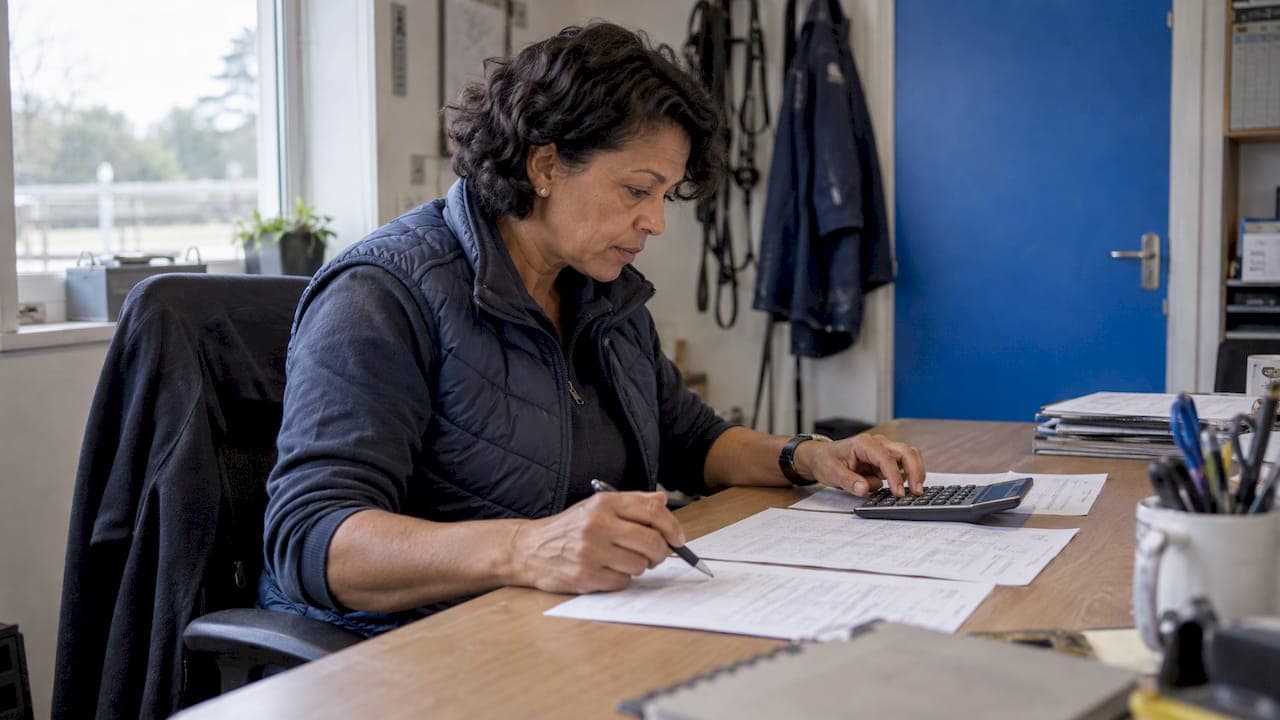
A stable budgeting framework is a repeatable way to forecast what the yard will earn and spend, split costs into fixed and variable buckets, convert them into a per-horse figure, and compare the forecast with actual results every month. Follow those five moves and surprise bills turn into planned lines, fee increases become easy to justify, and cash flow stops being a guess.
This guide walks through the framework step by step, with a worked example in Australian dollars, the mistakes that blow budgets up, and a way to keep owners and staff looking at the same numbers.
TL;DR
- Start with revenue, not costs: forecast boarding, training, foaling and show income from real history, then build expenses underneath it.
- Sort every cost into a fixed or variable bucket, then divide each by horse numbers to get a cost per horse.
- Budget for the big, foreseeable items (float tyres, vehicle replacement, equipment) as well as routine bills.
- Compare actual with budget monthly, work out why a line is off, and revise only when the cause is real.
- Share the bucketed numbers with owners so fee changes look reasoned, not arbitrary.
Table of Contents
- What a stable budget actually is
- The five-step framework
- Step 1: Forecast revenue first
- Step 2: List your fixed costs
- Step 3: Estimate variable costs
- Step 4: Turn the buckets into a per-horse figure
- Step 5: Plan for seasons, big items and emergencies
- Step 6: Review monthly and diagnose variances
- Don't forget marketing in the income side
- Make the budget useful for owners and staff
- Our perspective
- Run the framework inside one workspace
- A simple monthly routine
- FAQ
- Sources
What a stable budget actually is
A stable budget is a financial plan and forecast of planned revenue and expenditure. Its job is to let you measure actual performance against the forecast, manage cash flow, spot inefficiencies and handle shortfalls or surplus income. It is not a document you write in January and file away. The same source says an effective budget is compiled reasonably, followed, and routinely compared with actual results so it can be adjusted as trends or operations change.
That last part is what separates a framework from a spreadsheet. A framework has a fixed order of steps, a rhythm (monthly review), and a rule for what happens when the numbers drift.
The five-step framework
- Forecast revenue by income line.
- List fixed costs.
- Estimate variable costs.
- Convert everything to a per-horse figure and a break-even.
- Review monthly and revise on evidence.
The sections below take each one in turn.
Step 1: Forecast revenue first
Stable Management recommends beginning with revenues, using realistic assumptions drawn from past history, current performance, prices and services, industry and economic trends, and expected volumes. Where it helps, estimate by profit centre, service area or staff member.
For a professional yard, the income lines usually include:
- Boarding or agistment, split by type: seasonal, full care, self care, and extra services.
- Training fees, including rider and horse sessions.
- Foaling and breeding services, where you offer them.
- Show and competition fees recharged to owners.
Splitting boarding by type matters because margins differ sharply. A self-care paddock horse and a full-care stabled horse do not cost you the same, so a single "boarding" line hides which one is subsidising the other.
Be conservative. Use last year's actual occupancy, not the occupancy you hope for. If you carry two empty stalls most winters, your forecast should carry them too.
Step 2: List your fixed costs
Fixed costs are the bills that arrive whether you have 12 horses or 22. Typical examples are a mortgage or lease payment, and from the UK-style enterprise budget model, interest, depreciation, taxes and insurance.
For an Australian yard, think through:
- Lease or loan repayments, council rates and land costs
- Public liability and workers' compensation insurance
- Permanent salaried staff
- Vehicle and float registration
- Software subscriptions and accounting fees
Write each as an annual figure and divide by twelve so the monthly view is smooth. Annual insurance premiums that hit in one month are a classic cause of a "bad" March that was entirely predictable.
Step 3: Estimate variable costs
Variable costs move with horse numbers or activity. The NRHA Pro Trainer guide lists feed and hay as tied to horse numbers, and fuel and lodging as tied to shows. Stable Management adds supplies, wages, bedding and feed to the list, estimated from usage and the other factors that affect cost.

The enterprise-budget model also names pasture maintenance and hired labour as variable items. Casual and weekend staff fit here.
A practical way to keep variable costs honest is to tag every expense to a horse or a category the day it happens. If you want a ready-made list of categories, our stable budget playbook on 10 expense categories shows how to stop the catch-all "miscellaneous" line from swallowing real information.
Step 4: Turn the buckets into a per-horse figure
The NRHA guide gives a simple formula: fixed costs divided by the number of horses or stalls. Its example is $5,000 across 20 stalls, which is $250 per stall. Variable cost per horse is total variable cost divided by total horses.
Here is a worked example with invented, illustrative numbers in AUD, so you can see the mechanics. These are not benchmarks.
| Item | Monthly total | Per horse (20 horses) |
|---|---|---|
| Fixed: lease, insurance, permanent wages, rego, software | 14,000 AUD | 700 AUD |
| Variable: feed, hay, bedding, farrier, casual labour | 9,000 AUD | 450 AUD |
| Total cost | 23,000 AUD | 1,150 AUD |
If the average horse pays you less than 1,150 AUD a month, you lose money on every horse. At 20 horses the yard needs at least 23,000 AUD in income to break even, before any profit margin.
Notice what happens when you lose two horses. Fixed costs stay at 14,000 AUD, now spread over 18 horses, so the fixed share rises from 700 to about 778 AUD per horse. This is why empty stalls hurt more than most managers expect, and why per-horse numbers should be recalculated whenever occupancy changes. Our piece on per-horse cost tracking and break-even goes deeper on that calculation, and per-horse P&L for professional stables shows how to see profit by horse rather than only by yard.
Step 5: Plan for seasons, big items and emergencies
A budget built only from routine bills fails the first time something large breaks. The NRHA guide advises planning for foreseeable major costs such as truck tyres, maintenance and replacement. In a yard, that list might include:
- Float and truck tyres, servicing and eventual replacement
- Arena surface top-ups and fencing repairs
- Water pump, trough and feed-room equipment
- Tractor and slasher servicing
Treat each as a sinking fund: estimate the cost, divide by the months until you expect to spend it, and set that amount aside monthly. The expense then shows up as a small, steady line instead of a shock.
Seasonality needs the same treatment. Hay prices and availability swing with the season, show-season fuel and travel costs cluster, and income from competition recharges follows the calendar. Build twelve monthly columns rather than one annual total, so you see the pinch months before you reach them. Our guide to cash flow for stables covers how to time owner invoices around those pinch points.
For emergencies, hold a cash reserve separate from the operating account. How large it should be depends on your fixed-cost base and your risk appetite, so talk it through with your accountant. Vet emergencies are an owner-billable cost in most yards, so the practical question is how fast you can recover them. A clear chargeback process helps, and the 72 hour tag-to-ledger workflow shows one way to bill owner costs quickly.
Step 6: Review monthly and diagnose variances
Compare actual results with the budget regularly, preferably monthly, and investigate variances. The useful discipline is to ask which of three things you are looking at:
- An aggressive revenue forecast. You assumed more income than the yard can realistically earn.
- Underestimated expenses. The cost was always going to be higher than you planned.
- Overspending. The plan was fine; the money went somewhere it should not have.
Each needs a different response. A forecast problem means revising the numbers. An estimating problem means better inputs next time. Overspending means a conversation or a control, not a new budget.
The Michigan State University Extension workbook makes the underlying point that useful financial analysis depends on accurate and complete enterprise records. If receipts live in glove boxes and group chats, no framework will rescue the numbers. A monthly sweep helps: our expense auditing checklist for stables lists what to check each month.
Revise the budget when a trend is real: a feed supplier raised prices, a long-term boarder left, a new training program filled. Do not revise because one month was messy.
Don't forget marketing in the income side
If your forecast depends on filling empty stalls, the cost of filling them belongs in the budget too. A monthly marketing budget template for small business can help you set a revenue-linked figure for advertising, photos and your yard's website, so recruitment of new boarders is a planned line, not an afterthought.
Make the budget useful for owners and staff
A budget only changes behaviour when the people affected can see it. Chad Horkey of NRHA Pro Trainer says that bucketed costs make margins easier to identify and make fee increases more transparent to customers.
In practice:
- Owners should see their horse's costs by category each month, not a single lump on an invoice. When feed rises, they can see feed rose.
- Syndicates need expenses and income presented consistently, so administrators can answer questions without a scramble.
- Staff should know which lines they influence: feed waste, bedding use, vehicle running.
- Vets and responders benefit from emergency details kept in the same place as the horse's record, which is a separate matter from budget but part of the same tidy system.
For single-horse owners trying to sanity-check a quote, real per-horse budgets from $200 to $4,500 a month gives a sense of what sits behind different price points.
Our perspective
Most yards we talk to do not have a budgeting problem. They have a records problem. The budget is simple arithmetic once the data is clean, but the data is scattered across paper, phones, texts and memory.
We built EquiBETS around that. Finance tracking sits in the same workspace as horse records, team tasks, feed plans and owner updates, so a feed purchase can be tied to a horse and a category at the moment it happens. That is what makes per-horse costs and monthly variance checks quick instead of a weekend job. Offline access matters too, because yards often have patchy reception and expenses are easiest to log on the spot.
Our view is that a framework should be boring and repeatable: the same buckets, the same monthly review, the same per-horse maths every time. Fancy forecasting adds little if last month's actuals are guesses.
— isaac
Run the framework inside one workspace
EquiBETS Complete includes finance tracking, horse records, owner portals, feed planning and team coordination in one plan, at 9.99 AUD per month, with a free trial before you subscribe. It covers unlimited horses and team members, so your per-horse costs do not grow with your headcount. You can see the details on the EquiBETS Complete pricing page.

A simple monthly routine
Once the framework is set up, the upkeep is small:
- Week 1: log every outstanding expense and tag it to a horse or category.
- Week 2: compare actuals with budget by line; flag anything more than a set percentage off.
- Week 3: diagnose each flagged line as forecast, estimate or overspend.
- Week 4: update the per-horse figures, send owner statements, and adjust the forecast only where a trend is clear.
Pick the variance threshold that suits your yard. A small yard may flag anything over 10 percent; a larger one may flag by dollar amount. The number matters less than applying it consistently.
FAQ
How often should a stable review its budget?
Monthly is the recommended rhythm for comparing actual results with the budget. Investigate variances each time, and revise the forecast only when a real trend or operational change justifies it.
What are fixed and variable costs in a stable?
Fixed costs stay the same regardless of horse numbers, such as lease payments, insurance and permanent wages. Variable costs move with horse numbers or activity, such as feed, hay, bedding, casual labour and show travel.
How do I calculate cost per horse?
Divide total fixed costs by the number of horses or stalls, then divide total variable costs by the number of horses, and add the two. For example, 5,000 spread across 20 stalls is 250 per stall in fixed cost.
Should I budget for equipment replacement?
Yes. Plan for foreseeable major costs such as float tyres, maintenance and replacement, not only routine bills. Setting aside a small amount each month avoids a large unplanned hit.
Sources
- Budgeting Basics for Farms and Stables, Stable Management
- Equine Enterprise Budgets: Examples For Your Business, Stable Management
- Budgeting by Buckets, NRHA Pro Trainer
- Horse Farm Management Workbook, MSU Extension