
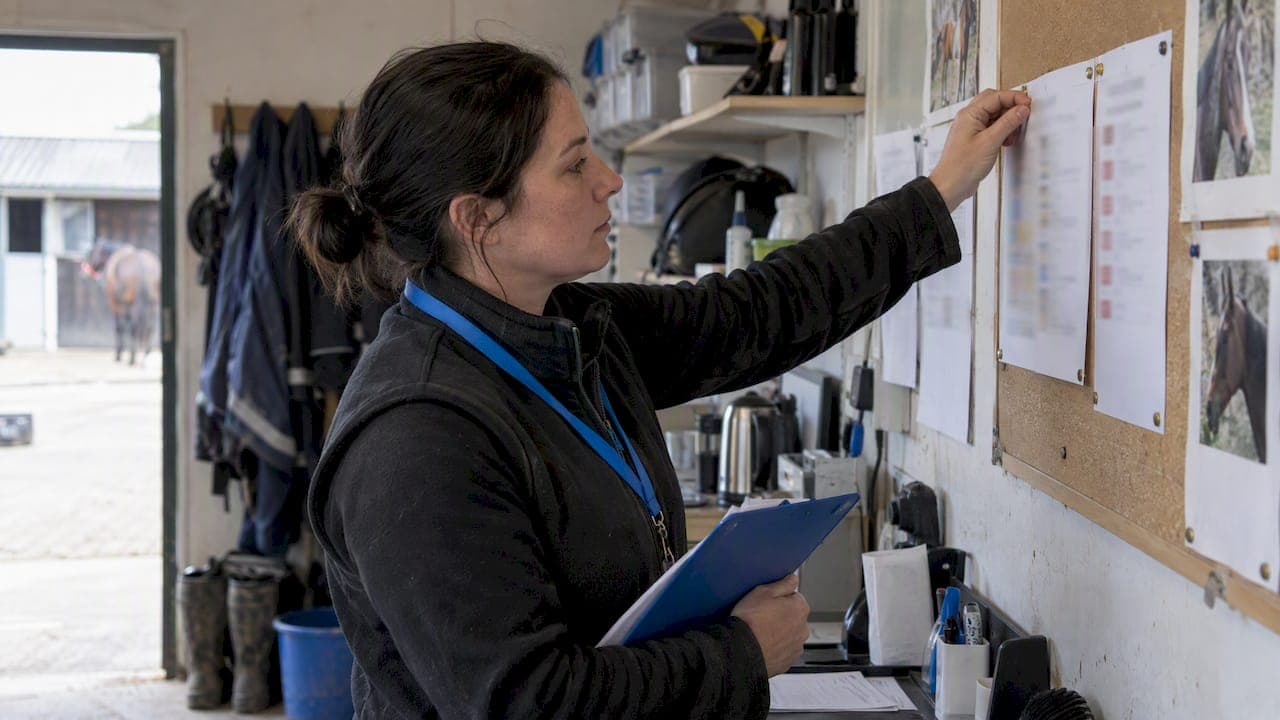
An effective on-call rota for stables is a named, accountable schedule with primary, backup and escalation contacts, attached shift checklists and an accessible emergency plan, rehearsed and recorded. Guidance from the National Equine Welfare Council and the British Horse Society backs this up, and tools like EquiBETS now let yards run the whole system digitally.
TL;DR:
- Rota entries must specify exact shift times, roles, primary and backup contacts, and assigned responsibilities to prevent gaps in communication or task coverage.
- An emergency response hierarchy should include a primary responder, a backup, and a tertiary fallback, all of whom must be rostered explicitly and tested regularly.
- Scheduling should account for rest requirements by including overlaps and handover periods, with flexibility documented through formal Workforce Agreements when possible.
- Emergency plans need to be revised annually, with drills at varied times including nights and weekends, while records of participation should be maintained for inspections.
- Transitioning to a digital rota system ensures real-time updates, accessible checklists, and owner portals, significantly reducing errors and response times during emergencies.
Table of Contents
- A rota template and the fields that make it work
- Creating an on call hierarchy and cover that actually works
- Scheduling practicalities and legal rest considerations
- Emergency plans and how often to rehearse them
- How a digital rota and emergency toolkit should work
- A one-page action plan to audit your rota this week
- Running your on call rota through EquiBETS
- FAQ
- Sources
A rota template and the fields that make it work
A workable rota is only as good as the fields it forces you to fill in. Vague entries like "on call: Sarah" leave gaps the moment Sarah's phone dies or she is stuck in traffic.
A solid roster row should capture:
- Date and shift window, written as exact start and end times, not "evening" or "overnight".
- Role covered, such as night checks, feed round or emergency response.
- Named primary contact with a working mobile number.
- Named backup contact, listed even when you expect the primary to show up.
- Tertiary escalation contact for when both primary and backup are unreachable.
- Specific tasks attached to the shift, drawn from a night check checklist.
- Who holds the keys or vehicle for that shift.
- Swap rule and any notes on planned absence.
The National Equine Welfare Council makes the point directly: a rota works as a communication tool only when it assigns individual responsibility for routine tasks rather than simply listing who is present. That means daily inspections, water checks, feed, security and equipment checks all need an owner, not just a shift.
For swaps and absences, keep the labelling simple:
- Mark a planned absence at least 48 hours ahead with the replacement's name already filled in.
- Require the outgoing and incoming staff member to both initial the swap, on paper or digitally.
- Flag any unconfirmed swap in red or with a clear "unconfirmed" tag until it is locked in.
A horse emergency contacts sheet that sits alongside the rota closes the loop: everyone covering a shift can see who to call without hunting through old messages.
Creating an on call hierarchy and cover that actually works
A rota with only one name per shift is a single point of failure. The fix is a cascade: primary, secondary and tertiary contacts, each with a defined response action.
- Primary: first responder, expected to answer within minutes and attend if needed.
- Secondary: steps in if primary does not respond within an agreed window, or backs up during a genuine emergency.
- Tertiary: a final fallback, often a senior manager or owner, used when both primary and secondary are unreachable.
The National Equine Welfare Council notes that this kind of cascade reduces single-point failures, but only if backups are rostered explicitly and tested during drills rather than assumed. The British Horse Society recommends reviewing emergency contact lists at least twice yearly, checking that phone numbers and alternates still work.
Rotate who sits in the primary slot. If the same person is always first on the list, fatigue builds and cover quietly weakens over time.
Pro Tip: Run a surprise call test on your backup contacts every six months: if nobody answers within the agreed window, you have found a gap before an actual emergency does.
Scheduling practicalities and legal rest considerations
Planning cover is not just filling slots. You need to account for holidays, training days, sickness and maternity leave well ahead of time, or you end up patching gaps at short notice.
Overlap periods matter more than most rotas admit. The handover window between shifts is working time, and the RCVS working hours guidance warns that on-call time can count as working time and may cut into the required 11-hour rest break. Leaving overlap time out of your hours calculation risks breaching rest rules without anyone noticing until it is flagged.
Where lawful, a Workforce Agreement can offer flexibility around these rest requirements, but it needs to be documented, not assumed.
Practical steps that reduce overtime and unnecessary walking include:
- Cluster related duties into one round instead of three separate walks across the yard.
- Use handover notes so the incoming shift does not repeat checks already done.
- Keep swap policies simple enough that staff actually use them instead of working through fatigue.
A yard staff scheduling approach built around these principles tends to cut both walking distance and unplanned overtime.
Emergency plans and how often to rehearse them
An emergency plan attached to the rota needs to answer one question fast: what does whoever is on call do right now. The government guidance on fire safety for animal premises sets out escape times usually expected under two to two and a half minutes in timber buildings, with at least two escape routes required for larger premises.
Essential components:
- Escape routes marked and kept clear, with evacuation route maps posted where staff can see them.
- Fire detection and alarm systems that are tested, not just installed.
- Evacuation roles assigned by name, matching the on-call hierarchy.
- Emergency equipment locations listed, including fire extinguishers and halters.
- Transport and recovery plans for horses that need to move off-site.
The British Horse Society recommends running drills at least annually, with contact lists reviewed twice a year. Higher risk yards should consider six-monthly drills. Varying the time, including nights and weekends, matters: the AVMA emergency planning guide notes that day-only rehearsals tend to overestimate real response capacity, and recommends at least one off-hour drill every 12 months. Keep attendance and performance records for every drill so you have evidence ready for an inspection.
Quarantine procedures belong in this plan too. The Colorado State Extension barn manager guidance recommends quarantine periods of 7 to 30 days for new horses, with temperature checks every 12 hours and a dedicated staff member assigned to avoid cross-contamination. That assignment should sit inside the rota, not float separately.

How a digital rota and emergency toolkit should work
Paper rotas get lost, and a laminated sheet in the feed room does not update itself when someone calls in sick. A digital system should handle the parts that paper cannot, using digital logbooks for business checks to support routine inspections and audit trails:
- Publish the rota so every staff member sees the current version, not last week's printout.
- Allow swap requests that update primary and backup tags automatically.
- Attach shift checklists directly to each slot, so night checks are not left to memory.
- Log drills and attendance so records are ready for an inspection without digging through folders.
- Work offline, since barns are not always in mobile signal range.
Owner portals that give immediate access to the emergency plan cut down on phone calls during a crisis, since owners and vets can see what they need without waiting on a callback. A digital first aid kit reachable within two minutes serves the same purpose for on-call staff.
Pro Tip: Track missed checks and drill performance for the first 90 days after digitising your rota: small daily time savings on repetitive tasks compound quickly across a full yard, as outlined in guidance on stable task management.
A one-page action plan to audit your rota this week
Start with the basics. Adopt the template, verify every contact number on your cascade, and lock in a drill date within the next 30 days. Publish your swap rules so nobody is guessing who covers a gap.
Over the following 90 days, run drills at varied times, including at least one at night or on a weekend. Review staff hours against rest requirements, and if your rota still lives on paper, this is the point to move it onto a digital system that logs everything automatically.
A rota only earns trust once it has been tested under pressure, not just written down.
— isaac*
Running your on call rota through EquiBETS
Building this system from scratch in a spreadsheet works for a while, until a swap gets missed or a contact number goes stale without anyone noticing. EquiBETS Complete keeps the rota, contact cascade, shift checklists, emergency plan and owner portal in one offline-capable workspace, so the version your night staff see on their phone is always current.

- Rota scheduling with primary and backup tagging built into each shift.
- Owner portals that give vets and responders direct access to emergency plans.
- Offline mobile access for barns with patchy signal.
- A digital first aid toolkit reachable in minutes during an incident.
Check EquiBETS Complete for current pricing details, or look at the stable manager feature set to see how rotas and emergency plans fit into daily operations.
FAQ
How often should a stable run emergency drills?
At least once a year, according to the British Horse Society, with contact lists reviewed twice yearly. Higher risk yards should consider drills every six months, and varying the time of day, including nights and weekends, tests real response capacity rather than a best-case scenario.
Who should be on the on-call cascade for a yard?
A cascade needs a primary contact who responds first, a secondary who steps in if primary is unreachable, and a tertiary fallback such as a senior manager. The National Equine Welfare Council recommends rostering these backups explicitly and testing them during drills rather than assuming they will work.
Does on-call time count as working hours?
On-call time can count as working time and may affect the required 11-hour rest break, according to RCVS guidance. Where lawful, a documented Workforce Agreement can offer flexibility, but overlap and handover time should still be included when calculating total hours worked.
What should a written duty rota include for inspections?
Inspectors typically ask to see a written duty rota or a formal arrangement demonstrating 24-hour cover, as outlined in BVHA practice standards. Automated systems are acceptable when backed by a formal written arrangement, alongside drill records and attendance logs.
Can EquiBETS help manage an on-call rota digitally?
EquiBETS Complete lets yards publish rotas with primary and backup tagging, attach shift checklists and give owners direct access to emergency plans through an owner portal. It works offline, which matters for barns without reliable mobile signal. See EquiBETS Complete for current pricing details.
Sources
- BHS — Stable fires and fire safety guidance
- RCVS — Working hours and on-call guidance
- National Equine Welfare Council — Code of practice
- AVMA — Emergency planning and response guide
- Colorado State Extension — Horse barn manager guidance