
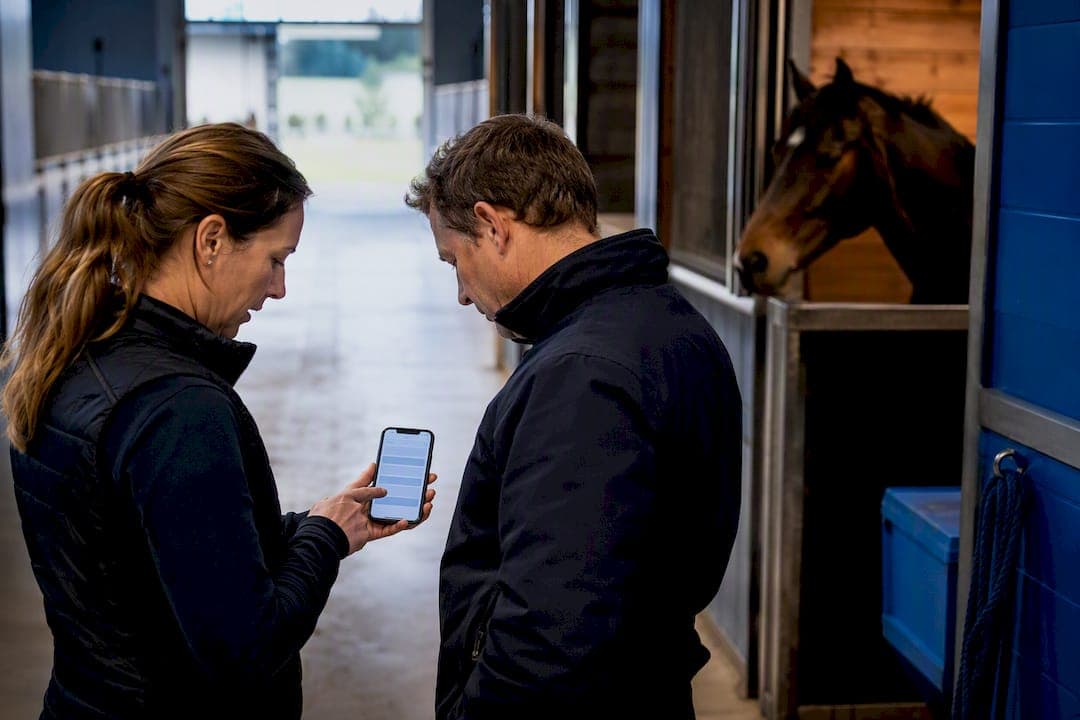
A stable's digital first aid kit is a shared, offline-accessible emergency plan paired with current horse medical records and a vet handover template. Everyone on duty, from the newest groom to the visiting relief vet, needs to reach it within two minutes. The single most important move is building that plan once, storing it where power cuts and dead phones can't touch it, and mapping every shut-off point before you need one.
TL;DR:
- A digital first aid kit must be stored in multiple locations, including cloud, encrypted offline files, and physical copies, and tested monthly for accessibility.
- Response protocols should be clearly assigned, with rehearsals and updates every quarter, including specific roles for incident lead, communication officer, and animal handlers.
- The plan must include detailed horse medical records, operational instructions, and emergency contact information, all kept current and accessible offline.
- Small yards should simplify storage and access, while larger operations need segmented records, zone leads, and role-based permissions for multiple owners.
- Equibets offers a platform that automates and secures these processes, ensuring faster vet handovers, offline access, and better record management during emergencies.
Table of Contents
- What is a first aid kit for stables, and what does it need to contain?
- How do you keep the kit accessible when the power or network fails?
- What should your team do in the first 30 to 60 minutes of an emergency?
- How often should you drill and update the plan?
- Who should be on your emergency response team, and what does each role do?
- What should a stable first aid kit contain for horses and people?
- How do you store the kit so it stays usable when you actually need it?
- What should staff know about first aid response for common stable emergencies?
- How do you scale the kit for a small yard versus a large competition stable?
- Common failures I see in yards, and the fixes that actually stick
- How EquiBETS makes a digital first aid kit reliable
- Where to go for official guidance and templates
- Sources
What is a first aid kit for stables, and what does it need to contain?
Forget bandages and antiseptic for a minute. The digital first aid kit is a structured set of files, maps and templates that let anyone on your property, staff, owner or attending vet, act fast and correctly during a crisis. US Equestrian's disaster preparedness guidance treats this as the backbone of equine emergency response, and for good reason: a fire, colic episode or storm doesn't wait for someone to remember where the paper folder is.
Here's what belongs in it, organised by category.
Facility items:
- A site map showing electrical and water shut-off points, marked clearly enough that a first-year groom could find them at 2am
- Evacuation routes and designated assembly points for horses and people
- Gate codes and access instructions for emergency vehicles
People and contacts:
- Primary and alternate emergency contacts for every horse's owner
- A communication tree showing who calls whom, and in what order
- External partner contacts, farriers, transport providers, the local emergency vet clinic
Horse records:
- Medical history, including past colic episodes, surgeries and chronic conditions
- Current medications, dosages and allergy flags
- Identification details, photos and up-to-date vaccination and passport notes
Templates ready to fill in fast:
- A one-page vet handover sheet
- An incident report form
- An evacuation manifest listing every horse on the property
- A medication log
Operational files:
- Trailer and transport instructions, including who is authorised to drive and load
- Insurance policy numbers and proof of ownership documents
Extension guidance from the University of Tennessee specifically recommends keeping ownership documents and photos alongside medical records, because during evacuation or a dispute over a rescued horse, that proof matters as much as the treatment history.
How do you keep the kit accessible when the power or network fails?
The plan that lives on one manager's phone is not a plan. It's a liability. US Equestrian's own guidance on plan failures makes the point bluntly: if only one person can open the file, the file doesn't exist when that person is unreachable, injured, or asleep.
The fix is redundancy layered three ways.
- Cloud master copy, updated in real time and accessible from any device with credentials
- Encrypted offline exports, pre-downloaded PDFs on at least two staff phones so a dead signal doesn't strand you
- Physical backup, a printed copy in a waterproof safe plus an encrypted USB stored off-site
CDFA's farm and ranch emergency plan guide recommends exactly this combination: electronic and hard-copy backups, stored in more than one visible location, because a single point of failure defeats the whole exercise.
Permissions matter just as much as redundancy. Give role-based access so casual staff see only what they need, but grant emergency-only external access to your primary vet, ideally as a read-only handover view they can open without a login delay. QR-coded stall signs linking straight to that view solve the "who has the password" problem instantly.
Pro Tip: Test your offline copy monthly by switching your phone to airplane mode and opening the plan cold. If it doesn't load in under 30 seconds, your setup has a gap you haven't found yet.
Keep basic privacy hygiene in mind too: medical and contact records deserve encryption, and if you operate across jurisdictions, check what local privacy rules apply to storing owner and staff contact details digitally.
What should your team do in the first 30 to 60 minutes of an emergency?
Speed in the first hour decides outcomes, for the horse and for how smoothly everyone else responds. Break it into a sequence rather than a scramble.
- First 5 to 10 minutes: Assign one person to secure the immediate area, using the map-guided shut-off points to kill power or water if fire or flooding is involved. Someone else opens the vet handover template.
- Minutes 10 to 20: Work the communication tree. Call the vet first, then the owner, then internal staff not already on-site. Keep messages short: horse ID, what happened, current status, what you need.
- Minutes 20 to 40: Complete the one-page vet handover. Practitioner guidance from TheHorse recommends this page capture horse ID, presenting signs, recent medications, current vitals, a photo if relevant, and owner contact, nothing more. Vets don't need a novel; they need the five facts that change their decision.
- Minutes 40 to 60: Log the incident with time-stamped photos and brief notes while details are fresh. This record protects your insurance position and gives the treating vet a timeline.
If transport is required, your trailer readiness check and pre-arranged transport contact should already be sitting in the operational files, not something you're hunting for while a horse is in distress.
- Keep the emergency contacts sheet current every time staff or ownership changes
- Rehearse the message script for calling emergency services so nobody freezes on the phone
- Store the evacuation manifest where it updates automatically when a horse arrives or leaves
How often should you drill and update the plan?
A plan that isn't rehearsed decays fast. Set a cadence and stick to it: quarterly checks on contact details and access permissions, an annual full drill, and immediate updates the moment personnel or horse populations change.
Vary the drill format so it doesn't become background noise:
- 15 to 30 minute tabletop drills, monthly, walking through a single scenario verbally
- Quick access checks, confirming staff can open the offline copy on their own device
- Annual full evacuation drills, ideally with your vet involved, because EquiManagement's practice preparedness guidance notes that including vets in drills reduces confusion during a real call-out and speeds triage.
Assign a kit owner and a deputy. Someone has to be responsible for version history, or you end up with three different "current" vaccination lists floating around on different phones.
After every drill, run a short debrief, update whatever template failed, and redistribute the offline copies immediately. Track a few simple numbers over time: time-to-vet-handover, time-to-assemble at the evacuation point, and the percentage of staff carrying a working offline copy. Farm emergency plan guidance treats this kind of measured drill cycle as standard for any working farm, not an optional extra for large operations.
Who should be on your emergency response team, and what does each role do?
Every stable, regardless of size, needs named roles, not just a general sense that "someone will handle it." CDFA's emergency plan guide recommends a designated emergency response team with clear, assigned duties, because ambiguity during a crisis costs minutes you don't have.
At minimum, assign these roles:
- Incident lead: the person who makes the call on evacuation, calls the vet, and owns the decision tree during the event.
- Communications officer: works the contact tree, calls owners and emergency services, and relays updates.
- Animal handler(s): physically move or restrain horses, ideally people with the calmest hands on the property.
- Records custodian: pulls up the vet handover template and horse records the moment they're needed.
- Logistics coordinator: handles trailers, transport bookings and the evacuation manifest.
Smaller operations will double up roles, one person might be incident lead and records custodian at once, but the assignment still needs to be explicit and written down, not assumed. Train backups for every role, because the person you'd normally rely on might be the one who's off-site, injured, or on leave when the emergency happens. Review the team list every time staff turnover occurs; an outdated roster is almost as bad as no roster at all.
What should a stable first aid kit contain for horses and people?
While this article focuses on the digital emergency plan, that plan should reference and locate your physical supplies too, because a vet arriving on-site needs to know exactly where equipment lives, not just what happened. CDFA's farm emergency plan guide recommends an equipment appendix listing exactly this kind of detail.
For horses, your plan's equipment appendix should note the location of wound care supplies, thermometers, stethoscopes, leg wraps and any medications your vet has pre-authorised for use before they arrive. For humans on-site, note the location of a general first aid kit, fire extinguishers, and any staff trained in basic first aid or CPR.
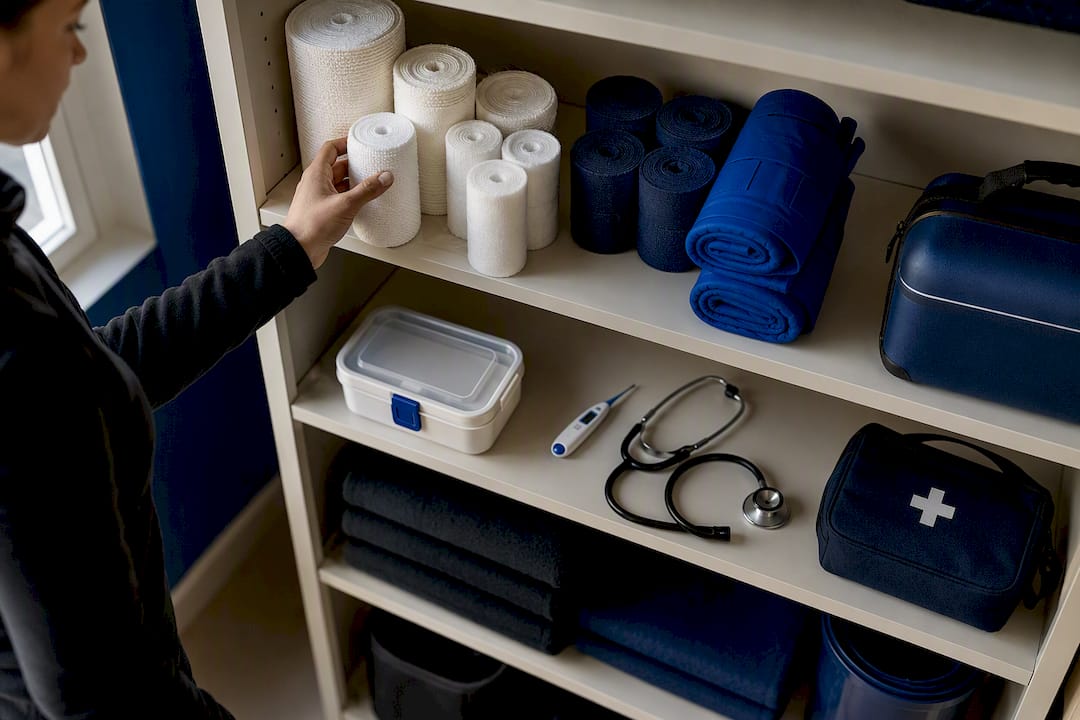
The digital plan's job here is simple: don't store the bandages in the app, store their location and last-checked date in the app, so nobody wastes emergency minutes hunting for a torch or a working extinguisher. Cross-reference this appendix during your quarterly checks, and flag anything missing or expired the same way you'd flag an outdated contact number.
How do you store the kit so it stays usable when you actually need it?
Storage discipline separates a plan that works from one that fails quietly for months before anyone notices. The digital master copy needs a clear owner, a scheduled review date and a version log showing who changed what and when.
Physical backups deserve the same rigour. A printed copy in a waterproof, fireproof safe does no good if it's from eighteen months ago and nobody's updated the medication list since. CDFA's guidance recommends posting emergency numbers and plan copies in multiple visible locations, tack room, feed shed, office, precisely because relying on one location invites the exact failure you're trying to prevent.
Set a maintenance rhythm: check offline exports monthly, confirm the paper copy matches the digital one quarterly, and swap the encrypted USB backup any time medical or contact details change materially. Store that USB off-site, with a trusted second party or in a bank deposit box if your yard is in a bushfire or flood-prone area, so a single event can't wipe out both your live system and your backup in one go.
What should staff know about first aid response for common stable emergencies?
Your digital plan should hold procedural notes for the emergencies your yard actually sees, colic, lacerations, choke, cast horses, and lameness after a fall, so staff aren't improvising a response from memory under pressure.
For each scenario, the plan's template should prompt staff to record: what was observed, when it started, vital signs if measurable, and any action already taken before the vet arrives. This isn't a substitute for veterinary treatment protocols, your vet sets those, but it standardises what gets reported so treatment decisions happen faster.
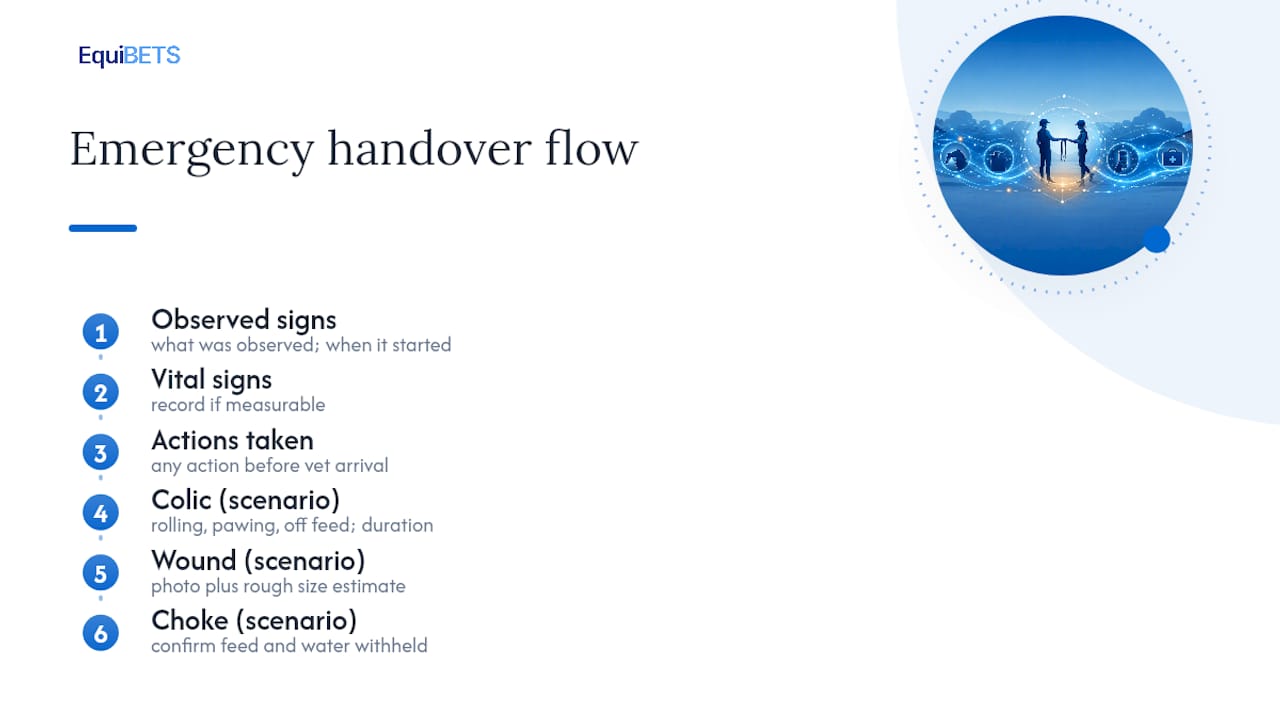
Colic notes should prompt staff to log whether the horse is rolling, pawing, or off feed, and for how long. Wound notes should prompt a photo and a rough size estimate. Choke notes should prompt confirmation that feed and water have been withheld. None of this replaces clinical judgement, but a consistent reporting structure means your vet gets the same quality of information whether it's your most experienced hand on duty or a Saturday casual.
Improving equine healthcare with digital medical records points out that remote access to structured records lets vets consult and make decisions faster, even before they arrive on-site, which is exactly the value this kind of standardised reporting delivers.
How do you scale the kit for a small yard versus a large competition stable?
A four-horse hobby yard and a 60-horse competition stable need the same categories of information, but very different depth and distribution.
For a small operation, keep it simple: one shared digital folder, two people with offline access, and a single vet handover template that covers every horse on the property. Complexity here just creates more things to forget.
For a larger yard, the plan needs to scale in structure, not just size. Segment records by barn or block so a manager isn't scrolling past forty horses to find the one that matters. Assign zone-level emergency response leads rather than relying on one incident lead for the whole property. Podcast and practitioner guidance from TheHorse stresses tailoring the plan to facility layout and each horse's individual handling needs, which matters far more once you're managing multiple barns, mixed disciplines, or horses with wildly different temperaments and medical histories.
Competition and syndicate operations carry an added wrinkle: multiple owners, each needing visibility into their own horse's records without seeing everyone else's. That's where role-based, horse-specific permissions stop being a nice-to-have and start being the only way the system stays usable at scale.
Common failures I see in yards, and the fixes that actually stick
The plan that lives on the manager's personal phone is the failure I see most often, and it's the easiest to fix. The second most common: contact lists that still list a farrier who retired two seasons ago, because nobody owns the update cycle.
The fixes aren't complicated. QR stall signs linking straight to a read-only vet handover view solve the access problem without anyone needing an app password mid-crisis. Owner portals cut down the "who do I call and what do they need to know" confusion, because owners see their own horse's records directly. Delegated offline access, two or three staff carrying a working copy rather than one, closes the single-point-of-failure gap that trips up most yards.
What surprises people is how rarely the fix is more technology. It's usually just assigning an owner to the plan and reviewing it on a set schedule.
— isaac
How EquiBETS makes a digital first aid kit reliable
Equibets is built around exactly the checklist this article walks through, because that checklist is what a working yard actually needs during a crisis, not a folder of PDFs nobody's opened since onboarding.

The platform gives you offline mobile access so a dropped signal in the far paddock doesn't cut you off from a horse's medication history. Owner portals mean owners see their own horse's records directly, cutting out a call in your communication tree. Emergency plan templates, including the vet handover format, come pre-built rather than something you draft from scratch at 11pm. QR stall links connect straight to a read-only emergency view, and audit logs show exactly who accessed or changed a record and when, which matters as much for insurance as for accountability.
The operational payoff is straightforward: faster vet handovers, multiple authorised offline users instead of one manager's phone, and centralised templates that update everywhere at once instead of three different versions floating around. If your yard's emergency plan currently lives in a folder nobody's checked this quarter, start a trial of Stable Manager and set up your first vet handover template today.
Where to go for official guidance and templates
For the standards behind this checklist, US Equestrian's disaster preparedness resources and CDFA's farm emergency plan guide are the primary references. For practice-side continuity planning, see EquiManagement's guidance for equine vets. Always consult your local emergency management authority and your primary vet when finalising your yard's plan.
Sources
- Disaster Preparedness | US Equestrian
- Farm / Ranch multi‑hazard emergency plan guide — CDFA
- W854 Equine and disaster preparation and response — UTIA
- Improving equine healthcare with digital medical records – Equine MediRecord
- Is your equine practice prepared for weather emergencies and other hazards? — EquiManagement