
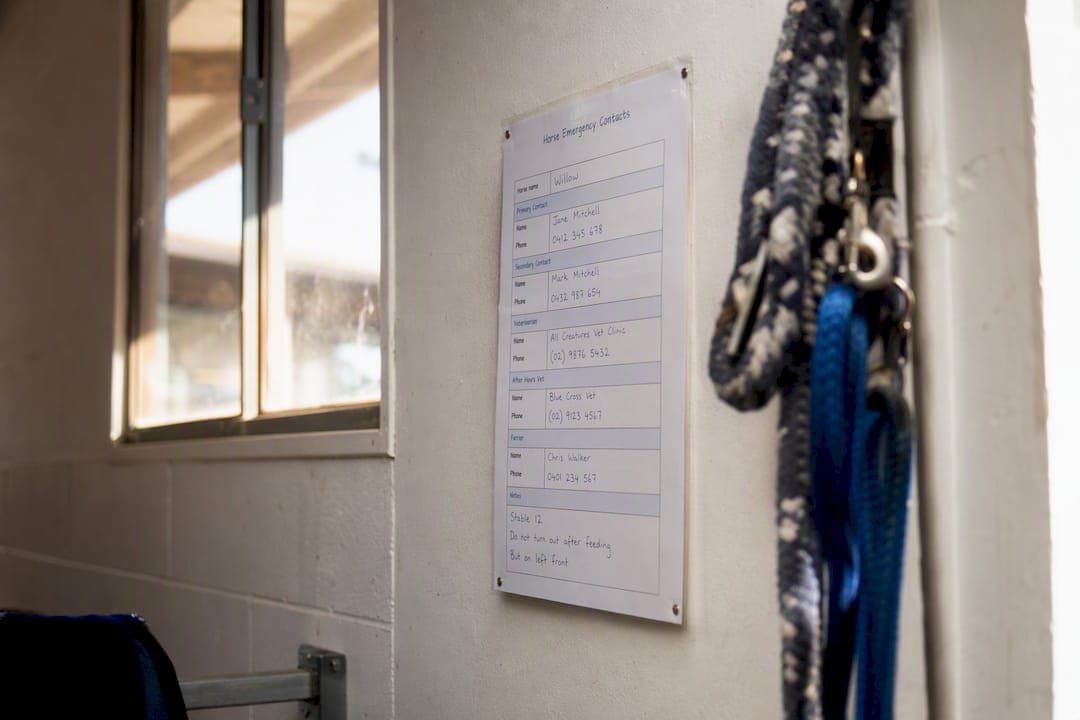
Every horse emergency contacts sheet needs eleven things: owner details, an authorised decision-maker, your primary vet, an after-hours emergency clinic, the nearest equine hospital, a transporter, a farrier, current medications and dosages, microchip and registration numbers, insurance details, and your property's exact GPS location. Miss one of these and you're the person standing in a dark paddock at 11pm scrolling through old text messages trying to find a number that might not even work anymore.
Here's what to do with that list right now:
- Print the sheet and laminate it, or slip it into a waterproof document sleeve.
- Post copies in the tack room, by the barn phone, and in every horse float.
- Save a digital copy somewhere every carer can reach it, even with patchy phone signal.
- Brief anyone who handles your horses on where the sheet lives and how to read it fast.
Further down, you'll find a copyable fillable template, a go-bag checklist, and a call-order script for the moment things go wrong.
Pro Tip: Keep one laminated copy in an easily visible place near your float loading area. In a genuine emergency, nobody wants to search the office for the sheet while a horse is down.
Key Takeaways
A horse emergency contacts sheet only works if it covers eleven core fields, follows a tested call order, and gets reviewed at least once a year.
| Point | Details |
|---|---|
| Cover every core field | Include horse ID, owner, authorised decision-maker, vet contacts, transporter, medications, and GPS location. |
| Follow a set call order | Call the primary vet or emergency clinic first, then your authorised decision-maker, then the transporter. |
| Pack a go-bag in advance | Store signed authorisation, medications, and documents in a waterproof case ready to grab. |
| Store copies in multiple places | Laminate one for the tack room, keep one in the float, and save a digital version. |
| Stay an established vet client | Regular preventative visits improve your priority for after-hours emergency care. |
| Digitise for reliability | Equibets centralises contacts, medications, and authorisations with offline access and carer permissions. |
Table of Contents
- Horse emergency contacts: the complete field list
- How to use the list in an emergency: call order and step-by-step actions
- Building a go-bag for the clinic or a hospital transfer
- What a printable emergency contact template actually looks like
- Why being an established veterinary client changes your emergency response
- Making horse emergency contacts actionable with a digital plan
- Turning your emergency plan into something every carer can actually use
- Frequently asked questions
- Sources
Horse emergency contacts: the complete field list
A proper emergency contact sheet isn't just a phone list. It's a working document that tells a stranger, whether that's a locum vet, a relief agister, or a paramedic, everything they need to act without waiting on you.
Horse identification comes first because a vet arriving at an unfamiliar property needs to confirm they are treating the right animal fast. Include the horse's name, breed, sex, colour, distinguishing markings or tattoos, and microchip number. Add the passport or registration number if your horse is competing or crossing state lines, since some transport and insurance claims will ask for it.
Owner and decision-makers matter more than most people realise until they're overseas or unreachable during a crisis. List the primary owner's mobile and a secondary contact, but also nominate someone with written permission to approve treatment on the spot. The British Horse Society's emergency plan template recommends naming an authorised representative who can present the horse for treatment and make calls if you're uncontactable, along with written notes on treatment preferences and budget limits. Without that signature, a vet may hesitate on anything beyond basic stabilisation.
Veterinary contacts need more detail than "vet: 0400 000 000". Record your daytime practice name and number, the after-hours emergency line (often a different number to the clinic's main line), and the nearest equine hospital for referral cases like colic surgery or fracture management. Note your client status too. Many practices reserve after-hours slots for established, active clients, which makes this line more than admin.
Support contacts round out the working team: your farrier, your regular transporter or float driver, and a backup handler if your horse is difficult to load or restrain.
Medical and management notes are where sheets usually fall short. List current medications with exact dosages, feeding instructions, known allergies, and any temperament warnings, especially around sedation, needles, or loading. A horse that's a nightmare to inject is useful information for a locum who's never met him.
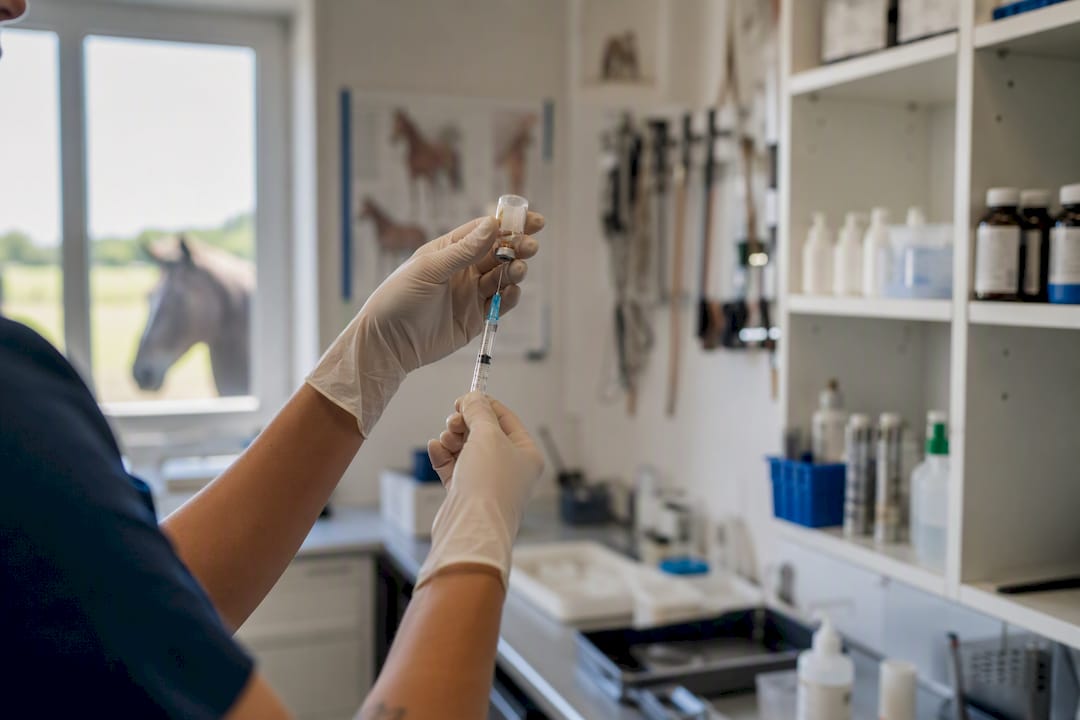
Logistics and admin covers your insurance provider and policy number, microchip and registration cross-references, your property's GPS coordinates, and where full records are stored, both paper and digital.
A few formatting details actually change outcomes here:
- Use a font size large enough to read by torchlight or in a stressed, shaky hand.
- Colour code emergency numbers (red for vet, blue for transporter, for example) so anyone can scan it in seconds.
- Post the sheet at eye level near the phone, not filed away in a folder nobody opens twice a year.
Pro Tip: Add a "client status" line under your vet's name, such as "regular client since 2022, last visit March 2026." It sounds unnecessary until a locum vet needs to make a fast judgement call about priority.
How to use the list in an emergency: call order and step-by-step actions
The sheet is only as good as the sequence you follow when you're staring at it with adrenaline running.
- Secure the scene first. Check for immediate danger to people before touching the horse. If a human life is at risk (electrocution, structural collapse, a vehicle involved), call your local emergency line before anything else.
- Contain the horse if it's safe to do so. A frightened, injured horse can do more damage moving than standing still. Don't rush this step if it puts you at risk.
- Call your primary vet first, unless the injury is clearly beyond field treatment (severe colic signs, major laceration, suspected fracture), in which case call the after-hours emergency line or nearest equine hospital directly.
- Call your authorised decision-maker if you're not the one on-site, so they can be reached before the vet needs a decision.
- Call the transporter only once you know whether the horse needs to move, so you're not paying for a float that arrives before diagnosis.
Have this ready before you dial: your exact address or GPS pin, the horse's name and ID, a one-line problem summary ("gelding down, distended abdomen, pawing"), and any vitals you've already checked, like gum colour or heart rate, if you know how to read them.
A basic phone script helps enormously under stress: "This is [name] at [property/GPS]. [Horse name] is showing [symptoms] since [time]. I'm an existing client under [account name]. Can you talk me through what to do while you're on the way?"
Pro Tip: Designate one person as the sole caller during an incident. Everyone else's job is to hold the horse, fetch equipment, or write down times, names, and instructions as they come in. Two people calling different numbers at once creates confusion exactly when you need clarity.
Building a go-bag for the clinic or a hospital transfer
A go-bag turns a scramble into a five-minute grab. Keep one packed and ready, not assembled from memory while a float idles in the driveway.
Documents to include:
- A signed authorisation form naming who can approve treatment
- A copy of the emergency contact sheet itself
- Vaccination history and recent health records
- Microchip details and passport or registration copy
- Insurance policy documents
Medical items:
- Current medications in labelled, dated containers with dosing instructions attached
- A spare headcollar and lead rope
- Basic wound dressing supplies and disposable gloves
Logistics gear:
- Phone charger and a torch
- A hay net for a stressed horse waiting at a clinic
- A fly rug or blanket suited to the season
- Trailer keys, vehicle registration details, and a fuel card or payment method
Pack it in a waterproof case, and keep laminated copies of the key documents inside. Duplicate the essentials, one set in the vehicle, one with your nominated authorised person, so a missing bag never becomes the bottleneck.
What a printable emergency contact template actually looks like
The simplest layout is a single page split into clear blocks: a header with your barn name and GPS coordinates, a left column for horse identification, a right column for emergency contacts, and a bottom strip listing quick actions and where full records are stored. AAEP-aligned poster formats group contacts by category, emergency services, vet, farrier, transport, insurance, which makes scanning faster under stress than a plain list.
A sample entry might read:
Horse: Bandit (bay gelding, star + snip, microchip 900xxxxxxxxxxxx) Vet: Riverside Equine, (07) xxxx xxxx | After-hours: (07) xxxx xxxx Authorised contact: Sam Taylor, signed authority on file, 0400 xxx xxx
Post copies in multiple accessible places including near the barn phone, the tack room, vehicles that tow floats, and digitally for easy access by carers.
Why being an established veterinary client changes your emergency response
Preparedness isn't only about paper. It's also about the relationship your vet practice has with you before anything goes wrong.
Many clinics prioritise established, active clients for after-hours and emergency callouts, largely because a vet who already knows your horse's history can make faster, safer decisions on the phone. That's a practical reason to keep up preventative visits even when nothing's wrong, not just a compliance box to tick.
A few things build that standing: regular check-ups rather than only emergency calls, clarifying your account status directly with reception so it's on file, and agreeing in advance on transport options if your horse needs referral to a hospital. At yard level, post directions and GPS coordinates where a first-time visitor can find them, brief every staff member on their role during an incident, and set a fixed date each year to review and update every contact on the sheet.
Pro Tip: Ask your vet practice directly what their after-hours policy is for non-established clients. The answer will tell you exactly how much this matters for your situation.
Making horse emergency contacts actionable with a digital plan
A laminated sheet solves half the problem. It fails the moment it's left in the wrong barn, soaked through, or out of date because nobody updated it after your farrier changed. That's the gap a digital emergency plan closes.
A centralised platform keeps every contact, medication note, and authorisation document in one place that updates the instant something changes, rather than requiring you to reprint and relaminate. Features worth looking for include an owner portal so authorised carers can view or update information themselves, offline access so a patchy paddock signal doesn't lock anyone out, and a quick-share option, a QR code or link, that lets a first responder or locum vet pull up everything in seconds. QR-based emergency cards are gaining traction for exactly this reason: one scan replaces a frantic phone search.
Setting one up takes three steps: build the emergency contact sheet inside the platform, attach go-bag documents like vaccination records and signed authorisations, then invite carers and set their access permissions. Run a mock drill once it's live, have someone unfamiliar with the account try to find the vet's after-hours number in under thirty seconds.
The practical payoff is real. Records stay current across every device automatically, vets can verify client status faster, and nobody wastes precious minutes hunting for a number that's changed since the last time the sheet was printed. EquiBETS's stable manager tools are built around exactly this kind of centralised, offline-ready record keeping for professional yards.
- Centralise every contact, medication, and authorisation in one live record
- Give authorised carers portal access without handing over full account control
- Test the plan with a drill, not just a printout nobody's opened since March
Pro Tip: Run your first emergency drill on a quiet Sunday afternoon, not during an actual crisis. You'll find the gaps in your plan a lot cheaper that way.
A yard manager's note on why the drill matters more than the sheet
I once watched a relief groom spend four minutes hunting for the after-hours vet number during a suspected colic, because the laminated sheet had been moved for a working bee and never put back. The horse was fine. The lesson wasn't. We started running a two-minute contact drill every time a new casual started, and it's caught more gaps than any audit.
Print the sheet, but practise it with everyone who touches your horses. A plan nobody's rehearsed is just a hopeful document.
Turning your emergency plan into something every carer can actually use
Equibets is the practical next step once your printed sheet is done, because paper alone can't sync itself when a phone number changes or a new carer starts. It centralises every contact, medication note, and signed authorisation in one place, keeps them accessible offline when paddock signal drops out, and lets you grant portal access to authorised carers without handing over full control of your account.

That means your vet, your relief agister, and your nominated decision-maker are all working from the same current information, not four different versions of a sheet last updated eighteen months ago. It also gives vets a faster way to confirm your client status, which matters more than most owners realise until they're calling after hours. If you manage a yard or care for horses professionally, start a trial and build your first digital emergency plan through EquiBETS's stable manager, or check current plans to see what's included.
Frequently asked questions
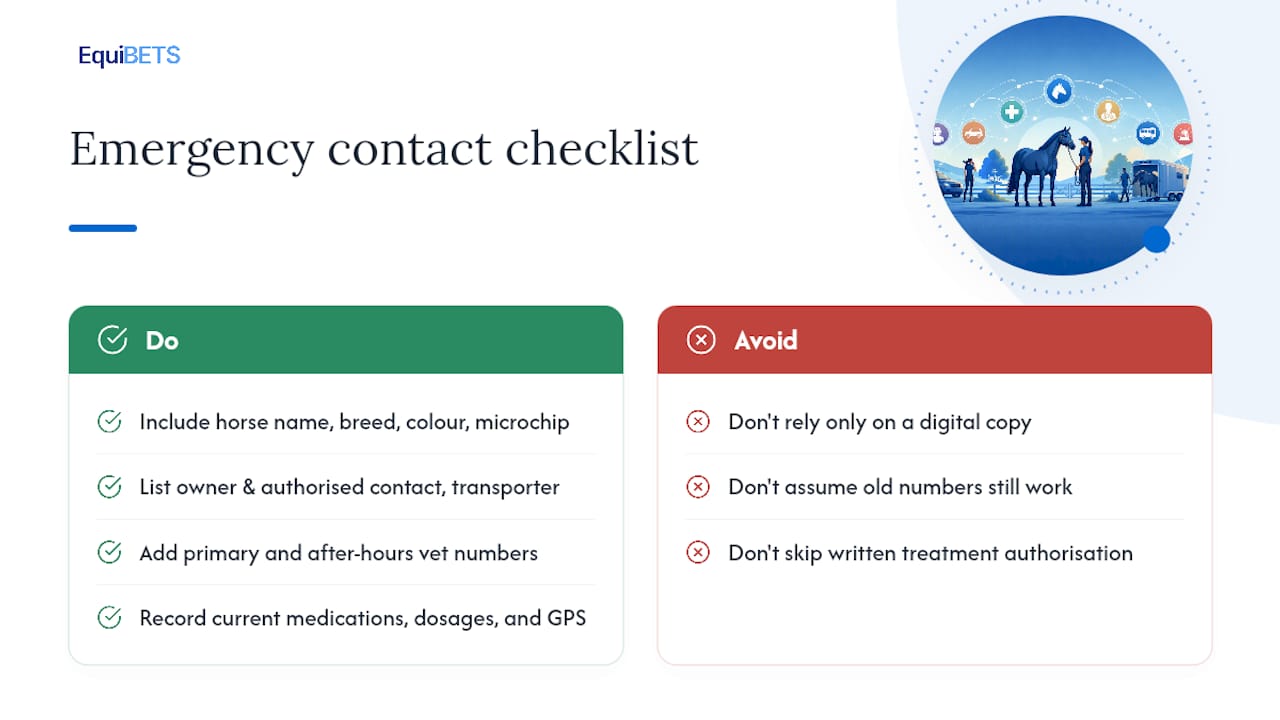
What information should be on a horse emergency contact card? At minimum: the horse's name, breed, colour, and microchip number; owner and authorised decision-maker details; primary and after-hours vet numbers; transporter contact; current medications and dosages; and your property's GPS location.
Who should I call first in a horse emergency? Call your primary vet first for most incidents. For anything beyond field treatment, such as suspected colic requiring surgery or a major fracture, call the after-hours emergency line or nearest equine hospital directly.
How often should I update my horse's emergency contact list? Review it regularly and update immediately after any changes to your vet, farrier, transporter, or medications. A number that worked last year can be dead by the time you need it.
Do I need written authorisation for someone else to approve my horse's treatment? Yes, ideally. Clinics often require documented consent or budget limits before acting on anything beyond basic stabilisation when the owner can't be reached, so a signed authorisation form removes that hesitation.
Should my emergency contact list be digital or printed? Both. A printed, laminated copy works when signal or power fails, while a digital version, updated in an app, stays accurate across every device and can be shared instantly with a vet or first responder.
Sources
For a ready-made poster, ConductScience's printable barn emergency contact sheet follows AAEP categories. For disaster-specific planning, the Northern Territory Government's horse emergency guidance covers evacuation basics, and the BHS equine care and emergency plan offers authorisation wording.
- Equine Emergency Preparedness | K-State | Kansas State University
- Equine care and emergency plan v4 | British Horse Society