

The essential owner portal needs seven things: a timestamped per-horse timeline, mobile access that works offline, configurable reminders, photo and document sharing, role-based permissions, finance statements, and emergency contact data vets can reach instantly. This article covers owner-facing portals built into yard management platforms, not the racing industry's registration and nominations systems. Get these seven right and owner queries drop, vet handovers speed up, and syndicate billing stops eating your Friday afternoons.
TL;DR:
- A complete owner portal should include a timestamped per-horse timeline, offline mobile access, configurable reminders, and role-based permissions.
- Owners need clear finance statements broken down by category and syndicate shares, as well as immediate emergency contact details and clinical data access.
- Vendors should clarify data ownership, export formats, deletion policies, and backup procedures before any commitment, ensuring records are not held hostage.
- Running a two-week pilot with real horse profiles, offline testing, and proof of owner communication confirms the portal’s usability and integration.
- EquiBETS offers an all-in-one platform with these features for $9.99 AUD per month, with a trial available to verify its capabilities before paying.
Table of Contents
- What horse owner portal features actually matter?
- How do finance, emergency plans, and GPS data fit an owner portal?
- What should you ask vendors about data ownership and trials?
- How do you pilot an owner portal in two weeks?
- What operators get wrong about owner portals
- Where EquiBETS fits if you're shortlisting a portal
- Sources
- FAQ
What horse owner portal features actually matter?
Search for "horse management software" and you'll land on a mess of billing suites, racing administration tools, and owner portals all tangled together. That confusion is exactly why yards end up juggling a paper diary, a WhatsApp group, and a spreadsheet nobody updates. A dedicated owner portal fixes the fragmentation by giving owners one place to look instead of three.
The core feature set breaks down like this:
- Per-horse timeline — dated entries covering vaccinations, farrier visits, worming, and vet notes, tagged with who recorded them and searchable by filter.
- Timestamped updates — every entry carries a time and an author, building an audit trail that stops "did anyone check on him?" disputes before they start.
- Mobile and offline access — staff enter data in the yard with wet hands and patchy signal, and the app syncs once it finds a connection.
- Photos and documents — passport scans, shoeing photos, and vet letters attached directly to the horse's record, ready to export for a sale or transfer.
- Reminders — recurring tasks for farrier, worming, and boosters that fire notifications to both staff and owners.
- Permissions — separate access levels so owners see their horse, staff see their yard, and vets see only what's clinically relevant.
A yard-first portal differs from a DIY owner diary in one crucial way: it surfaces staff actions and role information, not just an owner's private notes. That distinction matters when three grooms and a relief rider all touch the same horse in a week.
How do finance, emergency plans, and GPS data fit an owner portal?
Owners want three things beyond the timeline: what they're paying for, who to call in a crisis, and what their horse actually did today. Handle all three well and you'll field far fewer phone calls.
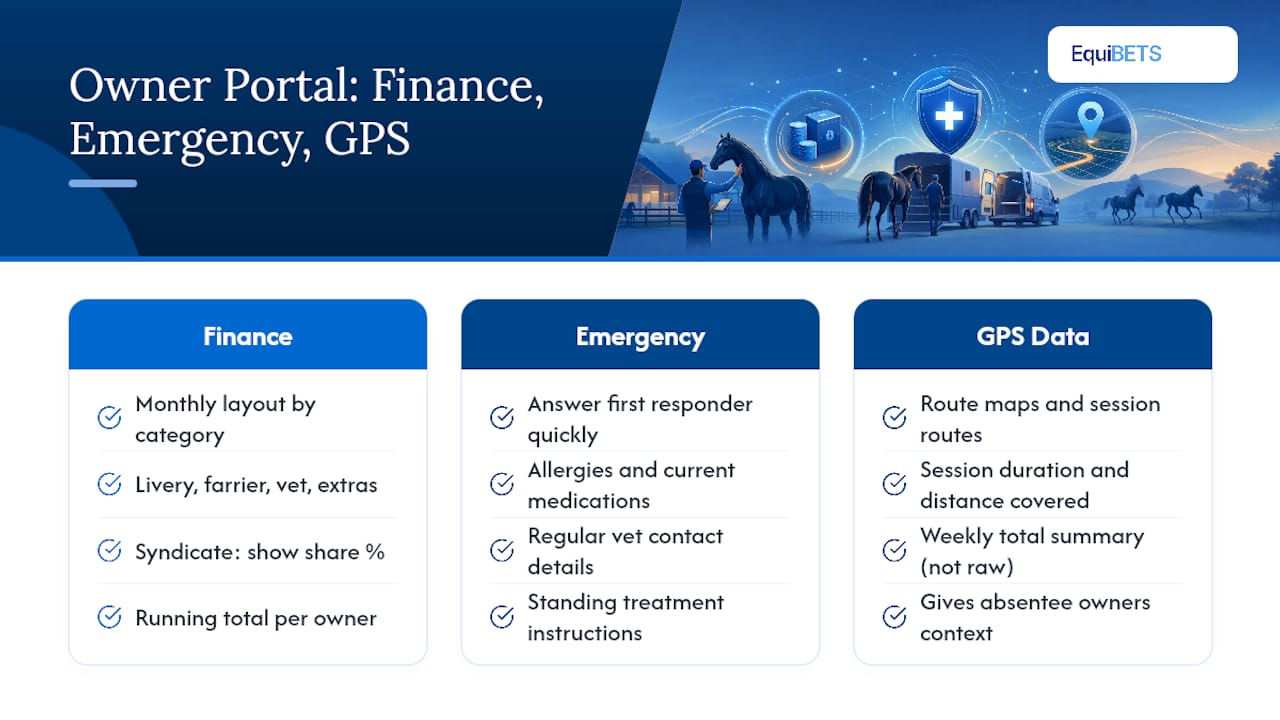
Finance statements work best as a simple monthly layout: livery, farrier, vet costs, and any extras, broken down by category rather than dumped as one lump figure. Syndicate arrangements need a bit more care. Show each owner their share percentage and running total, but keep the underlying yard-wide ledger separate from what any individual owner can see. Reconcile the portal figures against your actual invoicing monthly. A mismatch that sits for three months is far harder to untangle than one caught in week one.
Emergency plans need to answer a first responder's questions in under thirty seconds: allergies, current medications, regular vet contact, and any standing instructions (insurance requirements before treatment, for instance). Grant temporary elevated access when a locum vet or a relief carer needs the full clinical picture rather than the owner-facing summary. Clear guidance on routes for vets to access horse data securely helps here, particularly for yards running multiple vet practices across a syndicate.
GPS and ride data is the feature owners actually enjoy, not just tolerate. Route maps, session duration, and distance covered give an absentee owner a genuine sense of their horse's week, especially useful for syndicate members who visit rarely. Keep the analytics summary simple: a weekly total, not a raw data dump that means nothing without training in equine biomechanics.
One friction point worth naming honestly: SourceForge's directory of horse software listings shows just how often yard billing tools, racing suites, and genuine owner portals get bundled together in search results. That's precisely why mobile usability and clean data export deserve more weight in your shortlist than a long feature list on a sales page.
What should you ask vendors about data ownership and trials?
Before you sign anything, get straight answers on four fronts. These aren't nice-to-haves. They're the difference between a portal you can leave cleanly in two years and one that holds your horse records hostage.
- Hosting and export formats. Ask exactly where data is hosted and whether you can export full records as CSV or PDF on demand, not just on request to support.
- Deletion processes. Confirm what happens to an owner's records when a horse leaves the yard or an owner cancels, and how long that data is retained afterwards.
- Clinical record boundaries. A portal entry logging "wormed 15 March" is not the same as a formal veterinary clinical record. Clarify with your vet practice which system is the source of truth for medical history, because a portal note and a vet's own file diverging is a liability problem waiting to happen.
- Backup and sync reconciliation. Ask how the system handles two staff members editing the same horse's record offline at the same time, and what happens if a sync fails halfway through.
On trials specifically, some vendors gate reminders or exports behind a payment wall, so you never really test the feature that matters most until you've already paid. Push for a trial without card details that lets you build real horse profiles and set up genuine reminders, not a stripped demo account.
How do you pilot an owner portal in two weeks?
Run a small, real test before you commit the whole yard. Here's a pilot that takes under a fortnight and tells you almost everything you need to know.
- Set up three pilot horses and invite two owners per horse, including at least one owner who's not particularly tech-confident.
- Test the offline path deliberately. Have a groom log a note with the phone in airplane mode in the yard, then confirm it syncs once back on Wi-Fi.
- Create one recurring reminder (farrier, say) and confirm both staff and the owner receive the notification.
- Share a GPS ride and a finance statement with an owner and time how long it takes them to find and open it on their phone.
- Collect your evidence: screenshots of the timestamped timeline, proof the offline entry synced correctly, and a quick message from each owner confirming they received and understood their update.
If timestamped updates are visible, exports work cleanly, and owners can open everything from their phone without a support call, the portal has passed the test that actually counts.
What operators get wrong about owner portals
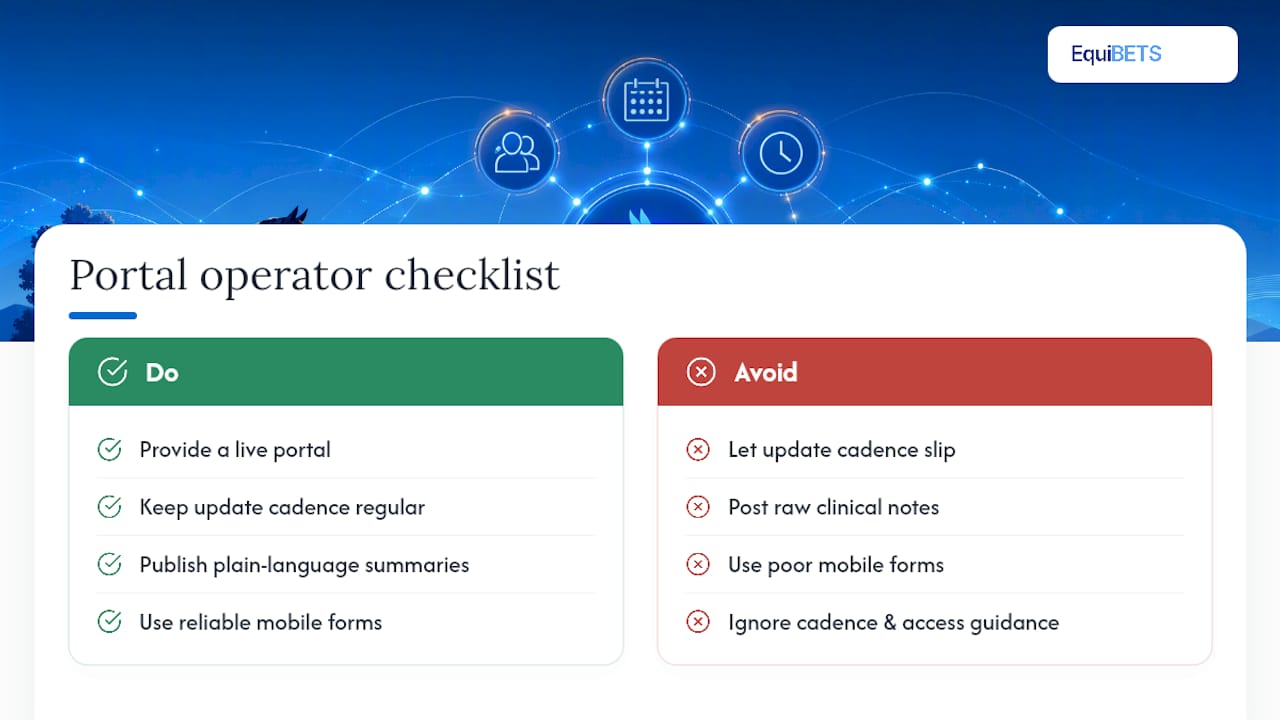
Give owners a live portal and the phone stops ringing for routine questions. That's the biggest operational win, and it compounds: clearer vet briefs because the history is already documented, and faster staff handovers because nobody's relying on memory or a scrawled note in the tack room.
The pitfalls are just as predictable. Yards adopt a portal, then let update cadence slip within a month, and owners notice the silence faster than they'd notice a bad update. Others over-share raw clinical notes that panic an owner unnecessarily, when a plain-language summary would have done the job. Worn-out mobile forms in poor light or with wet hands push staff back to paper within weeks. The publisher's own guidance on owner communication systems and its notes on update cadence and role-based access are worth reading before you set your yard's own rhythm, because getting cadence wrong once tends to stick.
— isaac
Where EquiBETS fits if you're shortlisting a portal
If you're testing the checklist above, EquiBETS is worth running through it directly rather than taking on faith. It bundles the owner portal, offline mobile access, finance tracking, and emergency plans into one workspace, alongside AI-powered movement analysis and GPS ride tracking, so a yard isn't stitching together three separate tools to cover what one platform handles natively.

That consolidation is the practical advantage: your timeline, ride data, and finance statements sit in the same record instead of three logins an owner has to remember. The Stable Manager product page walks through the full feature set if you want the detail before you commit staff time to a trial. Pricing sits at $9.99 AUD per month for EquiBETS Complete, with a trial available to test the portal against the pilot checklist above before you pay for anything.
FAQ
Can horse owners see finance and billing details in the portal?
Yes, most yard-first portals show owners a monthly statement broken down by category, such as livery, farrier, and vet costs. Syndicate members typically see their own share percentage rather than the full yard ledger.
Does an owner portal work without internet access at the yard?
A properly built portal lets staff log entries offline and syncs automatically once a connection returns, which matters given how patchy signal is in most stable blocks. EquiBETS is built with offline mobile access specifically for this reason.
Who should have access to a horse's emergency plan?
Owners, regular staff, and the yard's usual vet should have standing access, with temporary elevated access granted to locum vets or first responders during an emergency. The plan should list allergies, medications, and standing treatment instructions in a format readable in under thirty seconds.
Can I trial an owner portal without entering payment details?
Reputable vendors let you create real horse profiles and set up genuine reminders during a trial period without a card on file. Confirm this before signing anything, since some platforms gate exports or reminders behind payment.
How much does EquiBETS cost for a professional yard?
EquiBETS Complete is $9.99 AUD per month and includes the owner portal, finance tracking, offline mobile access, and emergency plans in one subscription. A trial is available for yards that want to run the pilot checklist before committing.