
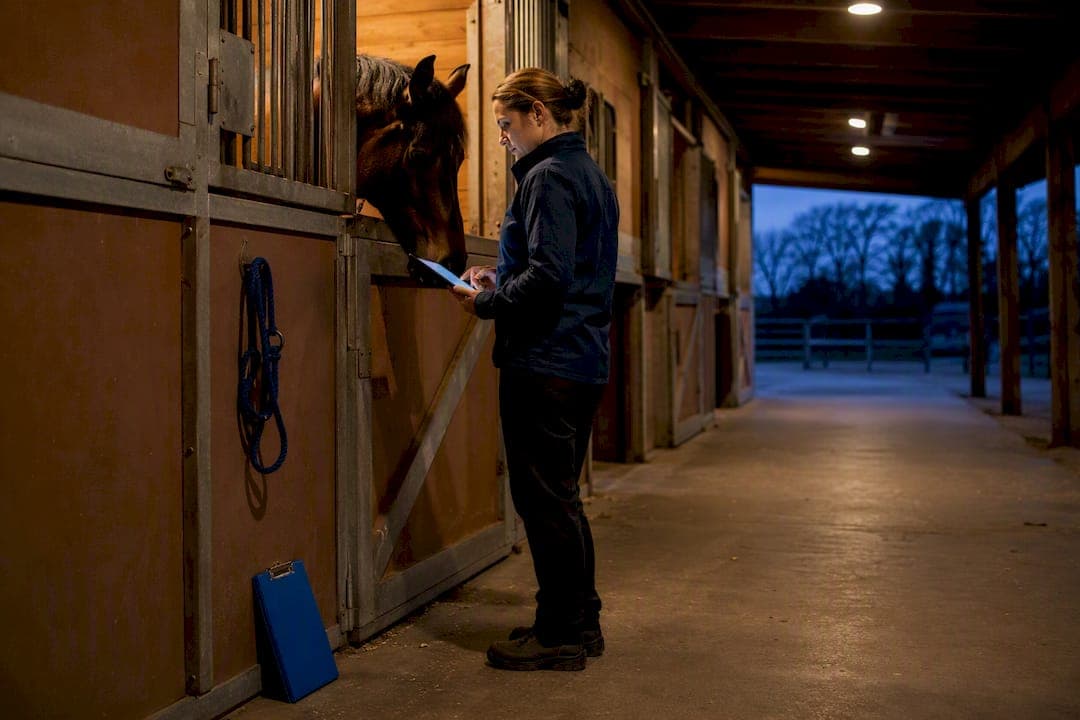
Send owners a weekly welfare summary as the default, with instant alerts for anything urgent, and only shift the schedule when a horse's status or an owner's contract says otherwise. New arrivals, unwell horses and competition prospects move to daily updates. Owners who explicitly ask for less get a monthly summary instead. Every update gets a timestamp and staff initials, no exceptions.
TL;DR:
- Horses that are new, unwell, or competing within 30 days require daily updates, while stable, healthy horses usually only need a weekly summary.
- Urgent incidents such as colic or injuries trigger immediate alerts, overriding any regular update schedule to ensure rapid communication.
- Routine owner updates should include timestamped details, staff initials, wellbeing statements, exercise notes, and any medication or feed changes.
- Communication channels vary by update type, with owner portals for record-keeping, SMS for urgent alerts, and email for detailed reports or invoices.
- Clear roles, scheduled automation, offline data capture, and owner feedback management are key to maintaining consistent, reliable welfare communication.
Table of Contents
- What's the right cadence for each type of update?
- Which channel should each update use?
- What should every owner update include?
- How do you tailor cadence to different owner types?
- Who's responsible for sending updates, and what's the backup plan?
- How should you handle owner feedback on your updates?
- What privacy rules apply to sharing horse health updates?
- What separates yards that get this right from yards that don't?
- How EquiBETS supports the cadence you've just built
- Sources
What's the right cadence for each type of update?
Cadence isn't one number. It's a set of rules matched to what's actually happening with the horse.
A daily brief is a short check confirming the horse ate, moved normally, and has no visible concerns. It suits new arrivals in their first fortnight, horses recovering from injury or illness, and anything heading to a competition within the month. Send it in the evening once feeds and turnout are done, so the report reflects the full day rather than a 9am snapshot.
A weekly summary is the workhorse of the system. Most healthy horses on full livery or in regular work need nothing more. It covers exercise load, any feed or medication tweaks, turnout patterns, and a plain-language note on how the horse is doing. Send it the same day every week (Sunday evening works well for most yards) so owners know when to expect it.
A fortnightly welfare check suits recreational horses in light or no work, where daily variation is minimal and owners have said they'd rather not be flooded with messages.
A monthly report pairs with the invoice cycle and suits owners who've opted into lower-frequency contact, plus anyone wanting a finance-focused rundown rather than day-to-day detail.
An incident-driven alert overrides every other schedule. Colic, lameness, a vet call-out, a fence-line injury. These go out the moment staff know, not at the next scheduled slot.
Decision rules that speed up the choice:
- If the horse is new, unwell, or competing within 30 days, send daily.
- If the horse is stable and in regular work, send weekly.
- If the owner has asked for less contact in writing, send monthly and log that preference.
- If anything falls outside normal health, behaviour or safety parameters, send an alert immediately, regardless of the standing schedule.
Syndicate members and vets need the same welfare data as the primary owner, but syndicate reports often carry formal reporting obligations, detailed further here, on top of the standard cadence.
Pro Tip: Build the daily/weekly/monthly split into your owner portal as default settings per horse, not per owner. A horse's status changes faster than an owner's preferences do, and the schedule should follow the horse.
Which channel should each update use?
The channel matters as much as the timing. Get this wrong and urgent news arrives too slowly, or routine news feels like an intrusion.
An owner portal should be the primary channel for anything that needs a record: welfare summaries, exercise logs, feed changes, invoices. It's searchable, timestamped, and holds attachments without cluttering anyone's phone.
- SMS or a messaging app — short, urgent, time-sensitive alerts. A vet visit scheduled for tomorrow, a change in turnout group, a quick "all good tonight" for an anxious new owner.
- Phone calls — genuine emergencies and anything requiring immediate decisions, like colic surgery consent.
- Email — longer welfare summaries, monthly reports, and invoices where a formatted document reads better than a chat bubble.
- Printed reports — livery agreements, insurance claims, or any owner who's explicitly asked for paper because they don't use apps.
Attachments carry real weight here. A photo of a healing wound, a link to a GPS-tracked ride, or a vet-ready trot trace generated in under a minute all turn a vague update into something an owner or vet can actually assess. Yards using digital tools with offline access can capture this data in the field and sync it once back at the office, which matters when barn Wi-Fi is patchy or non-existent.
One channel should carry the record of truth. If SMS is where the urgent word goes out, the portal should still log that the alert happened and when.
What should every owner update include?
Every update, regardless of cadence, needs a minimum set of fields to be genuinely useful. Skip any of these and you're sending noise, not information.
- Date and time
- Staff initials (who observed and who wrote it)
- Horse ID or name
- A one-line wellbeing statement
- Exercise or turnout notes
- Any feed or medication changes
- Next steps, if any
Optional but valuable additions: a photo, a GPS ride link, vet or farrier notes, and an invoice link when relevant. Documented routine checks around feeding, water, turnout and medication form the backbone of a trustworthy update, and they're what you'll want on record if a welfare question ever comes up.
Two quick templates:
| Update type | Example wording |
|---|---|
| Daily quick check | "6/3, 6:15pm, JT. Bella ate up, sound on turnout, no changes. No action needed." |
| Weekly welfare summary | "8/3, 5pm, KM. Diesel worked 3x this week, hacking and one schooling session. Farrier due next Tuesday. Feed unchanged. Photo attached from today's hack." |
Archive every update against the horse's record, not just the owner's inbox, and flag anything needing follow-up so it doesn't disappear into a chat thread.
How do you tailor cadence to different owner types?
The default schedule is a starting point, not a rule that fits every relationship. Owner type and contract terms should shift both frequency and format.
- Syndicate members usually expect a formal monthly report alongside any weekly summaries, often tied to their share of costs and outlined in the syndicate agreement.
- Full livery clients are well served by the standard weekly cadence, since they're paying for comprehensive care and expect regular proof of it.
- DIY liveries need less frequent updates on daily care (they're often doing much of it themselves) but should get prompt alerts on anything happening while they're away, and clear reference to what's covered in the livery agreement.
- Competition riders want performance-relevant notes on a tighter cycle around events: fitness progress, farrier timing, and anything affecting a start date.
Ask every new owner about preferred contact windows and quiet hours at onboarding, and store that against their profile. Some owners want nothing after 8pm; others check messages on their commute and prefer an early alert.
Non-responders need a different approach again. Short, regular nudges with a clear yes or no question work better than one long message every few weeks, a pattern well documented in advice on staying pleasantly persistent with busy clients.
Who's responsible for sending updates, and what's the backup plan?
Cadence only works if someone owns it every single day, including when the usual person is off.
Assign three roles clearly: the reporter (staff on duty who observes and writes the note), the approver (a senior staff member or trainer who checks anything unusual before it goes out), and the publisher (whoever hits send, which can be automated through scheduled portal updates for routine weekly and monthly reports).
- Use templates for every update type so reporters aren't writing from scratch under time pressure.
- Automate scheduled sends for weekly and monthly reports to cut the risk of a missed week.
- Run a quick daily check that every horse due an update actually got one, and a weekly check that reports are archived correctly.
- Keep an emergency contact list current for vets, farriers and out-of-hours cover, and make sure every staff member knows the escalation path.
Connectivity drops happen in fields and stables with patchy signal. Offline forms that sync once you're back in range stop a bad signal from becoming a missed update.
Pro Tip: Run a five-minute end-of-day huddle where the approver confirms every flagged horse has an update logged. It catches gaps before an owner does.
How should you handle owner feedback on your updates?
Owner feedback is data, not noise, and treating it that way improves the whole system over time.
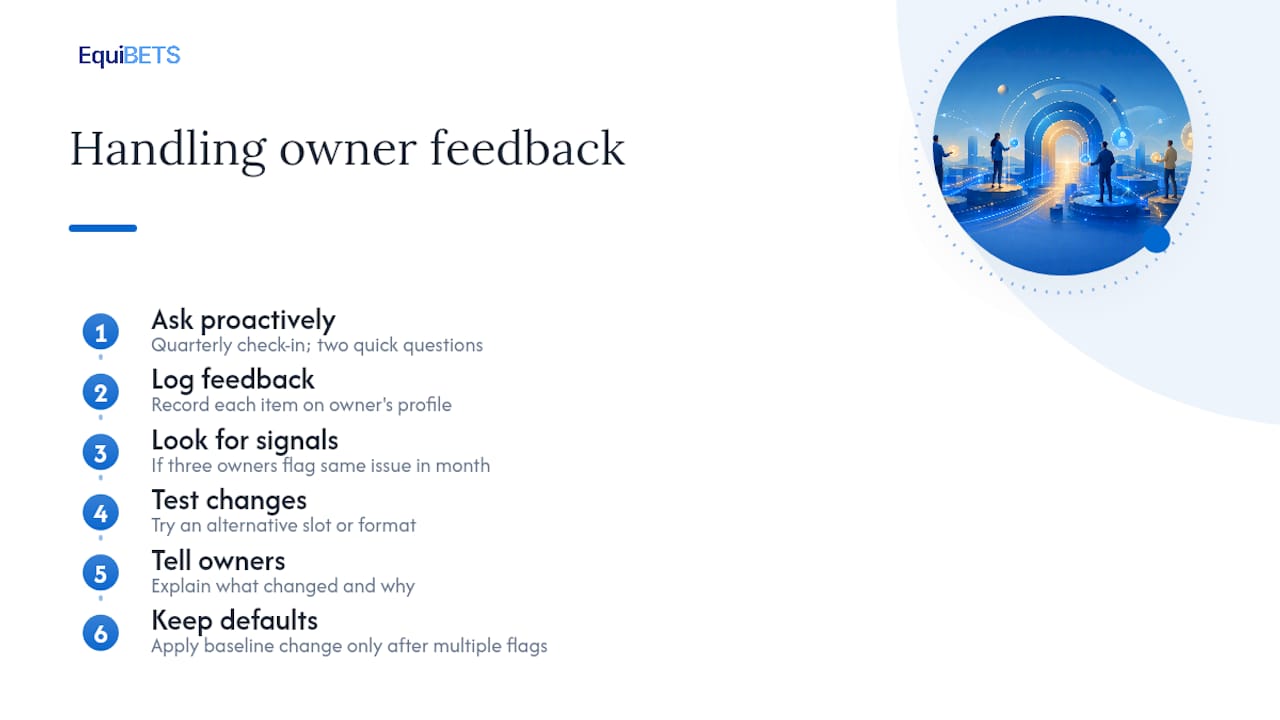
Ask directly, rather than waiting for complaints. A short quarterly check-in (even a two-question form: "Are updates frequent enough?" and "Is the format working for you?") surfaces problems long before they become confrontations. Some owners will say the weekly summary is too much; others will say they want more detail on feed changes. Both are useful.
Log every piece of feedback against the owner's profile, the same way you'd log a preference for quiet hours. If three owners in a month say Sunday evening updates get lost among their weekend messages, that's a signal to test a Monday morning slot instead.
Consistent communication routines reduce confrontation because owners know what to expect and when. When you do change the cadence or format based on feedback, tell every affected owner what's changing and why, rather than letting them notice a gap on their own.
Not all feedback should change the system. An owner asking for daily updates on a healthy horse in light work is a preference worth accommodating if resourcing allows, but it shouldn't reset your default cadence for every other horse in the yard. Separate individual preference requests from systemic issues, and only adjust the baseline when multiple owners flag the same friction point.
What privacy rules apply to sharing horse health updates?
Health and treatment information deserves the same care you'd want for your own medical records, even though horses aren't people.
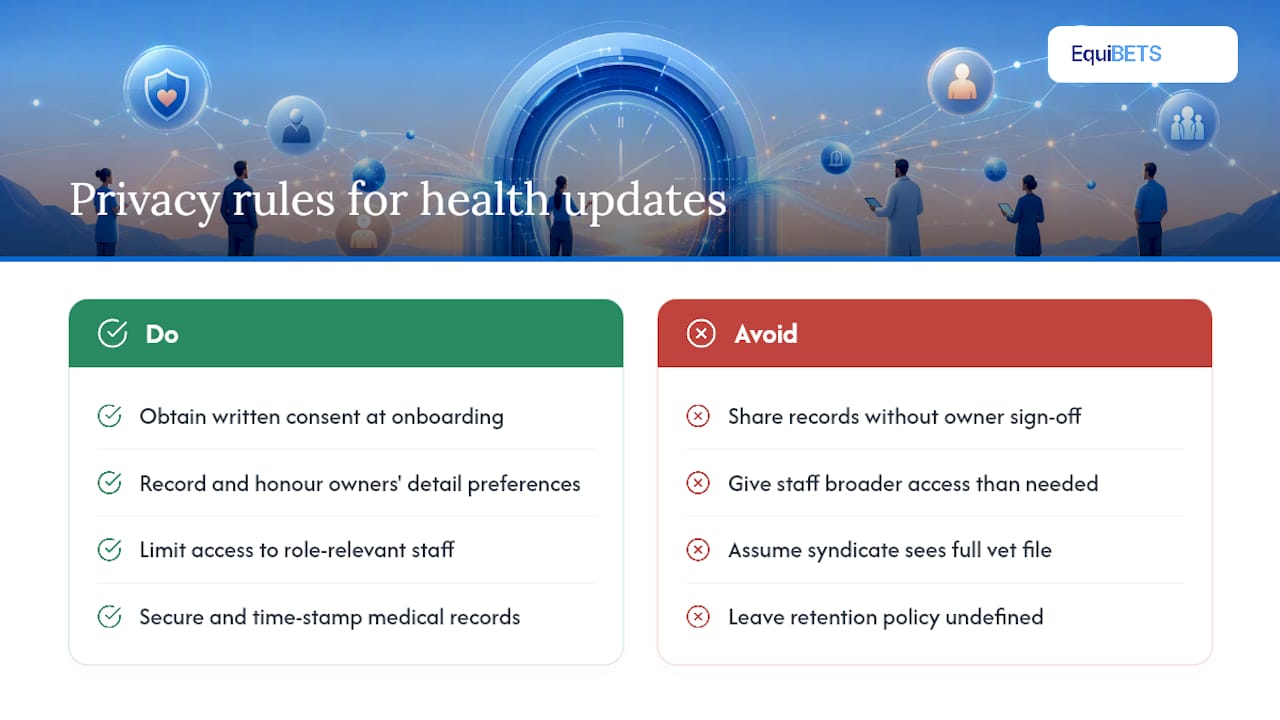
Get written consent at onboarding for who can receive updates and what level of medical detail they're comfortable seeing. Some owners want every vet note; others prefer a summary unless something's seriously wrong. Record that preference and honour it consistently.
Limit access strictly. Syndicate members might see a shared welfare summary but not necessarily the full veterinary file unless the syndicate agreement says otherwise. Staff should only access records relevant to their role, and any third party (a insurer, a prospective buyer, a competition body) needs explicit owner sign off before you share anything.
Keep records secure and time stamped, both to protect the owner's data and to protect the yard if a dispute arises later. A written livery agreement should spell out exactly what information gets shared, with whom, and how it's stored. That agreement is your reference point whenever a grey area comes up, not a guess made on the day.
Retention matters too. Decide how long you keep historical health records after a horse leaves the yard, and be upfront with owners about that policy rather than leaving it undefined.
What separates yards that get this right from yards that don't?
The yards that run this well aren't the ones sending the most messages. They're the ones sending the most consistent ones. A standardised weekly cadence, with clear exceptions for new or unwell horses, tends to cut ad hoc owner queries dramatically, simply because owners stop wondering if something's being kept from them.
The recurring mistakes are almost always the same three: no timestamp on the update, a different staff member writing each one with no consistent format, and reports that ramble instead of stating the wellbeing line up front. Fix those three and most owner friction disappears.
If you want quick wins, start here: pick one primary channel, put staff initials on every single update, and build two templates (daily and weekly) that any staff member can fill in under two minutes.
— isaac
How EquiBETS supports the cadence you've just built
Building this system by hand across spreadsheets, group chats and paper folders works until a busy week exposes the gaps. EquiBETS gives yards the infrastructure to run the exact cadence outlined above without adding admin load. Owner portals handle the weekly summaries and monthly reports, timestamped and logged against each horse's own record. Offline forms mean a staff member in a paddock with no signal can still log a wellbeing check that syncs when they reconnect, helping to manage connectivity issues.

For syndicates, structured reporting templates keep every member seeing the same standard of update, and GPS ride links plus vet-ready trot traces turn a vague "went well today" into something a vet or co-owner can actually assess. A sensible starting configuration for most yards is weekly summaries as the default, daily for any horse flagged as new, unwell or competing, and monthly finance reports tied to the invoice cycle. If you're ready to see how it runs in practice, the stable manager platform is worth a look, with a trial available before you commit to anything.
Sources
- Perfecting pleasantly persistent in your horse business
- Mindful barn management: creating calm, connected spaces