

For a typical Australian boarding barn of moderate size, equestrian management software typically pays back its subscription cost within less than a year when you account for three drivers: admin time recovered, revenue that was earned but never invoiced, and the subscriptions the new platform replaces. Run your own numbers using the worksheet framework in this guide, or start a free trial with Equibets to validate those assumptions against your actual yard data before you commit to a paid plan.
The three drivers that move equestrian software ROI the most:
- Admin time recovered: Many yard managers spend significant hours per week on tasks software can automate.
- Missed charge recovery: Uninvoiced lessons, trail fees, and extras often occur in busy yards, and recovering a portion of these can increase annual revenue.
- Tool consolidation: Replacing multiple separate subscriptions with one platform typically saves several hundred to a few thousand dollars per year in direct fees, plus additional savings in labour.
Download the pre-filled worksheet template linked in Section 7, enter your own figures, and you will have a defensible payback period to present to owners or stakeholders within 30 minutes.
Key takeaways
For most Australian boarding barns with 20 or more horses, equestrian software ROI is measurable within the first billing cycle, with conservative payback periods of 3–4 months and base-case payback under two months.
| Point | Details |
|---|---|
| Payback period is short | Conservative scenario modelling shows payback in —; base case is 1.5 months for a 40-horse yard. |
| Three drivers dominate ROI | Admin time saved, missed charge recovery, and tool consolidation account for the majority of annual benefit. |
| Missed charges are underestimated | A typical 40-horse yard leaks $560/month in uncharged services; automated billing captures this at the point of service. |
| Adopt in phases, not all at once | Focusing on invoicing and owner communication first consistently delivers more year-1 ROI than a full-feature launch. |
| Equibets covers all ROI drivers | The single all-inclusive plan replaces multiple tools and maps directly to admin, billing, and owner communication savings. |
Table of Contents
- How to audit your admin hours and convert them to AUD
- How automated billing improves your cashflow and reduces bad debts
- What subscriptions does your current setup actually cost you?
- Finding revenue you have already earned but not yet charged
- How time savings translate into FTE gains and growth capacity
- The complete ROI formula and a worked Australian example
- How to choose realistic inputs and avoid common overestimates
- How Equibets delivers ROI in practice: a projection example
- What to do next: a clear recommendation and three practical steps
- Equibets puts the ROI drivers in one place
- Sources
How to audit your admin hours and convert them to AUD
The first step in any honest cost analysis of equestrian software is timing the work you already do.
The admin-time audit worksheet
Set up a simple table with five columns and track every recurring admin task for one week. The columns are:
A yard running around 40 horses typically spends roughly a dozen hours per week on these tasks. Software that automates invoicing, owner portals, and scheduling can realistically reduce that time by a majority, often cutting it by more than half.
Converting hours to AUD
Use a loaded labour rate, not just the base wage. A rough multiplier of 1.25–1.35 on top of the base wage covers most of these on-costs.
Worked micro-example:
- Task: chasing unpaid invoices
- Time per week: 60 minutes
- Annual hours: 52
- Base wage: $28/hour (stable hand or admin assistant)
- Loaded rate: $28 × 1.30 = $36.40/hour
- Annual cost of this one task: 52 × $36.40 = $1,893/year
Multiply that logic across all tasks in the table and the annual admin cost becomes visible fast.
Pro Tip: If you are the owner-operator doing this work yourself, use your opportunity cost rate, not a wage. What is an hour of your time worth in business development, training, or client retention? Most owner-operators set this at $50–$80/hour, which makes the time-savings case even stronger.
How automated billing improves your cashflow and reduces bad debts
Days sales outstanding (DSO) is the average number of days between issuing an invoice and receiving payment. In manual billing environments, Australian equestrian facilities commonly experience longer delays between invoicing and payment. Automated billing with card-on-file or direct debit can shorten that delay significantly.
Here is how to build the accounts receivable improvement calculation for your yard:
-
Calculate your average monthly invoice value. Take total monthly revenue divided by the number of invoices issued. For a 40-horse boarding barn at $800/month board, that is roughly $32,000/month across 40 invoices, or $800 average.
-
Estimate your current DSO. If you send invoices on the 1st and most owners pay by the 25th, your DSO is approximately 24 days. If some owners routinely pay in the following month, your real DSO may be 35–45 days.
-
Project your post-software DSO. Automated card billing or direct debit at the time of invoicing typically achieves 3–7 days DSO. Use 7 days as a conservative estimate.
-
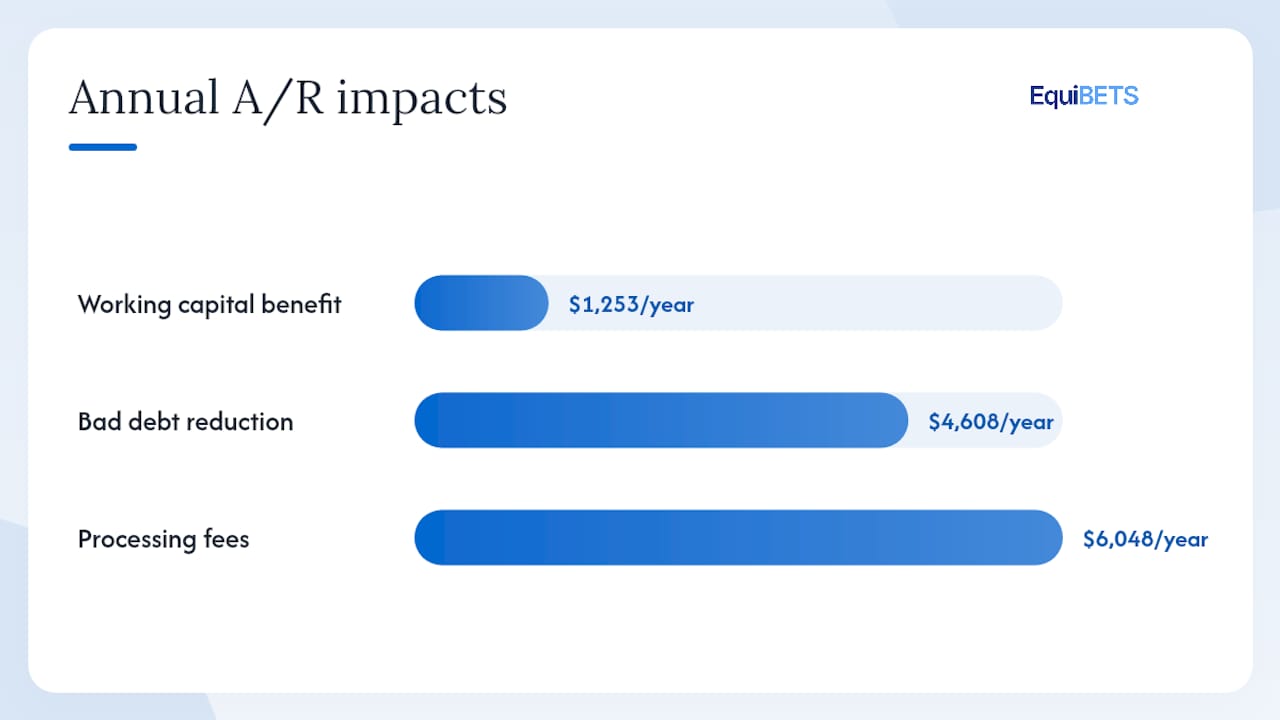
Calculate the working capital benefit. The formula is: (DSO reduction in days ÷ 365) × annual revenue × your cost of capital (or overdraft rate). For a yard with $384,000 annual revenue, a 17-day DSO reduction (24 to 7), and a 7% cost of capital: (17 ÷ 365) × $384,000 × 0.07 = $1,253/year in freed working capital.
-
Add the bad debt reduction. If your facility experiences a certain percentage of revenue loss from unpaid invoices, automated billing can reduce this loss substantially, though exact savings depend on the specific circumstances.
-
Net against payment processing fees. Card processing in Australia typically costs 1.4–1.75% per transaction for Visa/Mastercard. On $32,000/month, that is $448–$560/month ($5,376–$6,720/year). Weigh this against the bad debt reduction and DSO benefit to get the net A/R improvement figure.
The net benefit in this example: $1,253 + $4,608 − $6,048 (mid-point processing fees) = −$187/year on A/R alone. That sounds like a loss, but it ignores the staff time saved chasing debts and the cashflow certainty that lets you plan purchases and payroll with confidence. For most yards, the real value is the elimination of the collections conversation, not the interest arithmetic.
What subscriptions does your current setup actually cost you?
Before you can calculate the return on investment from equestrian software, you need an honest inventory of what you are already spending. Most yard managers are surprised when they add it up.
Work through this checklist and note the monthly cost and the hours per month spent reconciling or syncing data between each tool:
- Accounting package (Xero, MYOB, or QuickBooks): $30–$80/month
- Scheduling or booking app (generic calendar tools, booking platforms): $20–$60/month
- Payment processor (Square, Stripe standalone, or bank merchant facility): fixed fees $10–$30/month plus per-transaction costs
- Owner communication tools (group SMS services, WhatsApp Business, email marketing platforms): $15–$50/month
- Spreadsheets and manual tracking (no direct cost, but typically 3–5 hours/month in data entry and reconciliation): $0 direct, but $110–$200/month in labour at loaded rates
- Health and feed record systems (paper or generic apps): $0–$30/month
- Separate GPS or ride-tracking app: $10–$25/month
A yard using multiple separate tools typically incurs dozens to a few hundred dollars per month in subscription fees, plus additional labour costs syncing data between them, resulting in several hundred dollars monthly in total costs.
A single equestrian management platform that replaces all of these consolidates that spend into one subscription and eliminates the sync labour entirely. The Equibets stable manager module covers scheduling, billing, finance tracking, owner portals, and team coordination in one workspace, which is the consolidation most yards are looking for.
Finding revenue you have already earned but not yet charged
Missed charges are the most underestimated line item in any equestrian software ROI calculation. They are not bad debts — the service was delivered, the horse was fed, the lesson ran. The money just never made it onto an invoice.
Common sources of missed charges in Australian boarding barns:
- Lesson extras: arena hire, equipment use, or coaching time added informally and not recorded
- Trail and hack fees: charged per ride but tracked manually, with rides frequently going unlogged
- Veterinary call-out admin surcharges: coordination time billed to owners but often forgotten
- Feed and supplement adjustments: changes to a horse's feed plan mid-month that increase costs but are not reflected in the next invoice
- Late payment fees: stated in contracts but rarely applied because the manual process of tracking and adding them is too time-consuming
The missed-charge audit worksheet
Monthly missed charges can add up to several hundred dollars, representing revenue already earned but not yet collected. For a 40-horse yard, that figure is conservative. Automated booking and billing features reduce this leakage by capturing charges at the point of service, not at the end of the month when memory fails.
How time savings translate into FTE gains and growth capacity
Saving 6–8 hours per week in admin does not automatically mean you reduce headcount. For most Australian boarding barns, the more realistic and valuable outcome is redeploying that time into revenue-generating activity or avoiding the next hire.
Here is a simple FTE conversion:
A conservative estimate of hours saved per week can equate to a significant fraction of a full-time position, translating into substantial annual labour cost savings.
That $12,970 is either a direct saving if you were planning to hire, or a redeployable resource if the time goes to lessons, client acquisition, or horse care.
Growth capacity example: If those 7 hours per week are redirected to taking on additional horses or running extra lessons:
Reallocating saved time can allow capacity for additional horses or lessons, potentially generating significant additional revenue depending on pricing and client demand.
Neither of these requires hiring. They require the time to be available, which is exactly what the software creates.
Australian labour costs add a specific consideration here. With the Fair Work Act minimum wage and mandatory superannuation, the cost of even a part-time admin hire in 2026 runs $28,000–$38,000/year fully loaded. Software that defers or eliminates that hire pays back its subscription cost many times over in the first year alone.
The complete ROI formula and a worked Australian example
The formula
The ROI formula calculates return as a percentage by comparing total annual benefits, including admin time saved, accounts receivable improvements, missed charge recovery, and tool consolidation savings, against total annual costs such as subscription, implementation, and training.
Required inputs
- Monthly board rate (AUD)
- Number of horses
- Admin hours saved per week
- Loaded labour rate (AUD/hour)
- Current DSO and projected post-software DSO
- Bad debt rate (current and projected)
- Monthly missed charges recovered (AUD)
- Current tool subscription costs (AUD/month)
- Software subscription cost (AUD/month)
- One-off implementation and training cost (AUD)
Full worked example: 40-horse Australian boarding barn
Inputs:
- 40 horses at $800/month board = $384,000 annual revenue
- Admin hours saved: 7 hours/week
- Loaded labour rate: $36.40/hour
- Bad debt reduction: 1.5% to 0.3% of revenue
- Missed charge recovery: $560/month
- Tool consolidation saving: $200/month (direct fees) + $150/month (sync labour)
- Software subscription: $250/month (all-inclusive plan)
- Implementation and training: $500 one-off
Annual benefit calculation:
Annual cost:
ROI calculation:
- ROI = ($28,765 − $3,500) ÷ $3,500 × 100 = 722%
- Payback period = $3,500 ÷ ($28,765 ÷ 12) = 1.5 months
Three-scenario sensitivity table
Even conservative scenarios can show payback periods within a few months. Copy this table into Excel or Google Sheets, replace the inputs with your yard's actual figures, and you have a worksheet ready to present to owners.
The Equibets pricing page shows the current all-inclusive plan cost, which you can drop directly into the "Annual cost" row of your worksheet.
How to choose realistic inputs and avoid common overestimates
The ROI numbers above look compelling, and they are achievable. But the fastest way to lose credibility with a sceptical owner or board member is to walk in with inflated assumptions. Here is how to keep your estimates honest.
Input guidance:
- Admin hours saved: Time yourself doing the tasks for one full week before estimating. Most managers guess high on invoicing time and low on owner communication time. Use the actual audit, not a guess.
- Loaded labour rate: Use the Fair Work Award rate for your state plus 11.5% super, plus 20% for leave entitlements. Do not use the base wage alone.
- Board rate: Use your current average, not your advertised rate. If you have discounted arrangements with some owners, the average is lower.
- Bad debt rate: Pull your last 12 months of write-offs from your accounting records. If you have never tracked this, use 1% as a conservative starting assumption.
- Missed charges: Audit one month manually before estimating. The number is almost always higher than you expect, but you need real data to defend it.
Three conservative assumptions to test sensitivity:
- Cut admin time savings by 40% (software adoption is slower than expected in the first three months)
- Set missed charge recovery at 50% of your audit figure (not every category will be captured immediately)
- Add $1,000 to implementation cost for unexpected training time or data migration
Sanity checks before presenting to stakeholders:
- Does the payback period feel believable given your yard's size and complexity?
- Is the admin time saving less than the total hours you currently spend on those tasks?
- Does the annual benefit exceed the subscription cost by at least 3x in the conservative scenario?
- Have you included payment processing fees as a cost offset against A/R improvement?
- Is the implementation cost realistic for your team's technical comfort level?
If all five checks pass on the conservative scenario, the ROI case is solid.
How Equibets delivers ROI in practice: a projection example
The investment signals in the equine tech sector are hard to ignore. Equine MediRecord secured an eight-figure private equity investment to expand its welfare and anti-doping platform, and Equiyd attracted multi-million pound backing to scale its AI-driven equine services globally. These are not niche bets. They signal that equine management software is moving from an optional convenience to a mainstream operational standard, and that buyers should prioritise vendors with clear product roadmaps and measurable ROI.
Here is how a typical Equibets client projection looks, based on a mid-sized Australian professional yard:
Client projection table
| Input | Value |
|---|---|
| Horses under management | 45 |
| Monthly board rate | $820 |
| Admin hours saved per week | 8 |
| Loaded labour rate | $38/hour |
| Monthly missed charges recovered | $480 |
| Tool consolidation saving | $320/month |
| Equibets subscription | All-inclusive single plan |
| Output | Year 1 value (AUD) |
|---|---|
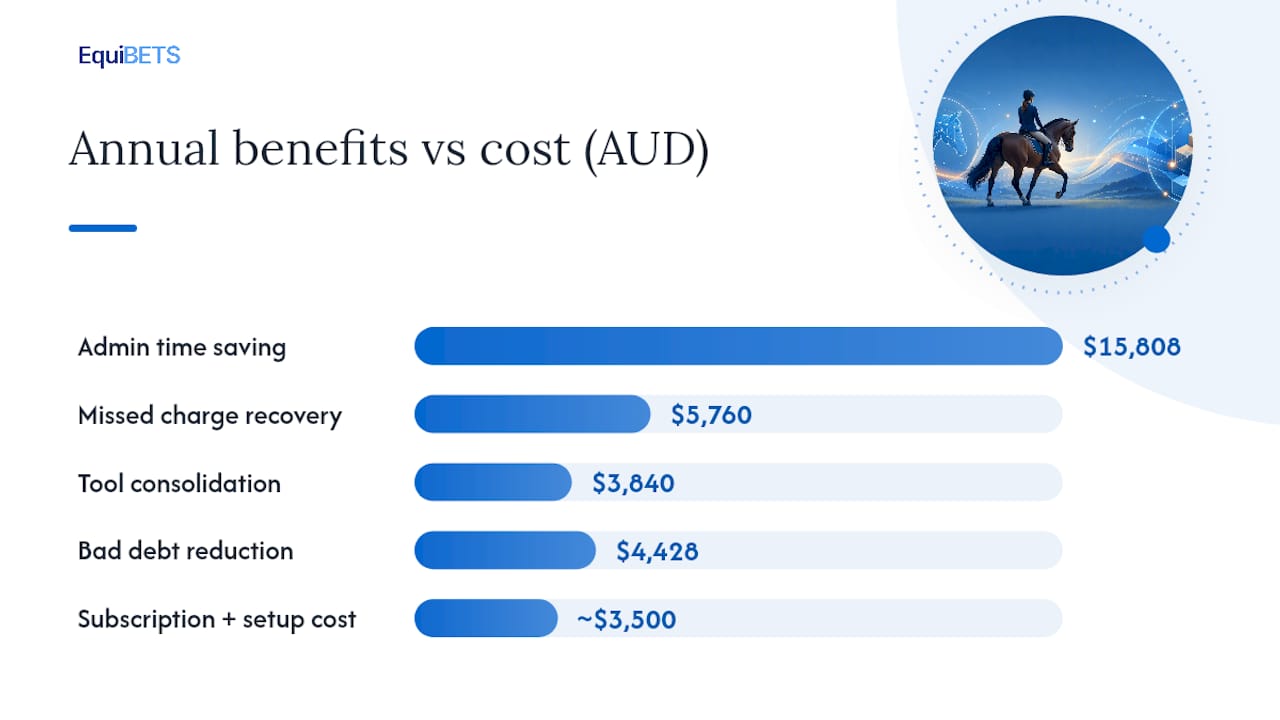
| Admin time saving | $15,808 |
| Missed charge recovery | $5,760 |
| Tool consolidation | $3,840 |
| Bad debt reduction (—% of $442,800) | $4,428 |
| Total annual benefit | $29,836 |
| Subscription + setup cost | ~$3,500 |
| Simple ROI | ~752% |
| Payback period | ~1.4 months |
In the first 1–6 months of a typical implementation, the measurable early results tend to follow a consistent pattern. Month 1 is dominated by setup and data migration, with admin time savings beginning to appear in weeks 3–4 once invoicing automation is live. By month 3, missed charge recovery is measurable because automated booking has been capturing extras for a full billing cycle. By month 6, bad debt rates are visibly lower and the owner portal has reduced inbound phone calls by a material amount.
Pro Tip: Run a 90-day pilot with three specific KPIs before committing to a full rollout: (1) admin hours logged per week versus your pre-software baseline, (2) invoices issued within 24 hours of the billing cycle versus your current rate, and (3) number of missed charges identified in the first automated billing run. These three numbers tell you whether the ROI model is tracking as expected or needs recalibration.
The Equibets platform offers a free trial, which makes this pilot approach straightforward. You can run the trial against your real yard data, measure those three KPIs, and have a validated ROI figure before you spend a dollar on a subscription.
What to do next: a clear recommendation and three practical steps
If your conservative-scenario payback period is under 12 months, the software purchase is justified. That threshold holds for almost every Australian boarding barn with 20 or more horses, because the admin time savings alone typically cover the subscription cost within the first quarter.
Three practical next steps:
- Step 1 — Run the worksheet. Use the sensitivity table in Section 7 with your actual inputs. If you cannot complete the admin hours column without guessing, do the one-week time audit first. The 30 minutes this takes is the most valuable 30 minutes in the ROI process.
- Step 2 — Book a demo or start a free trial. Bring your worksheet inputs to the demo conversation. A good vendor will walk you through how their platform maps to each benefit driver. If they cannot show you where admin time savings come from in their specific workflow, that is a red flag.
- Step 3 — Set pilot KPIs before go-live. Agree on three measurable outcomes for the first 90 days (admin hours, invoice turnaround, missed charge rate). Review them at day 30 and day 90. If the numbers are not moving, the implementation needs adjustment, not the software decision.
Implementation and training timeline for Australian yards:
Most equestrian management platforms take 2–4 weeks to implement for a yard of 20–60 horses, assuming clean data migration from existing spreadsheets or accounting software. Training for a team of 3–5 staff typically requires 4–8 hours of structured onboarding, plus 2–3 weeks of supervised use before the team is operating independently.
The obstacle nobody talks about
The most common reason equestrian software ROI falls short of projections is not the software. It is incomplete adoption in the first 60 days.
The invoicing automation runs, but the team still takes phone bookings and records them manually. The owner portal is live, but owners are still calling because nobody told them to use it. The missed charge capture is available, but staff are not trained to log extras at the point of service.
The fix is straightforward: before go-live, identify the two or three workflows that drive the most ROI (usually invoicing and owner communication), and make those the non-negotiable first habits. Everything else can follow. A phased adoption plan that focuses on the highest-value workflows first consistently outperforms a full-feature launch where nothing gets done properly.
One practical tip you can apply before you even sign up: map your current invoicing workflow on paper, step by step, and identify the three manual steps that take the most time. Those three steps are your implementation priorities. Any platform that automates those three steps will deliver the majority of your projected ROI, even if the rest of the features take months to embed.
Equibets puts the ROI drivers in one place
Running the ROI numbers is one thing. Having a platform that actually delivers them is another. Equibets is built specifically for professional yards that need admin automation, owner communication, and finance tracking to work together without patching together four separate tools.

The ROI drivers from this guide map directly to Equibets features:
- Admin time savings: Automated invoicing, scheduling, and team rostering through the stable manager module replace the manual workflows that consume 8–15 hours per week.
- Missed charge recovery: Booking and billing features capture extras at the point of service, not at month-end when details are forgotten.
- Owner communication: Built-in owner portals deliver real-time updates and reduce inbound calls, cutting the communication overhead that most managers underestimate.
- Finance tracking: Integrated expense and revenue tracking replaces the Xero/spreadsheet reconciliation loop and the labour cost that goes with it.
- AI nutrition analysis: The AI equine nutrition module adds a welfare and performance dimension to ROI that goes beyond administration, supporting evidence-led feeding decisions that reduce waste and vet costs over time.
Equibets runs on a single all-inclusive monthly plan with no per-module fees and no long-term lock-in contract. Start with a free trial, run it against your real yard data for 30–90 days, and measure the three pilot KPIs from Section 9 before you commit. See the full plan and start your free trial.
Sources
- Equine MediRecord secures eight-figure US private equity investment - News & Events | Trinity College Dublin
- Equiyd Secures Multi-Million Pound Investment from Capiteq to Accelerate Global Expansion in Equine AI Technology - Business in the News
This article is general information, not a substitute for advice from a qualified financial advisor. Consult a qualified financial professional about your own circumstances before acting on anything here.