
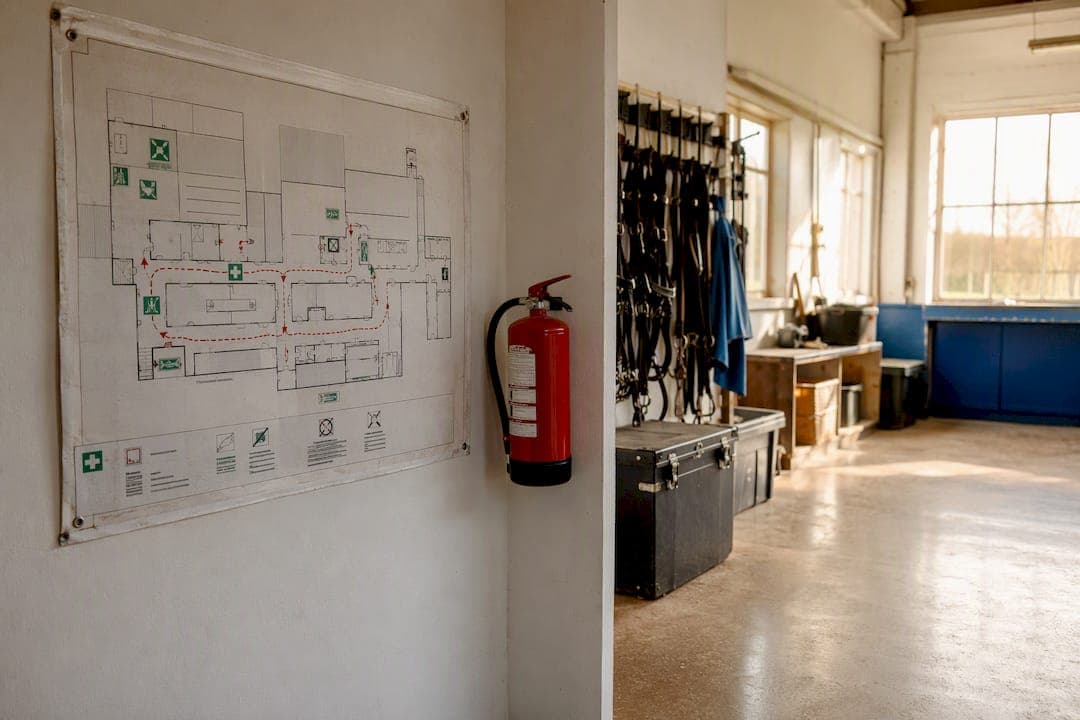
Your barn fire plan is a written, laminated action sheet plus a simple farm map posted at every entrance. That single step lets firefighters act fast and saves lives. If nothing else gets done today, do this.
The first rule overrides everything else: call emergency services immediately, then get people out. Never re-enter a burning barn to rescue an animal or equipment. Bodies survive; buildings and belongings do not.
- Post a laminated action sheet and farm map at every barn entrance, not filed away in an office.
- Call 000 (or your local emergency number) before attempting anything else.
- Back the plan with recognised guidance: Penn State Extension's fire prevention advice, CFPA-E's farm building guideline, and a digital platform like Equibets that keeps the same information accessible offline.
TL;DR:
- Installing laminated barn fire plans and maps at every entrance reduces response time for responders and ensures quick access to critical information during an emergency.
- Regularly inspecting and correctly placing fire extinguishers within 50 feet of any barn area increases the likelihood of small fires being contained early.
- Routine maintenance, such as annual electrical inspections, proper hay curing, and eliminating ignition sources, dramatically lowers fire risk.
- Conducting annual fire drills and inviting local fire brigades improve staff preparedness and response coordination during a real incident.
- Using digital storage solutions like Equibets enhances plan accessibility offline, keeping critical data updated and instantly available despite weather or power issues.
Table of Contents
- Barn fire safety checklist: what to fix today
- How do you build a barn fire action plan?
- Preventing barn fires through routine maintenance
- Detection and extinguishers: what actually stops a small fire becoming a disaster
- Training, drills, and pre-authorised decisions
- Keeping your barn fire plan current without the paperwork
- Key Takeaways
- Sources
Barn fire safety checklist: what to fix today
Most barn fires are preventable, and most of the fixes below cost a weekend, not a renovation budget. Work through this list in order of how fast it reduces risk.
- Check emergency vehicle access. Driveways should be wide enough with sufficient overhead clearance to allow emergency vehicles access, and gates should never be padlocked shut during operating hours.
- Post the laminated action plan and map at every entrance. Keep a digital copy too, because paper gets lost, wet, or left behind in a panic.
- Map extinguisher placement. NFPA guidance recommends ABC-type extinguishers within roughly 15 metres (50 feet) of any point in the barn. Check inspection tags monthly.
- Inspect hay and bedding storage. Keep bales cured before stacking, maintain clearance from ceilings, and separate hay from anywhere animals are housed if your layout allows it.
- Eliminate ignition sources. Ban smoking outright, protect wiring from rodents and moisture, keep heaters clear of combustibles, and never run extension cords as permanent wiring.
- Mark water sources on the map. Ponds, dry hydrants, and static water tanks need to be visible to a crew that has never set foot on your property before.
Pro Tip: Walk your own barn as if you were a firefighter arriving at 2am with no torch and no idea where anything is. If you can't find the extinguisher or the shutoff switch in under ten seconds, neither can they.
How do you build a barn fire action plan?
A proper action plan does two jobs: it tells your own people what to do in the first five minutes, and it gives arriving fire crews everything they need without asking a single question. CFPA-E's guideline on farm building fire safety recommends documenting building sketches, compartmentation, livestock locations, main isolating switches, hazardous materials, and water capacity, exactly the detail that lets rescue services prioritise their actions instead of guessing.
Your farm map should show:
- Building footprints and the number and location of horses in each
- Fuel tanks, chemical sheds, and anywhere flammable liquids are stored
- Water sources, including dry hydrants and static supply
- Main electrical isolating switches and known underground utility lines
Your action sheet needs a fixed set of fields every time:
| Field | Example entry |
|---|---|
| Property address and GPS coordinates | Full street address plus lat/long for rural properties |
| Driving directions from the nearest main road | "Turn at the red gate, second driveway on the left" |
| Gate and access codes | Combination or keypad code, updated when staff change |
| Animal counts and locations by building | "Barn A: 12 stalls, currently 9 horses" |
| Keyholder and emergency contact names | Names and mobile numbers, at least two people |
Laminate two or three copies and post them at every entrance and in the site office. Store a digital backup somewhere staff can reach it without power, and decide now who else gets access, boarders included. In the first three to five minutes after someone spots smoke, one person calls emergency services, one opens gates and directs the driveway, and everyone else moves horses to a pre-agreed safe paddock.
Preventing barn fires through routine maintenance
Most barn fires trace back to electrical faults, heating equipment, or stored hay that heated up unnoticed. Routine maintenance closes off all three.
- Have wiring, panels, and junction boxes inspected annually by a licensed electrician, and check that nothing is exposed to chewing animals or damp conditions.
- Use only equipment rated for agricultural environments, and keep space heaters a safe distance from bedding, hay, or timber stalls.
- Cure hay fully before storing it. Damp bales can heat internally and combust without any external spark. Separate the hay store from animal housing where your layout allows, and maintain roughly 60cm (24 inches) of clearance between stored hay and the ceiling.
- Clear cobwebs, dust, and oily rags regularly. They are far more flammable than most owners assume, especially near light fittings.
- Install bulb guards on all barn lighting and keep aisles and exits completely clear of clutter.
- Where your budget allows, consider compartmentation, fire-rated walls between hay storage and stabling, as a structural backstop.
Detection and extinguishers: what actually stops a small fire becoming a disaster
Detection matters more than most owners realise. NFPA 150 guidance highlights early detection over suppression as the critical factor in barn fire outcomes, because horses can't self-evacuate and every extra minute of undetected smoke shrinks the rescue window. Choose heat detectors or corrosion-resistant smoke detectors built for dusty, high-humidity barn environments, and prioritise systems with remote alerts that reach your phone when nobody's on site.
- Position ABC-type extinguishers within roughly 15 metres (50 feet) of any point in the barn, and log inspection dates on the tag itself.
- Train every staff member on extinguisher use at least annually, not just at induction.
- Sprinkler systems are worth considering for larger operations, but they only work if hay storage maintains proper ceiling clearance, otherwise water spray never reaches the seat of the fire.
- Keep on-site hose reels charged and accessible. Rapid deployment of on-site firefighting equipment is often what contains a small fire before crews even arrive.
- Mark pond and dry hydrant water capacity directly on the action plan so crews know what they're working with.
Training, drills, and pre-authorised decisions
A plan nobody has rehearsed is a plan that fails under stress. Run a full drill at least once a year, and again whenever staff or boarders turn over.
- Schedule an annual drill and document who attended and what went wrong.
- Invite your local fire brigade for a pre-plan walkthrough so they know your access routes and water sources before an emergency, not during one.
- Assign fixed roles, caller, gate person, animal handler, records controller, and print them on the action sheet.
- Prepare signed, pre-authorised veterinary and financial instructions so a vet or responder can act on an injured horse without waiting on a phone call that might not connect.
Pro Tip: Pre-authorised veterinary instructions remove the worst part of a crisis, having to make an irreversible decision about an animal's welfare while in shock. Sign them now, when you're calm.
Keeping your barn fire plan current without the paperwork
A laminated sheet is only as good as its last update. Equibets gives that sheet a digital twin: your farm map, emergency contacts, and animal counts stored centrally and accessible offline when the power or signal drops during an incident.
- Recreate your action-plan map using Equibets's farm mapping and GPS tools, then share it with authorised responders or boarders through the owner portal.
- Store signed veterinary and financial instructions, staff training logs, and even incident photos where you can retrieve them instantly, not dig through a filing cabinet.
- Offline access means the plan works exactly when you need it most, during a power cut or dead mobile signal.
Explore how it fits your yard at Equibets.
A note on rehearsal and simple systems
Prioritise people over property, rehearse every role until it's automatic, and keep the plan somewhere everyone can see it. Name one person as your dedicated gate and access contact before you need them.
— isaac
Turn your laminated plan into a digital backup today
A laminated sheet on the wall is only ever one weather event away from being unreadable. Equibets is the practical backup, not a replacement, for that sheet: your farm map, emergency contacts, and animal counts live in one place, accessible offline, and shareable instantly with an owner or a first responder standing at your gate.

Instead of hunting for a folder or hoping the laminate held up, your team pulls up the same information on a phone with no signal required. Owners get real-time updates through their own portal without a phone call from you. Training logs and drill records sit alongside the plan itself, so your annual review takes minutes, not an afternoon of digging through paperwork.
Start a free trial or check what's included at Equibets, and see how a stable management platform like Equibets handles the emergency side of running a yard.
Key Takeaways
An effective barn fire plan combines a posted laminated action sheet, a detailed farm map, positioned extinguishers, and annual drills with named roles for every staff member.
| Point | Details |
|---|---|
| Post the plan physically | Laminate the action sheet and farm map, and display copies at every barn entrance. |
| Map access and water | Show driveways, water sources, utility shutoffs, and chemical storage clearly for responders. |
| Place extinguishers correctly | Keep ABC extinguishers within roughly 15 metres (50 feet) of any point and log inspections. |
| Rehearse annually | Run a full drill every year and invite the local fire brigade for a walkthrough. |
| Digitise for backup access | Equibets stores your map, contacts, and training logs offline for when paper fails. |
Where to find the standards behind this plan
For deeper reading, see Penn State Extension's barn fire prevention guide and the CFPA-E farm building fire safety guideline.